Six Hidden Safety Risks in NACS (SAE J3400) Connectors
NACS (North American Charging Standard, formally SAE J3400) is replacing CCS1 as the new default DC fast-charge connector in North America. It integrates AC and DC into a single five-pin interface rated up to 1000 V DC — 500 A air-cooled, over 1 MW liquid-cooled — with a handle roughly a third lighter and noticeably smaller than CCS1. But 'smaller and lighter' means far tighter tolerances on contact precision, thermal management, and latch durability. NHTSA issued multiple recalls on NACS-to-CCS1 adapters in 2024 alone. Below are the six pitfalls most likely to bite during sourcing.
The biggest safety risk during the NACS transition is not native chargers but the adapter chain. NHTSA issued multiple recalls in 2024: early NACS-to-CCS1 adapters losing latch retention force after ~10,000 insertion cycles; adapters overheating under sustained ≥500 A use; third-party adapters with off-spec latch pins that would not lock securely, causing mid-charge disconnection and arcing. Tesla has explicitly warned against adding any extension cord or adapter to a liquid-cooled DC cable — it breaks the thermal-loop match, leading to overheating or even short-circuit fires.
NACS pins are smaller than CCS1's but run at higher contact pressure (120N/pin vs. 80N, cutting contact resistance by ~40%. The trade-off: heat is concentrated into a much smaller area. Air-cooled designs hit a physical ceiling above 500 A: the cable weighs 30 kg+, is stiff and unwieldy, and pin temperatures stay high, accelerating contact resistance growth, arcing, and premature failure. Above 600 A, liquid cooling is mandatory—but the cooling system itself introduces pumps, tubing, and coolant-leakage failure modes. It is not just 'adding a water line'.
The M5 retaining screws on high-power NACS contacts must be torqued to exactly 3.5 N·m. NFPA maintenance guidance notes that a deviation of just 0.2 N·m creates a micro-gap → micro-arc → carbon tracking → higher contact resistance vicious cycle. Mechanical wear from frequent public-station plugging also drives resistance up—at 350 kW, even a fraction of a milliohm rise is enough to trigger the charger's over-temperature shutdown.
NACS reuses the same large contacts for both AC (240 V) and DC (1000 V) — L1/DC+ and N/DC-. That halves the connector size but puts the high-voltage DC rail uncomfortably close to the low-voltage CP/PP signal pins. Once insulation degrades or an arc occurs, HV spikes can couple into the signal circuit, causing handshake faults and incorrect state detection. This demands higher insulation and shielding performance than CCS1.
NACS has only been an open SAE standard (J3400) for just over two years. Many new entrants are still finishing sample builds and have not completed the full UL 2251 certification cycle. The market is already full of cheap 'NACS-compatible" products that have only partial testing, brass (not silver-plated copper alloy) pins, and no onboard NTC temperature sensing. When sourcing NACS accessories, certification completeness matters more than the advertised amp rating.
| Dimension | Minimum Requirement | Ideal Standard |
|---|---|---|
| Standard Compliance | SAE J3400 dimensional fit | Full UL 2251 + IATF 16949 certification |
| Contact Material | Nickel-plated copper | Silver-plated copper alloy, high contact pressure |
| Temperature Control | Charger-side sensing only | In-cable NTC with active derating |
| Cooling Method | Natural air convection | Liquid-cooled loop recommended ≥350 A |
| Ingress Protection | IP44 when mated | IP67 cable body + dual root seal |
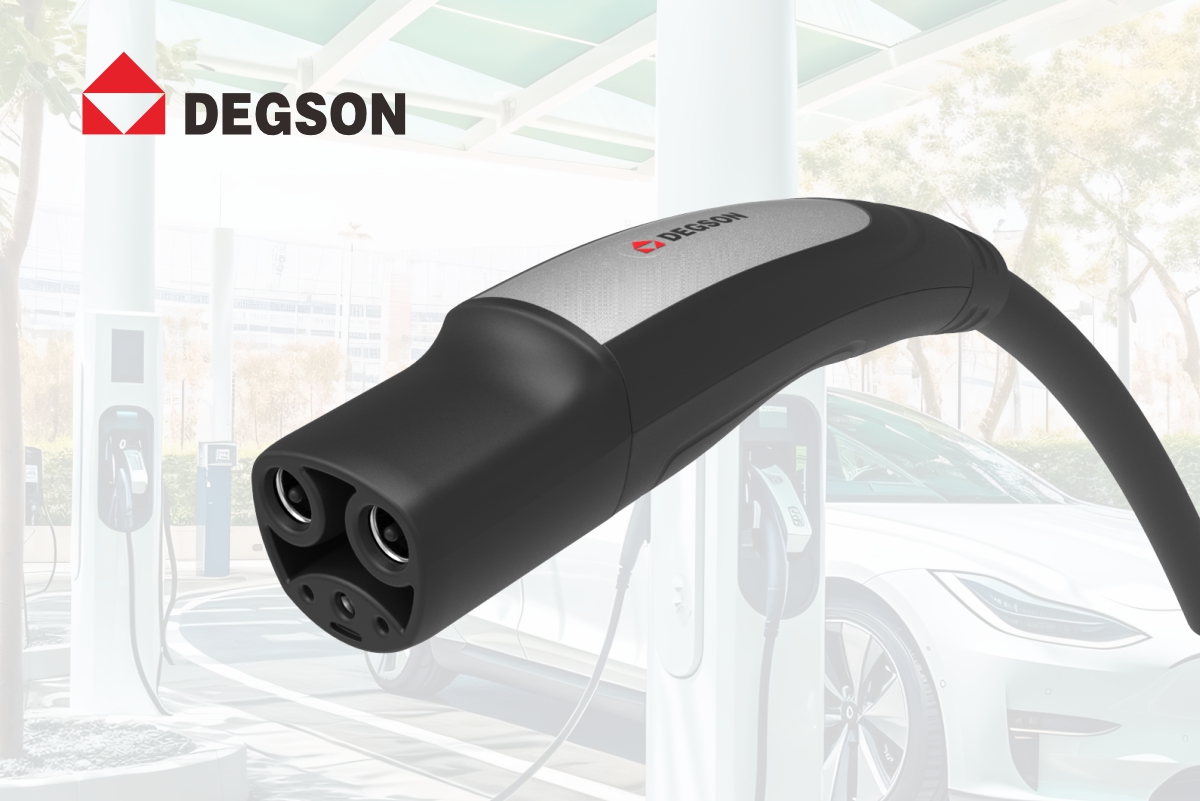
Stacked against the checklist above, DEGSON's NACS (SAE J3400) line hits nearly every pain point:
-
Full silver-plated contacts + IATF 16949 automotive-grade system — both power and signal pins are silver-plated, delivering substantially lower contact resistance than nickel-plated options, suppressing pin burning and carbon tracking at 350 kW (addresses hazards #2, #3).
-
In-cable NTC thermal monitoring + over-temperature protection — real-time temperature sensing with active power derating closes the blind spot where control systems only react after pins glow red (addresses hazards #2, #3).
-
High-strength metal latch — internal locking uses a metal hook rather than plastic, with a crisp 'click' feel; cycle life far exceeds plastic latches in high-frequency public fast-charge use (addresses hazard #4).
-
IP67 cable body + multi-layer root sealing — the shared AC/DC interface demands stricter sealing; IP67 plus dual-cable-root seals protects HV contacts and signal pins from rain and de-icing salt spray (addresses hazard #4).
-
Fully certified platform — Degson NACS cables (e.g. MTDC-S-250A series) are fully compliant with SAE J3400 and UL 2251, engineered and manufactured under IATF 16949 — not merely dimensional 'compatible' clones (addresses hazard #5).
Founded in 1990, with UL-CTDP, VDE-TDAP, and CNAS accredited laboratories, 400+ patents, and six global production bases. The EV charging connector portfolio covers Type 1 / Type 2 / GB/T / CCS1 / CCS2 / NACS, with on-board high-voltage connectors compliant with USCAR-2 / LV215.


