High-Voltage Interlock (HVIL): The “Hidden Defense Line”in the Vehicle High-Voltage Safety Architecture
High-Voltage Interlock (HVIL) serves as a hidden defense line in the high-voltage safety system of new energy vehicles. Relying on a series low-voltage signal loop and precise contact timing, it continuously monitors the connection status of high-voltage components to fundamentally avoid potential hazards caused by live mating/unmating. This paper analyzes reliability challenges faced by HVIL under severe vehicle operating conditions including vibration, high-low temperature cycling and salt spray corrosion. It interprets the underlying working principle, core design difficulties and full-life cycle reliability requirements of HVIL, elaborates its key role in preventing live unmating and eliminating safety risks. Combined with harsh on-board application scenarios, it delivers the concept of systematic high-voltage safety design, providing professional references for OEMs in high-voltage system development and component selection.
1. Industry Perception: Redefining the Safety Value of HVIL
As the voltage level of new energy vehicle high-voltage systems keeps rising, high-voltage safety design is no longer a single-point protection measure but a multi-level systematic engineering. Fuses, insulation monitoring units and high-voltage relays perform their respective functions. HVIL, however, is the most easily underestimated underlying monitoring link in this safety system, covering all high-voltage components. Many engineers initially regard HVIL merely as "a signal wire for on-off control". But under complex vehicle operating conditions, the design logic of HVIL goes far beyond simple loop on and off. HVIL adopts a low-voltage signal loop that connects high-voltage components including battery packs, motor controllers, on-board chargers, high-voltage connectors and charging inlets in series to form a closed loop. Only when the loop remains fully conductive will the BMS allow the vehicle to close the main high-voltage circuit and complete power-up. If the loop is broken, the vehicle must cut off high-voltage output and release residual voltage within the specified response time.
2. Core Logic: Safety Design Significance of Contact Timing (Operating Condition Challenges)
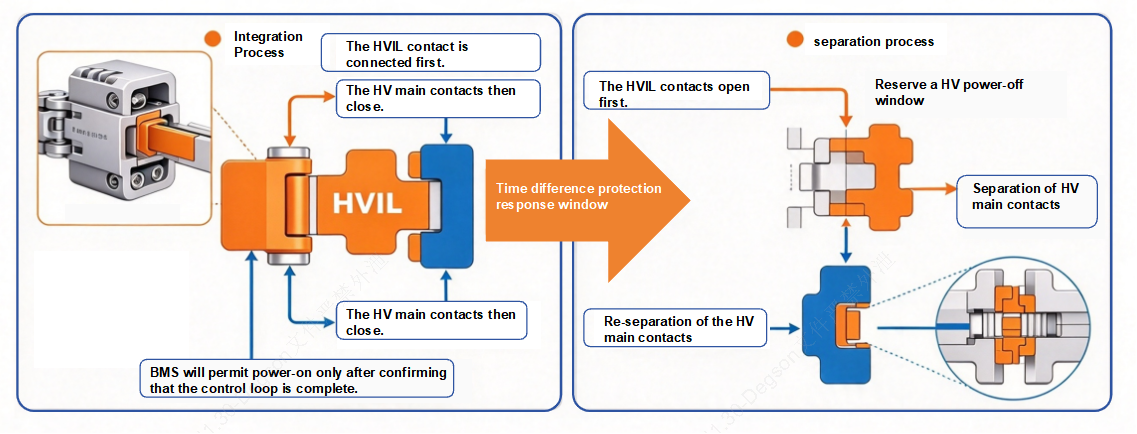
The core design of HVIL lies in contact timing. All high-voltage connectors integrated with HVIL follow a mandatory action sequence: during mating, HVIL signal contacts close first, followed by the closure of main high-voltage contacts. During unlocking and separation, HVIL contacts disconnect prior to the separation of main high-voltage contacts. This time difference reserves a window for the vehicle controller to execute high-voltage power-down, fundamentally preventing live unmating of the high-voltage circuit. The real challenge lies in full-life cycle reliability of the whole vehicle. Continuous vibration impact, repeated high-low temperature cycling, splashing muddy water and salt spray erosion on the chassis occur during long-term vehicle operation. Accidental open-circuit of HVIL signal contacts may trigger unscheduled high-voltage power-down and lead to loss of driving power. Conversely, if the loop suffers adhesion failure, the system will still judge the loop as normal even when the connector is half-locked or the housing is opened, leaving fatal high-voltage electric shock hazards.
This is why HVIL design cannot rely solely on schematic simulation. Component structural design, contact materials, plating schemes and locking mechanisms must pass a series of vehicle-level verifications including vibration, temperature cycling, salt spray and mechanical durability. High-voltage safety allows no margin for error. The design goal of HVIL is to eliminate all possibilities of "exposed live high-voltage parts".
3. Closed-Loop Significance of Multi-Layer High-Voltage Safety Protection
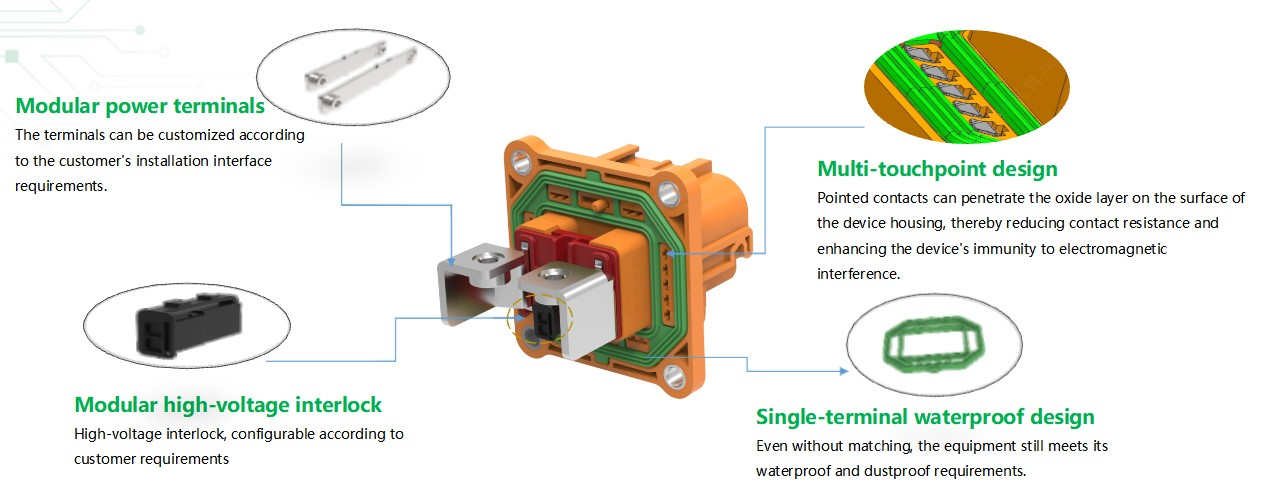
The closed-loop significance of the high-voltage safety protection system is to build a global, progressive risk interception system relying on multiple independent protection mechanisms, so as to block high-voltage failure risks before accidents occur. The insulation monitoring system continuously collects the insulation resistance of the high-voltage circuit to ground, monitors leakage hazards and sends early warnings at the early stage of insulation degradation. As the last passive protection against short-circuit faults, fuses blow rapidly when large-current short-circuit occurs in the circuit to cut off the energy path. The High-Voltage Interlock (HVIL) system undertakes the core task of continuously monitoring the physical assembly status of all high-voltage connection points such as high-voltage connectors and feed-through terminals in the vehicle. The feed-through high-voltage terminal shown in the figure adopts a modular HVIL structure. The independent modular HVIL contacts can be selected according to vehicle project requirements. Under normal vehicle driving conditions, the HVIL loop operates silently without interfering with vehicle power output. Once abnormal conditions such as partial mating, loosening or accidental separation of high-voltage connections occur, the HVIL loop disconnects instantly. The vehicle controller then executes high-voltage power-down and power cut-off protection actions to avoid electric shock and arc risks caused by live mating/unmating and exposed high-voltage parts. Meanwhile, it is equipped with multi-point power contacts and single-ended waterproof structure, maintaining cavity dustproof and waterproof performance even in unmated status, balancing assembly flexibility and environmental reliability.
For the development of vehicle high-voltage systems, HVIL is not an optional add-on but an indispensable part of the high-voltage safety architecture. Rigorous treatment is required in every link from component structural design and loop topology planning to vehicle bench and real-vehicle verification. Only by embedding safety logic into every detail of high-voltage connections can a reliable and stable on-board high-voltage system be truly developed to safeguard the safety baseline of vehicles and users. DEGSON on-board high-voltage team is committed to the field of high-voltage connection safety. The full range of high-voltage connectors and charging inlet products are embedded with rigorously verified HVIL structures, with precise control over contact timing and environmental resistance reliability. If your project is building a vehicle high-voltage safety system, welcome to choose DEGSON to jointly build a solid defense line for vehicle high-voltage safety.
References
1.State Administration for Market Regulation, Standardization Administration of China. GB 18384—2020 Electric vehicles safety requirements[S]. Beijing: China Standards Press, 2020.
1.State Administration for Market Regulation, Standardization Administration of China. GB 18384—2025 Electric vehicles safety requirements[S]. Beijing: China Standards Press, 2025.
1.State Administration for Market Regulation, Standardization Administration of China. GB/T 37133—2025 High-voltage connection systems for electric vehicles[S]. Beijing: China Standards Press, 2025.
1.State Administration for Market Regulation, Standardization Administration of China. GB/T 20234.4—2023 Connection devices for conductive charging of electric vehicles — Part 4: High-power DC charging interface[S]. Beijing: China Standards Press, 2023.
1.National Energy Administration. Safety Design Specification for Electric Passenger Vehicles - HVIL Function Design[S/OL].
FAQ
Q1: What is the core function of HVIL? Is it used to disconnect the main high-voltage circuit?
HVIL does not carry or disconnect high current directly. It is an independent low-voltage signal monitoring loop that continuously monitors the assembly status of high-voltage connection points. When the connector is half-mated, loosened or the housing is opened, the HVIL loop opens, the signal is reported to the vehicle controller, and the BMS executes high-voltage power-down to prevent live mating/unmating, arc and electric shock risks. It acts as a "hidden defense line" for status monitoring rather than a power switching device.
Q2: What are the engineering advantages of modular HVIL design?
Modular HVIL contacts are independently designed and available as optional configurations. For feed-through terminals, this solution can adapt to the development requirements of different vehicle platforms and facilitate change management. Meanwhile, power contacts, sealing structures and interlock modules are mutually independent to reduce cascading risks caused by single-point failure, balancing protection performance and customized project requirements.
Q3: Will vibration-induced transient disconnection of the HVIL loop directly trigger vehicle high-voltage power-down? How to avoid this problem?
Transient disconnection signals of HVIL will be identified by the vehicle strategy. Without anti-chatter delay mechanism, it may trigger protective power-down and result in loss of driving power. This is a core difficulty in HVIL design for vehicle applications. At the product level, contact structure and materials need to be optimized to improve vibration resistance. At the vehicle level, reasonable signal filtering and fault judgment timing shall be configured to distinguish genuine disconnection from vibration-induced transient interruption.
Q4: Must all high-voltage connectors be equipped with HVIL? What are the relevant requirements in national standards?
According to GB 18384, GB/T 37133 and other standards for electric vehicles, HVIL protection shall be configured for high-voltage connection positions with live risks that can be accessed or disassembled by personnel. Some enclosed, non-maintainable high-voltage points may be exempted after evaluation based on the vehicle safety scheme. The configuration of HVIL needs to be assessed in combination with the overall vehicle high-voltage safety architecture and cannot be generalized.


