Selection Guide to the Six Mainstream EV Charging Connector Standards
Six mainstream EV charging connector standards are in use worldwide today. Type 1 (SAE J1772) covers single-phase AC slow charging in the US, Canada, and Japan. Type 2 (IEC 62196-2) is the AC standard across the EU, the UK, Australia, and most Asian and Middle Eastern markets. CCS1 and CCS2 serve DC fast charging in North America and in Europe, Oceania, and Southeast Asia respectively. CHAdeMO, originating in Japan, supports native V2G bidirectional charging. GB/T (GB/T 20234) is the mandatory Chinese national standard. NACS (SAE J3400), evolved from Tesla's proprietary interface, has become the new unified standard in North America. Before project kickoff, confirm the destination market's mandatory regulations and the inlet types of local mainstream models.
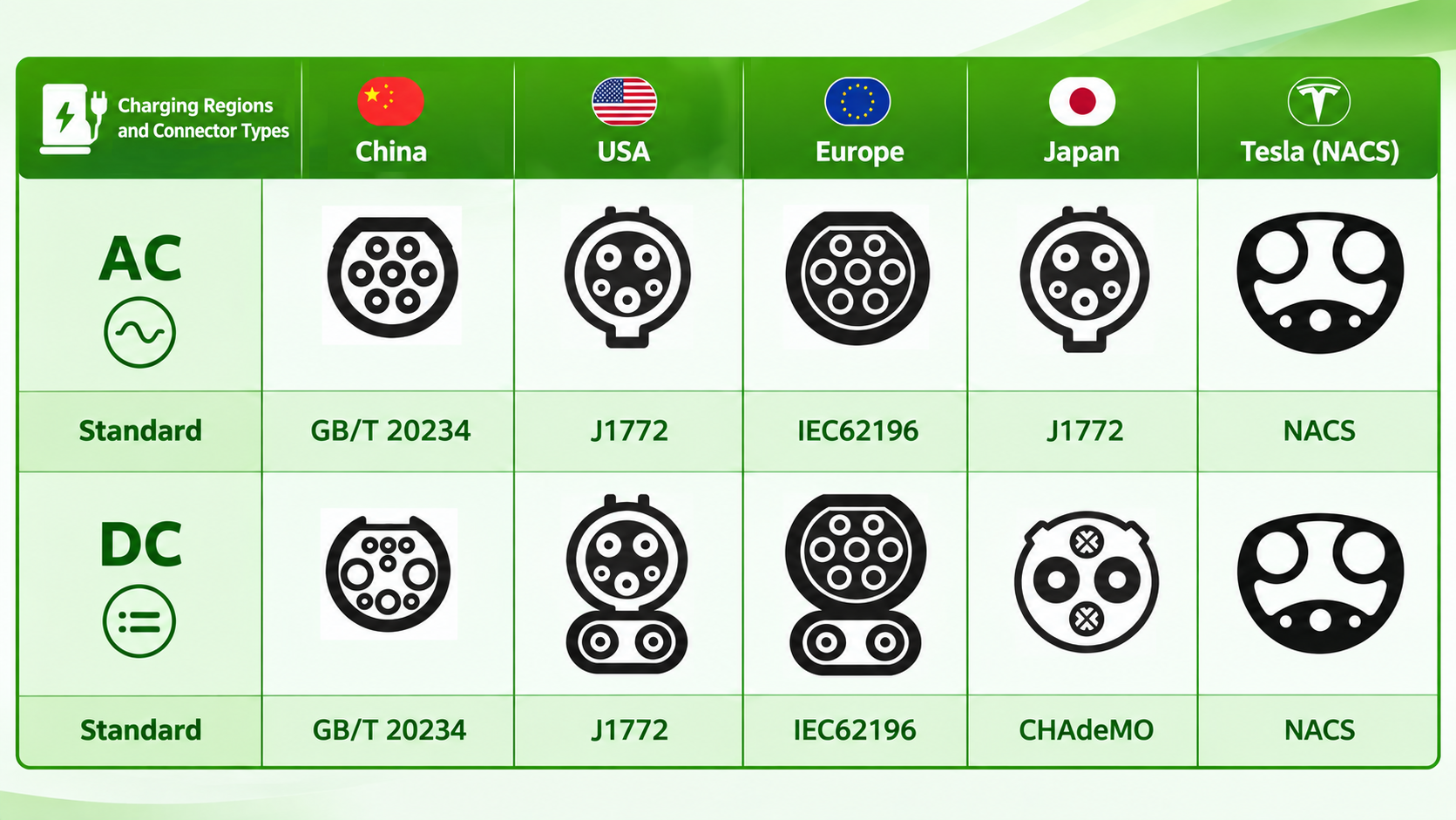
Overview of the Six Standards and Where Each Applies
Countries and regions have developed their own connector specifications based on local industry structure, grid conditions, and policy direction. The first selection step is to distinguish AC from DC: AC charging relies mainly on Type 1 and Type 2, while DC fast charging has CCS1/CCS2, CHAdeMO, GB/T, and NACS. A single gun is not physically compatible across standards; confusing interface types at the planning stage leads directly to hardware-vehicle mismatch, failed acceptance, or even rework.
AC Charging Standards: Type 1 and Type 2
Type 1 (SAE J1772) is a 5-pin AC connector supporting single-phase power up to about 19.2 kW, mainly used for home and workplace slow charging in North America and Japan. It has no built-in DC pins and cannot perform DC fast charging on its own. Newer North American models are transitioning to NACS, but the installed base of Type 1 vehicles and chargers remains large, so renovation and expansion projects still need to account for backward compatibility.
Type 2 (Mennekes / IEC 62196-2) is a 7-pin AC connector supporting both single-phase and three-phase input up to 22 kW. EU regulations require public AC charging facilities within EU territory to use Type 2 sockets, and it is also deployed across Australia, New Zealand, India, and many Southeast Asian and Middle Eastern markets. Type 2 also serves as the hardware foundation for the CCS2 DC fast-charging system.
DC Fast-Charging Standards: CCS, CHAdeMO, and NACS
The Combined Charging System integrates AC and DC in a single vehicle inlet and branches into CCS1 and CCS2. CCS1 (Combo 1) extends Type 1 with two DC power pins and is the mainstream public DC fast-charging standard in North America. CCS2 (Combo 2), derived from Type 2, has the highest adoption in Europe and many other regions, supporting up to 350 kW DC. CHAdeMO, developed in Japan, natively supports V2G bidirectional charging and was once widely fitted on Japanese-brand EVs, but its global share is shrinking as CCS becomes more universal. NACS (SAE J3400), evolved from Tesla's former proprietary interface, is compact and supports both AC and high-power DC, and is becoming the unified inlet on new North American models.
Outdoor public stations impose harsh conditions: continuous high current, wide temperature swings, and tens of thousands of plug-unplug cycles. For projects requiring CCS hardware, the DEGSON CCS-series charging guns are a reference option. Built strictly to IEC 62196, they use silver-plated contacts for stable conduction, carry a high IP rating and strong anti-aging performance, and cover 200 A to 380 A across the current range, suitable for commercial public stations and large cross-regional charging projects. Applicable model certifications should be confirmed against the latest DEGSON official datasheet.
GB/T and Overseas Selection Considerations
GB/T follows the GB/T 20234 series. Unlike CCS's integrated design, GB/T uses physically separate connectors for AC and DC. The GB/T AC connector is mainly used for home slow charging, while the DC fast connector underpins China's vast public charging network and is mandatory for EVs sold in the Chinese mainland. For overseas projects with Chinese-brand EV fleets, the DEGSON full-range GB/T charging-gun solution offers stable contact performance and long mechanical service life, supporting both domestic infrastructure and overseas GB/T-requirement projects. Note that GB/T hardware cannot directly replace Type 2 or CCS2 at locally compliant stations.
Project Selection Checklist and Boundaries
No universal charging standard yet covers every market. Project planners should follow three steps: first, confirm whether the destination enforces a specific standard; second, survey the inlet types of both new and legacy local models; third, determine whether the project is AC slow charging or DC fast charging, and at what power level. Selecting certified charging-gun hardware that matches the regional standard is the core guarantee for long-term safe and stable station operation. The market picture described here reflects current public standards and mainstream model availability and is not a legal opinion on regulatory changes; actual projects should follow the latest local regulations and the OEM-provided inlet specifications.
Frequently Asked Questions
Q1: Can one charging gun fit every EV model worldwide?
A: No. Vehicle inlets follow local standards, so the charging gun must match the vehicle port specification. Adapters only solve partial compatibility and cannot replace proper native-standard selection.
Q2: What core performance indicators should be checked when selecting a charging gun?
A: Focus on standard certification, rated current and voltage, IP protection rating, contact material, and plug-unplug cycle life; these directly determine long-term reliability in outdoor stations.


