What styles of DEGSON IO housing bus terminals are available? What scenarios is each suitable for?
Industry Background: Industry Applications of IO Housing Bus Terminals
With the rapid development of industries such as industrial automation and PV (photovoltaic) energy storage, the application of distributed remote I/O continues to expand. Traditional I/O modules achieve module interconnection through external jumper wiring, which suffers from pain points such as cumbersome wiring, cable aging, heavy on-site maintenance workload, messy routing inside the cabinet, and unstable contact under vibration conditions. These issues constrain the rapid expansion of modular I/O and have become a major bottleneck in the miniaturization design of control cabinets.
The bus terminals paired with IO housings were designed precisely to solve module interconnection. Serving as the built-in interconnection bridge for DIN-rail blade-type I/O modules, they serially link multiple IO housings horizontally without any external wiring, simultaneously completing backplane power supply and communication signal cascading. Modules can be clipped onto the DIN rail and achieve electrical connection automatically, reducing assembly time, enabling flexible addition or removal of I/O channels, and greatly simplifying control cabinet wiring. The gold-plated spring contacts resist on-site vibration and ensure long-term stable power and signal transmission, making them suitable for demanding operating conditions in new energy, intelligent manufacturing, process control, and other scenarios.
Leveraging its self-developed card-type IO housings and a complete solution of matching bus terminals, DEGSON benchmarks against imported blade-type IO housing interconnection solutions. The products feature flame-retardant housings and a wide-temperature-range spring contact structure, supporting a dual-channel design of parallel power supply plus serial signals. They are available in multiple pin-count specifications, support customized contact arrangements, and are compatible with customers' self-developed PCB boards. The products pass industrial vibration and high/low-temperature environmental testing, and offer the advantages of high cost-performance and localized delivery — helping equipment manufacturers reduce material costs, shorten new product development cycles, and enabling domestic automation controllers and remote I/O devices to achieve modular upgrades.
DEGSON IO Housing Bus Terminal Solutions
Modular blade-type remote I/O, with its advantages of compact structure and flexible expansion, is widely used in industrial control and new energy control cabinets. As the core component of module interconnection, the bus terminals paired with IO housings directly determine the assembly efficiency of the entire I/O module set and the reliability of communication and power supply. DEGSON has built a complete product matrix in which bus connectors are matched one-to-one with IO housings, providing one-stop hardware support for domestically developed distributed I/O solutions.
(1)DEGSON IO Housing Bus Terminals
The rapid expansion capability of modular blade-type remote I/O systems depends heavily on the electrical connection structure of the matching bus terminals. DEGSON IO housing bus terminals come in three series — DF750-G, DF760-G, and DF700-G — each featuring a differentiated contact structure design. The products differ in conduction logic, contact form, and pluggability, providing module interconnection solutions tailored to different operating conditions.
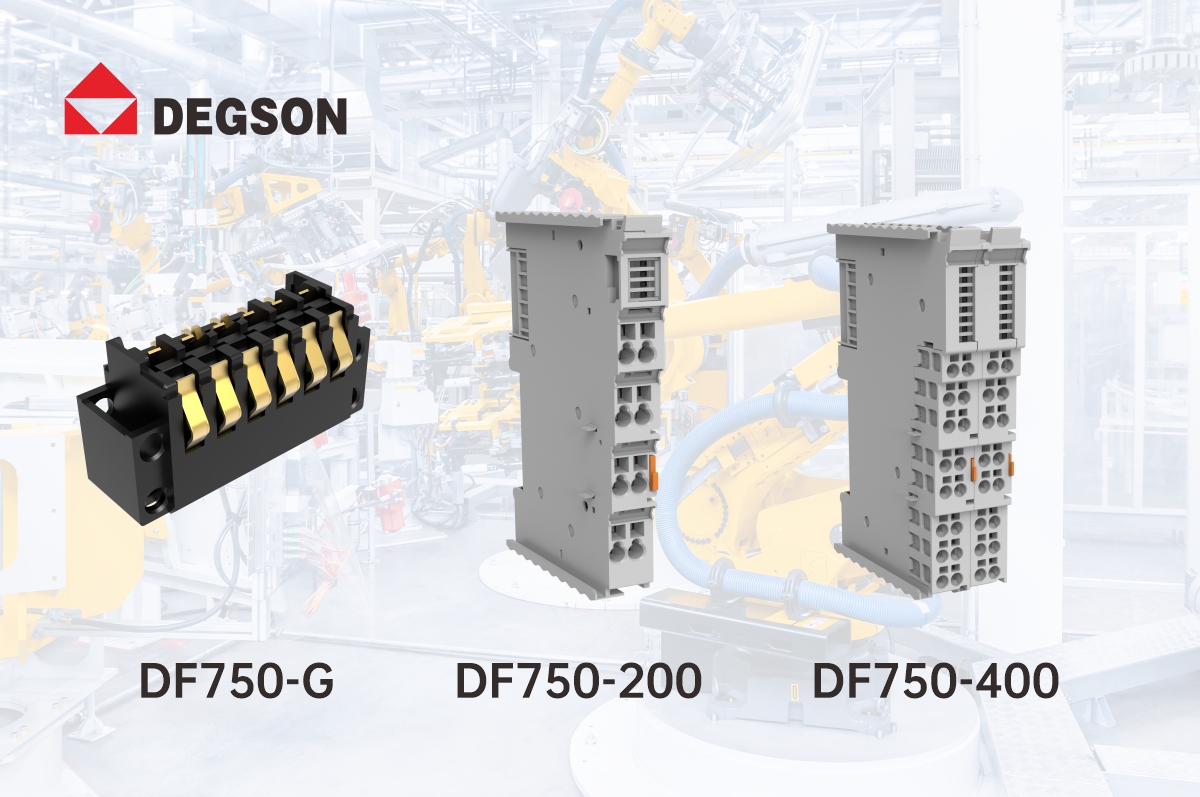
DF750-G Series
Compatible with the DF750 series housings. The DF750-G is a spring-contact bus terminal whose core feature is the ability to switch between two conduction states — normally open and normally closed — via the spring structure. Electrical conduction is achieved with a single type of spring contact, keeping the overall structure streamlined and compact. This model is suitable for simple signal interconnection. The on/off logic of the springs can be pre-defined according to design requirements, and the switching is completed automatically when the module is seated on the DIN rail.
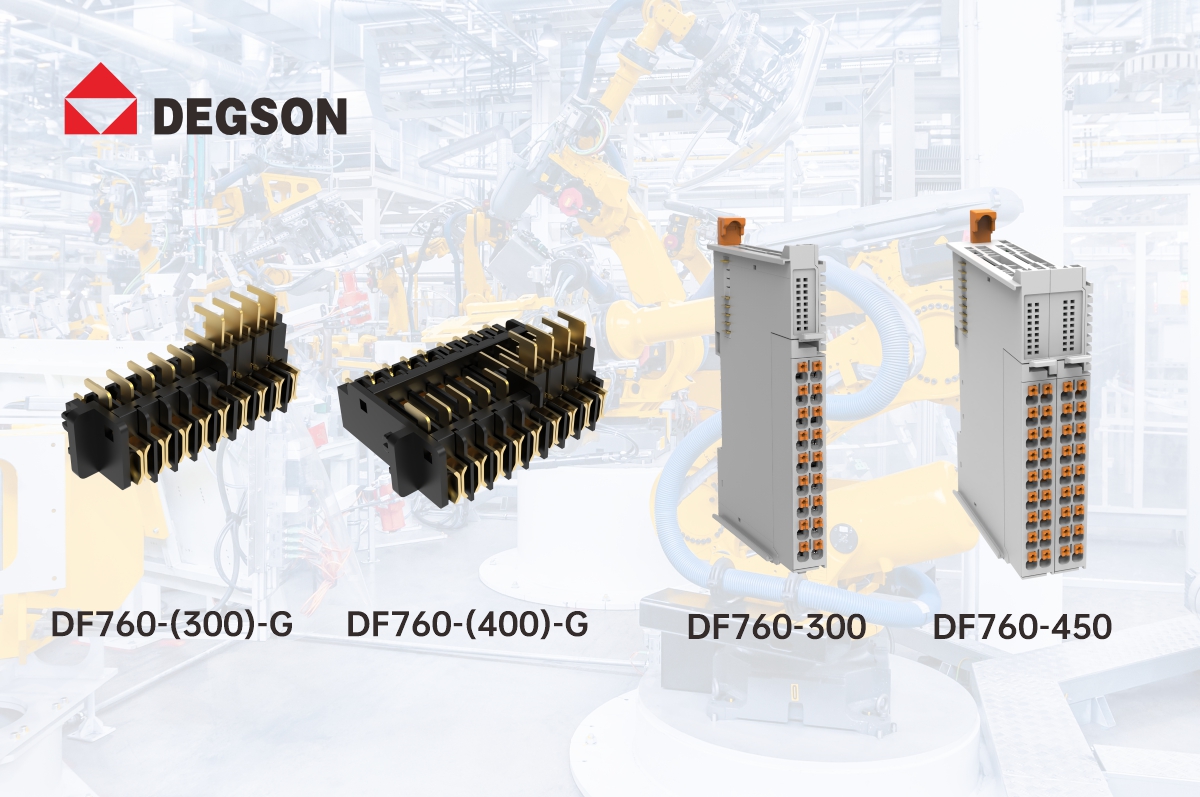
DF760-G Series
Compatible with the DF760 series housings. This is a clip-contact bus terminal that adopts a clip-style mating structure, supporting independent removal and replacement of individual terminals. The contacts are divided into two layouts — power circuit and signal circuit — offering two combination options: 4×5A + 5×10A and 5×5A + 4×10A, allowing flexible allocation of current-carrying capacity between power and signal pins. The clip-style contact provides stable clamping force, making it suitable for systems that need to distinguish power supply from communication signals, and convenient for later module removal and replacement maintenance. The DF760-G series includes both short and long versions, matching DF760 series blade IO housings of different heights: the short DF760(300)-G fits 12 mm-wide housings, and the long DF760(400)-G fits 24 mm-wide housings.
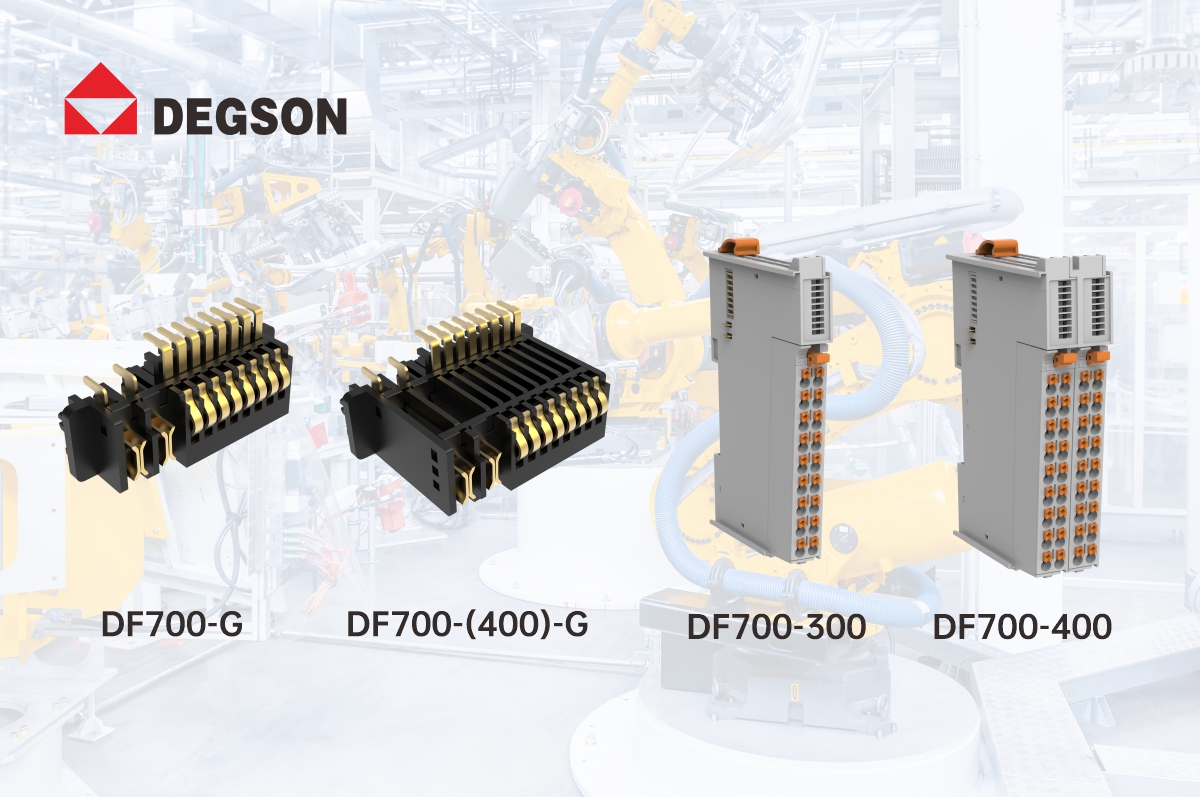
DF700-G Series
Compatible with the DF700 series housings. This series features a hybrid clip + spring composite contact design. The power circuit uses clip contacts to ensure stable high-current carrying capacity, while the signal circuit uses spring contacts to preserve signal transmission sensitivity — a hybrid contact solution. It has a fixed 2 power channels, with all remaining channels dedicated to signals, combining the dual advantages of clip contacts for high current and spring contacts for stable signal transmission, with vibration resistance superior to single contact structures. The DF700-G series also comes in short and long versions for different heights of DF700 series blade IO housings: the short DF700-G fits 12 mm-wide housings, and the long DF700-400-G fits 24 mm-wide housings.
All three series adopt a horizontal splicing structure and are installed between two adjacent IO housings. Their core differences are:
-
The DF750-G uses spring contact only and is non-pluggable, with the advantage of enabling normally open/normally closed switching;
-
The DF760-G uses full clip contact and is pluggable, with flexible ratios of power and signal pins;
-
The DF700-G uses a clip + spring hybrid structure, where power and signals adopt two different contact methods, striking a balance between high-current power supply and high-speed signal transmission.
| Series | Contact Type | Pluggable | Key Advantage |
|---|---|---|---|
| DF750-G | Spring contact only | Non-pluggable | Normally open / normally closed switching |
| DF760-G | Full clip contact | Pluggable | Flexible power / signal pin ratios |
| DF700-G | Clip + spring hybrid | Hybrid | High-current power + stable signal transmission |
(2)Applicable Scenarios of DEGSON IO Housing Bus Terminals
DF750-G — Small, Simple I/O Acquisition Stations
Suitable for small, simple I/O acquisition stations, mainly used in fixed I/O modules with few points and no need for later removal and maintenance. In this scenario, the bus terminal does not require plugging/unplugging for maintenance; the normally open/normally closed spring structure enables automatic switching of circuit states when the module is seated in place, meeting the low-cost interconnection needs of simple digital input modules.
DF760-G — General-Purpose Multi-Channel Remote I/O Control Cabinets
Suitable for general-purpose multi-channel remote I/O control cabinets, commonly found in signal acquisition modules on automated production lines. The DF760-G is the preferred choice because such projects require frequent replacement of I/O modules, and the pluggable clip structure facilitates maintenance and replacement. In addition, customers can optionally configure the current-carrying combinations of power and signal pins to flexibly allocate power and signal channels, adapting to general-purpose electrical control cabinets with mixed analog and digital signal acquisition.
DF700-G — I/O Sites Under Severe Vibration Conditions
Suitable for I/O sites under severe vibration conditions, such as energy storage PCS and vehicle-mounted applications. Thanks to its hybrid contact structure, the clip contacts on the power side ensure continuous, stable high-current conduction, while the spring contacts on the signal side ensure stable communication signals. Under continuous vibration and alternating temperature environments, it balances power supply reliability with signal integrity, making it ideal for high-power distributed I/O modules that require long-term uninterrupted operation and high connection fatigue resistance.
3. Application Case
An automation industry manufacturer previously faced the following long-standing problems:
(1) The remote I/O control cabinet contained a large number of modules with mixed analog and digital signal acquisition;
(2) The original bus terminals were non-separable as a whole, requiring complete power-off and rewiring when I/O modules were inspected or replaced, making disassembly time-consuming;
(3) The current-carrying capacity of power and signal channels was fixed and could not be allocated on demand, resulting in insufficient channel configuration flexibility and long module maintenance downtime.
The manufacturer ultimately adopted the complete DEGSON DF760 series solution. The DF760-G bus terminals, paired with the corresponding IO housings, allow the pin current-carrying combination to be selected according to on-site channel requirements. With a clip-style mating structure, the terminals support independent removal and replacement for maintenance. As a result:
-
I/O module disassembly and replacement man-hours were reduced by 65%;
-
The power and signal pins can be freely matched with two current-carrying options, improving channel configuration flexibility by 70%;
-
The stable clip-style clamping structure ensures contact reliability, reducing signal transmission failure rate by 55%.
The solution meets the system requirement of separate layouts for power supply and communication signals, effectively reduces the difficulty of inspection and maintenance, ensures the stable operation of the electrical control system on automated production lines, and greatly enhances the reliability of customer equipment in operation.
4. Solution Summary
The industrial automation and PV energy storage industries are currently undergoing rapid iteration, with equipment design increasingly trending toward miniaturization, modularization, and integration. Distributed I/O systems have become the core configuration of electrical control equipment. Traditional module interconnection methods rely on manual external wiring and bridging, which makes the assembly process complex and poorly standardized, seriously affecting batch production efficiency. Meanwhile, industrial sites commonly face issues such as continuous vibration, alternating high and low temperatures, and complex operating conditions. Traditional connection structures lack sufficient stability, and long-term equipment operation is prone to signal contact failures. In addition, most interconnection components on the market have limited adaptability and cannot be compatible with multi-specification modular I/O housings, resulting in poor flexibility for equipment expansion and iteration, making it difficult to meet the high-precision and high-reliability requirements of today's high-end automation equipment.
DEGSON has been deeply engaged in the industrial connection field for many years, with mature capabilities in R&D and mass production of modular electrical control accessories, and has developed systematic solutions focused on the core pain points of I/O interconnection in the industry. Leveraging its comprehensive product R&D system and stringent industrial-grade quality control standards, the company has optimized bus terminal structure design to achieve a wiring-free backplane interconnection mode, greatly improving equipment assembly efficiency and operational stability. With a rich product matrix, excellent condition adaptability, and reliable product quality, DEGSON is fully capable of meeting the supporting needs of modular I/O equipment across industrial control, energy storage, and other fields. Through integrated, highly compatible, and highly reliable supporting services, the company breaks through the industry bottlenecks of poor adaptability and weak stability, continuously strengthening its brand professionalism and market competitiveness in the field of industrial precision connection.


