22 mm Pushbutton Indicators in 2026: Platform Choice, IP Ratings and the Standards to Verify
Three different products fit a 22 mm panel cutout: an integral plastic operator, an integral metal operator on the same clip-on contact block, and a modular stack whose head, base, contact module and lamp module are separate order numbers. All three are quoted as 22 mm, 10 A, IP65, and all three differ in installation time, spare-part stock and the cost of adding a variant to an existing certification. This guide covers what each construction changes, which standard the contact block is designed to, how to read the ratings that set installed cost, and what to verify before a Chinese-manufactured series enters an approved list.
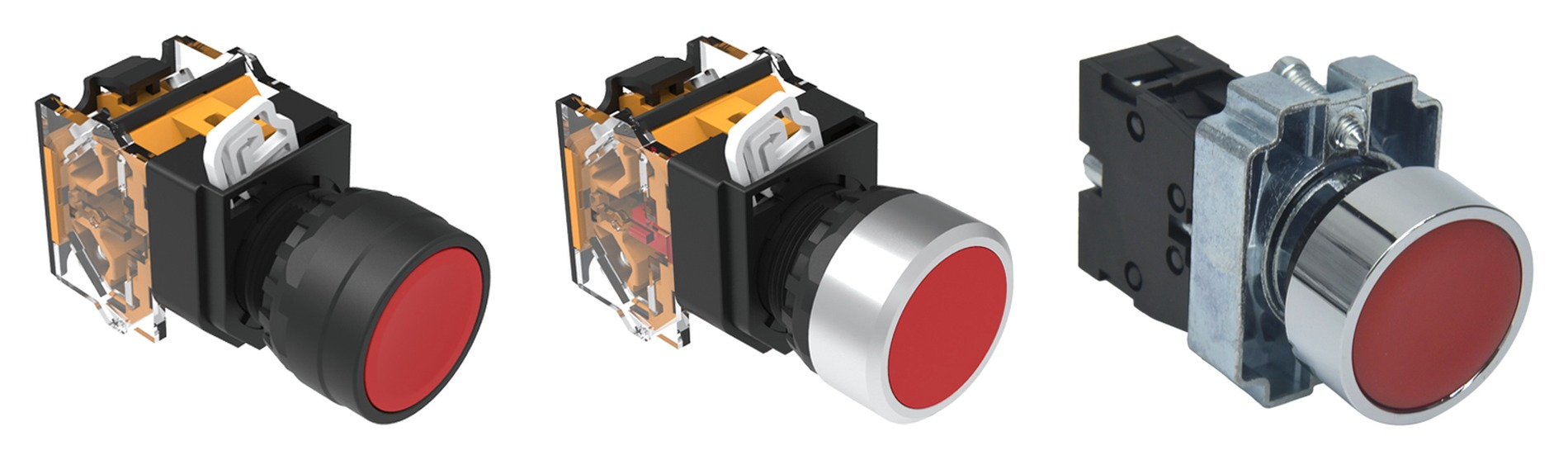
DT22A (integral plastic), DT22M (integral metal) and DT22MU (modular) share one 22 mm cutout.
The Cutout Is Standard; What Sits Behind It Is Not
The 22 mm family is built around a nominal 22 mm hole, 22.3 mm on most panel drawings, while 16 mm for compact instruments and 30 mm on older equipment still compete for the same panel space. The hole is the expensive part of a retrofit, so the platform decision usually outlives the product decision: every 22 mm operator passes through the hole, but not every mounting depth, terminal arrangement or legend plate fits behind it.
Two dimensions decide whether an order works on site: the depth behind the panel, which is the contact block plus the wiring bend radius, and the anti-rotation feature. An operator that turns in its hole, or that needs 60 mm of clear space behind a 40 mm cabinet, passes the datasheet and fails the installation.
Three Constructions and What Each One Costs on the Panel
Every 22 mm platform is one of three constructions, and the construction, more than the brand, decides how maintenance gets done.
- Integral plastic: actuator and bezel in one molding, contact block clipped on behind the panel. Fastener-free fixing, the lowest part count, whole-unit replacement.
- Integral metal: zinc-alloy bezel on the same clip-on contact block. More impact and heat tolerance, same whole-unit replacement.
- Modular: head screwed to a middle seat, then mounting base, contact module and lamp module. More part numbers, but the head, contact block and lamp are replaced independently.
Fastener-free describes the fixing, not the platform: a modular operator can be tool-free at the front and still be assembled from five items.
The consequence is spares. An integral failure consumes a complete operator; a modular failure consumes a contact module or a lamp module. On a 40-operator panel the modular route costs less to run, but only where the modules are stocked as separate SKUs and appear on the quotation as separate lines.
Compare the Numbers That Set Installed Cost
The table collects series-level data for the DT22 platform, which spans all three constructions (manufacturer product pages, November 2026). Confirm the order number before design freeze: ratings differ between heads, contact modules and lamp modules.
A fourth configuration, DTP22MU, is quoted for cabinet builds as separate head, base, contact and lamp modules. Its ratings are module-level, so ask for the module datasheet and the assembled-unit IP report rather than a series headline.
Two rows matter more than the rest. Electrical life is quoted at a stated load: 200,000 operations at rated current and at a fraction of it are different products, and the datasheet usually prints only the first. Mechanical life is a no-load count: two million operations describes the spring and the bearing, not the contacts.
Match the Operator Head to the Function
- Emergency stop: 40 mm mushroom, latching, rotation release, direct-opening contact. ISO 13850 expects a yellow background at the operator; check the stop category against IEC 60204-1.
- Selector: two or three positions, momentary or maintained. The position count and the operating type are separate codes and separate order numbers, which is where most wrong orders start.
- Key switch: authorization rather than stopping. Specify the key-removal position, because it decides whether anyone can restart the machine.
- Illuminated: an AC/DC 24 V lamp module (code D-AC/DC24V) in five LED colors. In the modular construction the lamp module is a separate item, which is the practical difference when a 24 V rail changes.
-
Mushroom without latching: large-area actuation for a normal stop, without the emergency stop function.
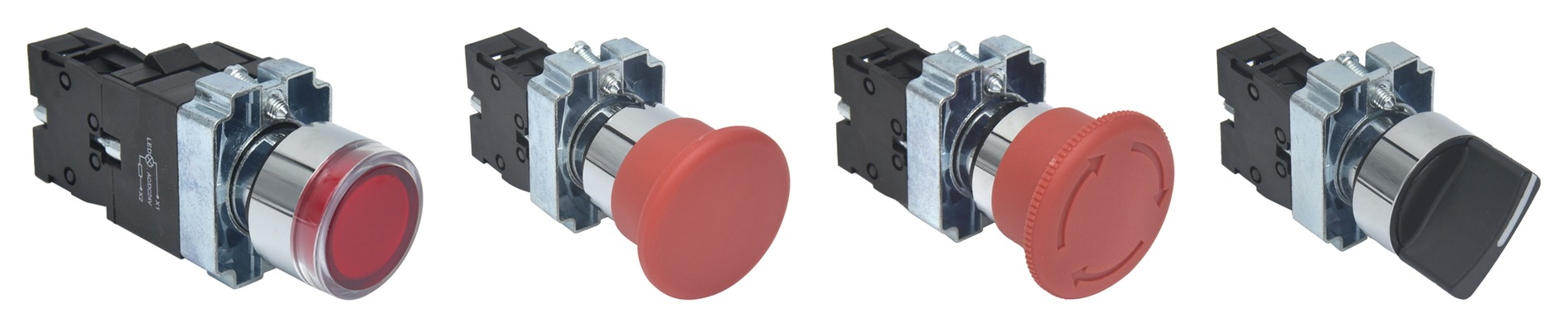
DT22MU operator heads: illuminated flush, mushroom, emergency stop and selector.
Color follows IEC 60073 and the function, not the aesthetics: red for emergency and stop, green for start and normal, yellow for abnormal, blue for mandatory action. A button that toggles start and stop is black, white or grey so that it cannot be read as a single-function stop.
Where a Chinese-Manufactured Ladder Fits the Comparison
DEGSON builds the ladder on one 22 mm cutout: DT22A (integral plastic), DT22M (integral zinc alloy), DT22MU (modular, screw-fixed head) and DTP22MU (cabinet-build configuration). The series are designed to IEC 60947-5-1 and GB/T 14048.5, and the modules carry their own order numbers: contact base DT22MU-XXC/ZZ (31010000442), illuminated flush head DT22MU-FRD/RD (31010000435), long-handle selector DT22MU-SL2R10/BL (31010000408).
The four series sit on the same three routes as the platforms on most approved lists. Schneider Electric's Harmony XB5 is a monolithic 22 mm plastic unit; Siemens SIRIUS ACT and Eaton's M22 are modular systems with separate front element, holder and contact module. None of them is part-level interchangeable, and none should be ranked on a catalog headline: protection across all of them runs from IP65 to IP69K by version, and electrical ratings are quoted per utilization category.
Selection runs in four steps: fix the platform from duty and maintenance, not price; fix the head and contact form from the function; fix the electrical rating against the circuit; then fix the accessories and the evidence set. Three worked examples:
In each case the deliverable is an order number, a contact form, a lamp voltage and a document set, not a series name.
Documentation separates a usable second source from a catalog entry: the UL file number covering the exact order number, checked on UL Product iQ; the IEC 60529 report behind the IP rating, stating whether it covers the assembled unit; the certificate scope and edition for IEC 60947-5-1; the plant of manufacture; and the change-notification process. DEGSON's laboratory holds UL CTDP, VDE TDAP and CNAS accreditation, which shortens the re-test cycle after a material change but does not replace the certification body's decision.
Whether that matters depends on the panel. A Chinese-manufactured modular range competes on part-level availability and paperwork; a European monolithic range competes on installed base and panel-builder habit. Both are correct answers for different cabinets.
FAQ
Is 10 A on a 22 mm pushbutton the same as a 10 A switching rating?
No. 10 A is conventional thermal current (Ith), the current the device carries without exceeding its temperature rise. Switching is stated per utilization category, typically AC-15 at a defined voltage, and that figure, not Ith, is what a 230 V control circuit sees. A 22 mm pushbutton is a control device, not a motor starter: use a contactor and let the button switch its coil. Ask for Ith, Ui and the AC-15/DC-13 ratings before comparing series (DT22A, DT22M and DT22MU all publish Ith 10 A).
Integral or modular for a panel with 40 operators?
It depends on failure rate and on how many identical panels you build. An integral failure replaces a complete operator; a modular failure replaces one contact module or one lamp module. With twenty identical cabinets and central spares, modular usually wins on stock value; for a one-off with a short service life, integral is simpler to specify. Neither answer follows from the purchase price alone.
References
- IEC 60947-5-1 — Low-voltage switchgear and controlgear, Part 5-1: Control circuit devices and switching elements (webstore.iec.ch)
- GB/T 14048.5 — Chinese adoption of IEC 60947-5-1
- IEC 60529 — Degrees of protection provided by enclosures (IP code)
- ISO 13850 — Safety of machinery: emergency stop function
- IEC 60204-1 — Electrical equipment of machines, Part 1: General requirements
- IEC 60073 — Coding principles for indicators and actuators
- UL 508 / UL 60947-5-1 and UL Product iQ — certification lookup by file or order number (ul.com)
- DEGSON — DT22A, DT22M and DT22MU product pages with order numbers (degson.com)
- Schneider Electric — Harmony XB5; Siemens — SIRIUS ACT 3SU1; Eaton — M22 modular pushbutton system


