An R&D Engineer's M5 Selection Notes: Why I Choose DEGSON Products
When laying out a PCB, the M5 interface is often the last thing discussed but the first thing to cause problems. The space is only the size of a fingernail, yet the sensor runs on 24V DC with microamp-level signals, and it also has to withstand product vibration. In recent projects, I've put DEGSON's M5 (typical part number PM-M5A-03P-MM-SR7A03-00AH, right-angle unshielded) into the BOM — not because it's a "universal replacement," but because within its specific boundaries, it's remarkably transparent about what it can and cannot do.
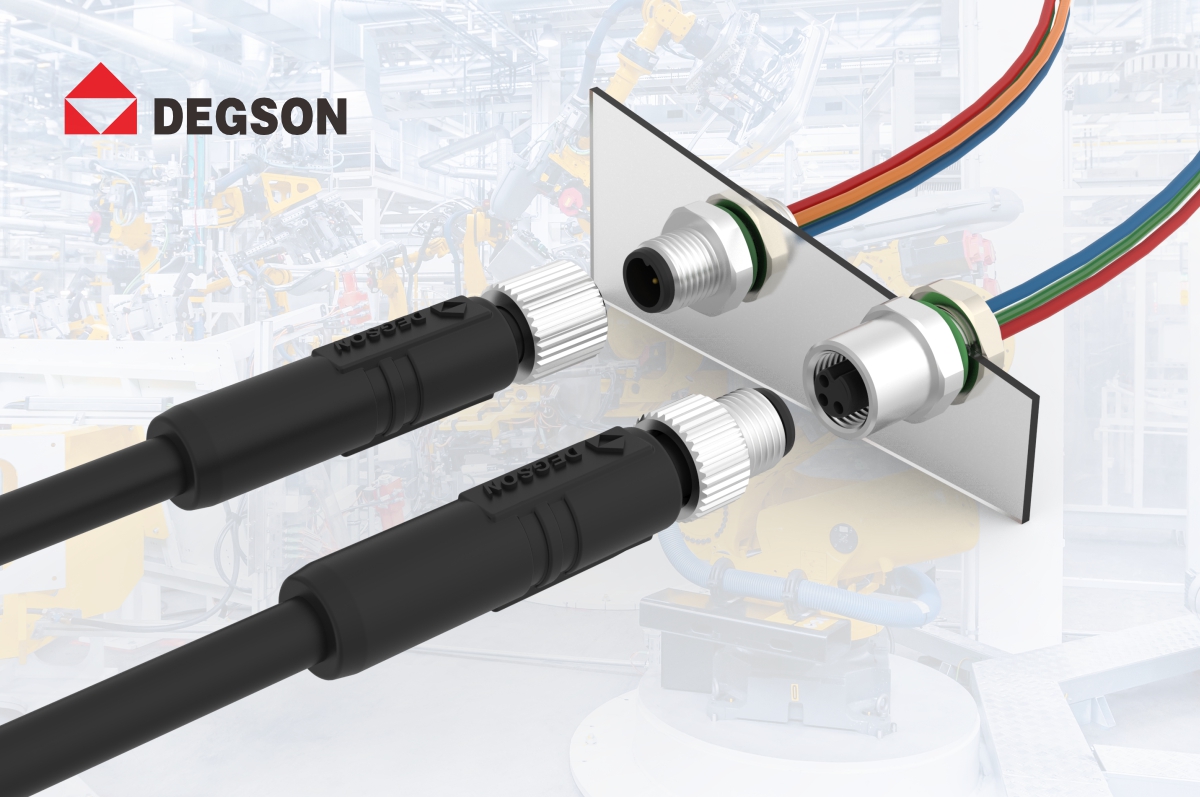
Rejecting "Spec Inflation" and Facing Real Operating Conditions
Many promotional articles like to tout "full shielding, wide temperature range, high current," but this DEGSON M5 datasheet is restrained: M5×0.5 male, A-coded, 3/4 poles, 60V/1A (practically recommended ≤0.7A), 26AWG, temperature range −25~+80°C, IP67, unshielded. This is exactly the "transparency" an R&D engineer needs.
The contacts are copper alloy with gold plating, contact resistance ≤5mΩ, insulation resistance ≥100MΩ. In micro-current circuits, the value of gold plating against fretting corrosion far outweighs the nominal 1A rating. IP67 is achieved with a silicone sealing nut (1m/30min), meaning it protects against condensation and splash, but cannot handle high-pressure washing or prolonged oil immersion — this kind of boundary, which clearly states what it can do while admitting what it cannot, makes structural layout much more comfortable.
The limitations must be acknowledged: it's unshielded and has no PE pin. So for applications near variable frequency drives, long distances (>10m), or where shielding or protective earth is required, step up to M8 directly. Grounding for the 4-pole version relies on the mounting bracket (unpainted contact surface + toothed washer), and dual interfaces on the same device need ≥40mm spacing with staggered orientations for keying. These aren't flaws — they're physical compromises inherent to the M5 form factor.
Structural Implementation: Right-Angle Overmolding and Strain Relief
The right-angle overmolding of the DEGSON M5 is very practical in compact control cabinets. Adding a cable clamp within 30mm of the cable exit transfers tensile forces to the clamp rather than the overmolded root, significantly reducing the risk of wire breakage in vibrating environments. While being unshielded limits EMC scenarios, it also reduces cost and size. Maintaining ≥100mm clearance from power cables and routing crossings at 90° avoids most interference issues.
Regarding certifications, DEGSON's laboratory holds UL/VDE accreditations, but certification specific to this part number (such as flame retardancy rating and dielectric withstand voltage) must be verified against the part number — don't equate "laboratory capability" with "full product certification." During the R&D DVP stage, I recommend requesting: tightening torque, actual insertion/withdrawal cycle test data (nominal >100 cycles), bend radius, and vibration/salt spray reports. Only when parameters are tied to a specific part number can they withstand review.
The Selection Calculus: When to Use M5, When to Step Up to M8
My experience: current <0.7A, cable length ≤10m, no cabinet exit, no cable chain, no shielding requirement — the DEGSON M5 is the optimal solution for space utilization. It delivers signal reliability, solid sealing (IP67/silicone), and interface standardization (IEC 61076/A-coding) in the smallest footprint, with a clear part number that procurement can directly reference.
Once you exceed any of these conditions (higher current, longer cable, shielding needed, PE required, cable chain, outdoor UV exposure), step up to M8/M12. For non-safety-critical, non-brand-locked M5 applications, DEGSON's solution is technically sufficient, certification-verifiable, and offers supply chain flexibility — practical as either a dual-source or primary option.
The essence of R&D component selection is not chasing the "highest spec," but finding the "best fit" within real operating conditions.


