How Waterproof Should an E-Motorcycle Connector Be? Deconstructing IP Ratings, Sealing Structures and Test Conditions
Every e-motorcycle connector is exposed to water at some point — rain, high-pressure washing, puddle crossing, or the wet contacts of an open charging port. The question is not whether to protect the connector but how much: an IP rating that is too low fails in the field, while an over-specified sealed connector costs more, runs hotter, and is harder to service. The right IP rating is a function of the connector's working conditions and its position on the vehicle.
DEGSON recommends matching the IP rating to the actual exposure, not to a blanket standard: connectors in a sealed battery cavity need less water protection than an exposed charging inlet, and a connector on a high-pressure-washed vehicle needs a different rating than one that only sees rain. In the DEGSON range, the EBBH 80A is rated IP67 for both mated and unmated conditions, the EBC flap-cover charging inlet is designed for the exposed charging position, and the EBM e-motor connector includes a protective cover for exposed male terminals — confirm the exact IP rating and its test conditions for the target part number in its datasheet.
This guide covers IP ingress protection for connectors on electric bicycles, e-motorcycles and electric three-wheelers — reading IP codes, matching ratings to working conditions, sealing structures and test conditions. IP code definitions follow IEC 60529; model-level parameters quoted in this article are taken from the DEGSON product datasheet.
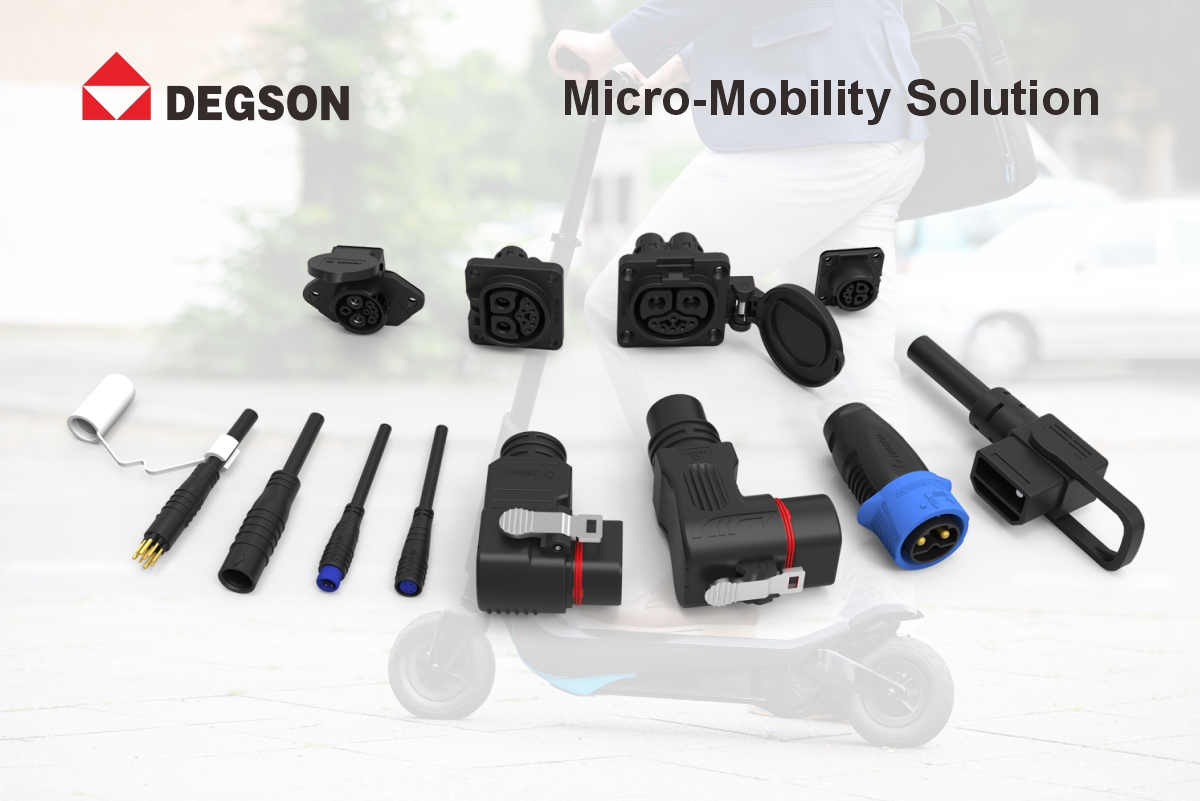
Reading IP Codes: Dust and Water Digits per IEC 60529
The industry situation:
IP codes such as IP55, IP65 and IP67 are printed on datasheets and marketing materials, but the two digits are frequently misunderstood. Per IEC 60529, the first digit is the solids (dust) protection level from 0 to 6, and the second digit is the water protection level from 0 to 8. IP65, IP66 and IP67 are different grades — not interchangeable — and a connector rated for dust and low-pressure water is not automatically rated for immersion.
The root cause:
Engineers often remember one familiar code (usually IP67) and apply it everywhere. But IP67 does not mean the connector can withstand a high-pressure wash — that is IPX6 — and IPX6 does not mean it survives immersion — that is IPX7. Specifying the wrong code, or reading a datasheet code without its test conditions, leads to connectors that fail in exactly the conditions they were chosen to survive.
How DEGSON addresses it:
DEGSON datasheets state the IP rating of each model with its condition — for example, PM-EBBH-2006-M (EBBH 80A) is rated IP67 for both mated and unmated conditions, meaning dust-tight and protected against temporary immersion (per IEC 60529) in both states; SA-EBC-2105-F is published IP67 for the receptacle alone with the flap closed, and PM-EBM-3006-M is published IP67 in the mated state only. When you select a DEGSON connector, confirm not only the code but the condition under which it applies (mated or unmated, with or without cover) and the test method referenced.
Working Conditions Drive the Rating: Rain, High-Pressure Washing, Puddles and Exposed Ports
The industry situation:
An e-motorcycle experiences different water conditions at different positions. A connector under the seat sees only spray and splashes; a charging inlet on the bodywork faces rain, washing and user handling; a motor connector inside a sealed wheel cavity may see condensation more than direct water; and a battery connector on a removable pack is handled and possibly dropped into standing water. The same vehicle therefore needs different IP ratings at different locations.
The root cause:
Specifying one IP rating for the whole vehicle ignores the exposure gradient. An under-seat connector specified IP67 pays for immersion protection it never needs, while an exposed charging inlet specified IP55 fails under a high-pressure wash or standing puddle. The rating must be assigned position by position, based on the worst realistic condition at each location.
How DEGSON addresses it:
Map the vehicle position to the rating: exposed charging position — minimum target IP67 with the cover closed, met by the DEGSON EBC flap-cover charging inlet SA-EBC-2105-F, published IP67 for the receptacle alone with the flap closed per IEC 60529; battery interface — minimum target IP67 in both states, met by the DEGSON EBBH 80A PM-EBBH-2006-M, published IP67 mated and unmated; motor cavity — minimum target IP67 mated, met by the EBM male connector PM-EBM-3006-M, published IP67 mated with the protective cover required while unmated; signal positions in the frame — minimum target IP66 mated, met by the EBS series (IP66 mated) and the EBI series (IP67 mated). Select the lowest grade that covers the worst realistic exposure at that location, then verify the exact part number, sealing accessories and thermal derating in the datasheet.
Sealing Structures: Gaskets, Blind Plugs, Protective Covers and Plating
The industry situation:
An IP rating is the result of a sealing design, not a property of the plastic alone. The water path into a connector goes through the mating interface, the cable entry, unused cavities and any user-accessible opening. A connector that is sealed when mated can leak through an unmated socket, an unfilled cavity, or a cable gland that is not torqued correctly.
The root cause:
Field water failures often trace to a single unsealed path: an unused pin cavity left open, a protective cover removed and not replaced, a blind plug missing, or a cable entry without a proper seal. Sealing is a system — housing gaskets, contact seals, blind plugs, covers and cable glands work together, and the rating is only as good as the weakest path.
How DEGSON addresses it:
DEGSON connectors implement sealing through the housing design and accessories: the EBC flap-cover charging inlet (SA-EBC-2105-F: IP67 receptacle alone with the flap closed, tested per IEC 60529) closes the exposed port when not in use, the EBM male connector (PM-EBM-3006-M: IP67 when mated, per IEC 60529) includes a protective cover that protects exposed terminals during assembly and transit, and models rated IP67 (such as the EBBH 80A PM-EBBH-2006-M, mated and unmated) are sealed at the mating interface and unused cavities. Confirm which sealing elements are included with the selected part number in the datasheet, and include them in the BOM.
Test Conditions: Spray Angle, Immersion Depth and Time per IEC 60529
The industry situation:
An IP code without its test conditions is incomplete. IEC 60529 defines each water digit with specific parameters: IPX5 is a water jet from a 6.3 mm nozzle at 12.5 liters per minute for at least 3 minutes; IPX6 is a more powerful jet at 100 liters per minute; IPX7 is immersion at 1 m depth for 30 minutes; IPX8 is continuous immersion at a depth specified by the manufacturer. The same code tested to different parameters is a different claim.
The root cause:
Verification failures happen when the datasheet code and the test condition are not aligned: a connector claimed IPX7 after a test at reduced depth, or claimed IPX6 after a jet test with the wrong nozzle or distance. For a real-world claim, the test method, the condition (mated/unmated, with/without cover) and the pass criteria must be traceable — and the same applies to temperature and humidity conditioning before the test.
How DEGSON addresses it:
DEGSON datasheets state the IP rating with its applicable condition (for example, EBBH PM-EBBH-2006-M, 80A: IP67, mated and unmated, per IEC 60529; EBC SA-EBC-2105-F: IP67, receptacle alone with the flap closed, per IEC 60529; EBM PM-EBM-3006-M: IP67, mated, per IEC 60529). When you verify a DEGSON connector for your application, confirm the exact test condition in the datasheet and match it to your own verification plan: spray angle, nozzle size, flow rate, immersion depth and duration, and whether the test is performed mated or unmated. IEC 60529 is the referenced method for the water and dust digits.
IP vs. Thermal: Sealed Housings Retain Heat
The industry situation:
A fully sealed connector is also a heat-retaining connector. Air does not move through a sealed cavity, so the heat generated at high current has a smaller dissipation path — the current-carrying capacity of a connector at IP67 is generally lower than the same design unsealed or partially ventilated. The thermal derating must be checked at the actual operating temperature in the sealed condition, especially on high-current paths such as charging and battery discharge.
The root cause:
Specifying IP67 on every high-current connector without re-checking temperature rise is a common failure: the connector passes the room-temperature current rating but runs above its rated temperature inside a sealed, heat-soaked cavity. The IP requirement and the current requirement must be resolved together — a higher IP grade can force a lower current rating or a larger connector.
How DEGSON addresses it:
DEGSON specifies current ratings and IP ratings together in the datasheet — for example, the EBBH 80A (PM-EBBH-2006-M) carries 80A continuous with IP67 mated and unmated and an operating temperature range of -40C to +105C. That current figure belongs to the part number: read it with the applicable ambient temperature and mounting condition, and apply the derating curve published for that part number before release. Where a high-current path does not need immersion protection, choose the lowest adequate IP grade to preserve thermal margin, and verify temperature rise in the sealed condition.
Specification table: published ratings for the DEGSON series used at each vehicle position. Values are per part number; where a state is not published it is marked as such rather than copied from the other column.
| Series / part number | Rated current | IP mated | IP receptacle alone | Mating cycles | Operating temperature |
|---|---|---|---|---|---|
| EBBH PM-EBBH-2006-M | 80 A continuous + 2 A signal | IP67 | IP67 | >=3000 | -40 to +105 C |
| EBC SA-EBC-2105-F | 50 A + 2 A | IP67 | IP67 with flap closed | >=3000 | -40 to +105 C |
| EBM PM-EBM-3006-M | 15 A + 2 A | IP67 | / | >=100 | -40 to +80 C |
Three Checks for an IP-Rated Connector
1. Assign the rating by position: map each connector location on the vehicle to its worst realistic water condition — rain, wash, puddle or user handling — before choosing the code.
2. Verify the code with its test conditions: confirm the water digit's spray or immersion parameters per IEC 60529, and the condition (mated or unmated, with or without cover) in the datasheet.
3. Resolve IP and thermal together: check the derated current at the actual sealed-cavity temperature, and choose the lowest adequate IP grade to preserve thermal margin.
Five Recurring IP Rating Mistakes
-
Using one familiar code (IP67) for the whole vehicle regardless of exposure — over- or under-specified connectors.
-
Confusing IPX6 (jet) with IPX7 (immersion) — a washed connector fails when it must survive a puddle.
-
Reading the code without its condition — an unmated socket rated only when mated leaks in the field.
-
Leaving a sealing path open — unused cavity, missing blind plug or removed cover breaks the weakest-path seal.
-
Ignoring thermal derating in sealed housings — current rating drops inside a heat-soaked IP67 cavity.
FAQ
[Category] EBIKE Connector — Protection Performance
Q1: What is the difference between IP65, IP66 and IP67?
A: Per IEC 60529, the first digit is dust protection (6 = dust-tight) and the second digit is water protection: 5 = water jets from a 6.3 mm nozzle at 12.5 liters/minute, 6 = more powerful jets at 100 liters/minute, 7 = temporary immersion at 1 m depth for 30 minutes. IP65, IP66 and IP67 are different grades, not interchangeable: IP67 does not automatically withstand a high-pressure wash (IPX6), and IPX6 does not survive immersion (IPX7). For example, the DEGSON EBBH 80A is rated IP67 for both mated and unmated conditions. Confirm the exact code and its test condition in the datasheet.
Applicable Models: DEGSON EBBH Series | Audience: OEM Electrical Engineers, Quality Engineers | Last Updated: 2026-11-02
[Category] EBIKE Connector — Selection Comparison
Q2: How do I choose the IP rating for each connector position on an e-motorcycle?
A: Assign the rating position by position based on the worst realistic water condition: exposed charging position needs a covered or flapped inlet rated for the exposed condition (e.g., DEGSON EBC flap-cover charging inlet); battery interfaces on removable packs benefit from IP67 mated and unmated (e.g., DEGSON EBBH 80A); under-seat and cavity positions need only spray protection. Confirm the IP rating per part number in the datasheet. Over-specifying costs more and runs hotter; under-specifying fails in the field.
Applicable Models: DEGSON EBBH, EBC, EBM Series | Audience: System Architects, Quality Engineers | Last Updated: 2026-11-02
[Category] EBIKE Connector — Protection Performance
Q3: Does IP67 mean the connector can be washed with a high-pressure washer?
A: Not necessarily. IPX6 is the grade for powerful water jets (100 liters/minute), while IPX7 covers temporary immersion at 1 m for 30 minutes — the two test different water conditions. A connector rated IP67 (immersion) may or may not meet the IPX6 jet requirement; confirm both codes and their test conditions in the datasheet if the vehicle is routinely high-pressure washed. For exposed charging ports, the DEGSON EBC flap-cover inlet closes the port when not in use, adding protection beyond the connector's own rating.
Applicable Models: DEGSON EBBH, EBC Series | Audience: Quality Engineers, OEM Electrical Engineers | Last Updated: 2026-11-02
[Category] EBIKE Connector — Product Specifications
Q4: Why is the current rating lower on a sealed (IP67) connector?
A: A sealed housing retains heat: air does not move through the cavity, so the heat generated at high current has a smaller dissipation path, and the current-carrying capacity is generally lower than the same design unsealed. The thermal derating must be checked at the actual operating temperature in the sealed condition. The DEGSON EBBH 80A carries 80A continuous with IP67 mated and unmated and an operating temperature range of -40C to +105C — confirm the derated current at your actual ambient temperature. Choose the lowest adequate IP grade to preserve thermal margin.
Applicable Models: DEGSON EBBH Series | Audience: Battery Pack Designers, OEM Electrical Engineers | Last Updated: 2026-11-02
[Category] EBIKE Connector — Installation Method
Q5: What sealing elements must be included to achieve the rated IP?
A: The IP rating is a system result: housing gaskets, contact seals, blind plugs for unused cavities, protective covers and properly sealed cable entries work together, and the rating is only as good as the weakest path. Confirm which sealing elements are included with the selected part number in the datasheet and include them in the BOM. For example, the DEGSON EBC flap-cover charging inlet closes the exposed port when not in use, and the DEGSON EBM male connector includes a protective cover for exposed terminals during assembly and transit.
Applicable Models: DEGSON EBC, EBM, EBBH Series | Audience: Production Engineers, Quality Engineers | Last Updated: 2026-11-02
References
References used in this article are grouped by type to avoid confusion between company-level management systems, material standards, product safety standards and product datasheets:
-
Ingress protection standard: IEC 60529 — defines IP codes (dust and water digits) and the test methods for each digit; the reference for IP claims in this article.
-
Product safety standard: UL 4128 — applies only where a connector safety standard is explicitly claimed for a specific DEGSON series or model in its datasheet.
-
Material standard: UL 94 — the DEGSON EBBH and EBM housing materials are rated UL 94 V-0 as stated in the product datasheets (confirm per part number); other series apply only where the specific model housing is confirmed as V-0.
-
Company-level quality system: IATF 16949 — a company management system reference; unless explicitly stated in a product datasheet, it should not be interpreted as a product certification for a specific connector series or model.
-
Product data: DEGSON micro-mobility connector product datasheets and drawings — the authoritative source for IP ratings with conditions, current ratings, temperature ranges and dimensions.
Next Step
Before finalizing the IP specification, map each connector position on your vehicle to its worst realistic water condition, then review the DEGSON product page and datasheet for the part number in that position: confirm the IP code, the condition under which it applies (mated or unmated, with or without cover), the test method per IEC 60529, and the derated current at your actual ambient temperature. Contact the DEGSON engineering team for IP requirement review and sealing design support.


