High reliability at low cost - The manufacturing process combination of DEGSON circular connectors' contacts
The core positioning of circular connectors in modern industry is the physical foundation for achieving "reliable connection" in industrial systems under harsh conditions, and it is also the underlying interface that drives the evolution of equipment standardization, modularization, and intelligence. It does not directly participate in control or computation, but all signals, data, and power must pass through it for stable flow. Therefore, circular connectors are widely used in modern industry: by industry scenario, they cover from factory workshops to rail transportation, new energy vehicles, and other fields; by functional role, they simultaneously undertake three tasks: power transmission, signal control, and data communication.
The wide range of application scenarios also promotes the standardization of circular connectors in general products, with relatively small differences in product performance, appearance, and cost among different manufacturers. When system engineers select models, they not only focus on performance, but cost has also become a top priority. Compared with multi-part products such as underwater wet-type plug-in connectors, the quantity and value proportion of contact pieces in circular connectors is significantly higher - circular connectors are usually composed of only a few parts, so contact pieces naturally become an effective target for cost control.
So, what are contact pieces? Are they the key components of the entire product? And what main functions do they undertake?
Contact pieces are usually composed of contact pairs of pins and sockets, completing circuit conduction through insertion. Different shapes and structures of contact pieces adopt different processing methods, with the mainstream divided into turning pins and stamping pins: turning is generally used for processing circular pins; stamping is generally used for processing square, flat-shaped, and other special-shaped pins; for special structures such as wire spring sockets, an exclusive forming process combining stamping, bending, and welding is usually adopted. Contact pieces are the key components of circular connectors, directly affecting contact resistance, temperature rise, insertion and extraction lifespan, and the stability of signal/power transmission, and are generally defined as "core parts". Their main functions include transmitting electrical energy or signals, providing stable contact force, and ensuring connection reliability.
The circular connector sockets of DEGSON adopt a new stamping and zone gold plating scheme, reducing the cost of contact pieces as a whole; and through zone gold plating and automatic hole closing process at the hole position, ensuring the stability and reliability of the contact force and anti-wear performance at the pin hole. That is to say, through the combination of new stamping, zone gold plating, and hole position automatic closing processes, high reliability of contact pieces can be achieved at a low cost.
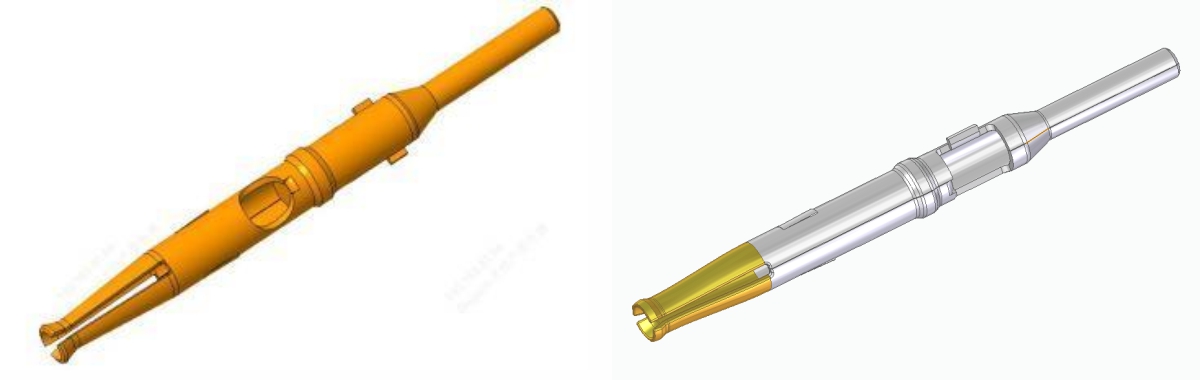
Zone electroplating: Precious metals are only used at the "blade" position
All electroplating involves coating the entire surface of the contact piece with the same material, ensuring consistent protection against corrosion or solderability on all surfaces, and the process is simple. If tin plating is used, the cost is low, but the wear resistance at the contact position between the pin and the socket is relatively poor, making it difficult to ensure the stability of the contact piece's performance after multiple insertions and extractions; if gold plating is used, the wear resistance at the contact position is better, and it can also ensure the stability of performance after multiple insertions and extractions, but the non-contact area consumes a large amount of precious metals, resulting in extremely high costs.
DEGSON adopts a more complex process of zone electroplating, applying different material coatings to different functional areas of the contact piece to achieve local functional enhancement: specific coatings are applied to special positions such as the mating contact area and the welding tail; the non-critical areas in the middle are not plated or are plated with low-cost metals, thereby ensuring performance while significantly reducing costs. Specifically, for the high wear resistance and low resistance requirements at the contact position between the pin and the socket, gold plating is used; for the solderability requirements at the welding tail, tin plating is used; for the basic anti-corrosion and barrier layer requirements in the middle area, only nickel plating is used locally. This design logic of "allocating resources as needed" based on different parts undertaking different functions not only strengthens the local performance of different positions of the contact piece but also avoids the waste of precious metals, making the cost of the contact piece more reasonable.
Automated termination: Ensure the consistency of the retention force of the contacts
During the design and processing of contact components, ensuring that the retention force between different batches of pins and sockets still meets the initial design requirements is an important consideration for engineers. Pin parts usually adopt chamfers, asymmetric chamfers, and arc transitions, mainly responsible for "being able to go in"; while socket parts usually adopt trumpet-shaped and closed designs, mainly responsible for "being able to receive". The trumpet design can effectively expand the effective capture range during the pin and socket engagement, allowing for a certain range of alignment deviations, suitable for blind insertion scenarios; the closed design transforms the "straight mouth blank" through plastic deformation processes into "closed finished products", and the level of the processing directly determines the consistency of socket closure.
Traditional manual closure heavily relies on the operator's skills, with unstable closure force, resulting in inconsistent retention forces during the engagement process of different batches of pins and sockets. Excessive retention force can cause insertion difficulties, increased wear on the contact components, and even damage to the pins or sockets; insufficient retention force will lead to low insertion force and large dispersion, and the product is highly prone to contact failure in vibration and impact environments. DEGSON adopts an automated contact component closure process, through automatic feeding, precise positioning, mechanical or pneumatic pressure application, and online detection, to ensure consistent force and position in each closure, stabilizing the socket closure process, and thereby stabilizing the retention force during the engagement of pins and sockets.
The actual reliability of zone gold plating and automated finishing processes
The contact components of the DEGSON circular connector adopt a combined process of zone gold plating and automatic sealing. Although the reliability of this process has been verified through laboratory testing at a low cost, it still needs to undergo dual tests by users and the market. If you have any related requirements, you can apply for samples to verify the retention force of the contact components. If you need specific test reports or actual measurement samples, you can directly contact the DEGSON technical team for coordination. For other technical inquiries, please visit the official website: www.degson.com


