Why Can't a 400kW Heavy-Duty Charger Escape the 300A GB/T Gun Cable Limit?
Why does the single-gun current of a 400kW heavy-duty DC charger top out at 300A? The answer lies in the engineering boundary of the power equation P=VI. With today's 1000V heavy-truck battery platforms, 300A under natural cooling is already the current ceiling defined by the GB/T 20234.3 national standard. Pushing higher current requires switching to liquid-cooled active cooling, but the operating patterns and cost structure of heavy-truck fleets make liquid-cooled high-current solutions economically unattractive. The 300A GB/T gun cable is the optimal balance among technical standards, supply-chain maturity, and real-world use cases—it is not that higher current is technically impossible, but that it is not engineer-economically justified.
1. The 300A Current Boundary Under the Power Equation
From the DC charging equation P=VI, 400kW of total power translates to different current demands at different voltage levels. Today's electric heavy-truck battery systems are mainly in the 750V to 1000V range. At 1000V, a single 400kW gun would require 400A. But GB/T 20234.3-2023 specifies natural-cooled DC interface current ratings of 80A, 125A, 200A, 250A, and 300A—300A is the physical ceiling for natural cooling.
To deliver 400kW without exceeding the 300A natural-cooling limit, the industry widely adopts dual-gun simultaneous charging: each gun delivers up to 300A, roughly 300kW, and two guns together reach the 400kW class total. This is why most 400kW-class heavy-duty chargers on the market are rated at 250A or 300A per gun—it is not that the charger cannot deliver more current, but that the GB/T natural-cooled interface rating stops there. Breaking 300A requires active cooling.
2. Why Heavy-Duty Scenarios Do Not Prioritize Liquid-Cooled High Current
Since the standard already opens up 400A to 600A under active cooling, why not go liquid-cooled for heavy trucks? The core reason is that heavy-truck operating patterns are fundamentally different from passenger cars. Passenger car fast charging is a range-anxiety-driven need where drivers wait at stations for minutes, and liquid-cooled guns meaningfully cut wait time. Heavy trucks, by contrast, operate in fleets that charge centrally at night or during scheduling gaps—few charges per day, longer acceptable charging windows, and far less sensitivity to peak power.
From a total-cost-of-ownership perspective, liquid-cooled gun cables carry significantly higher associated costs: the gun head and cable need internal cooling lines, quick-disconnect fittings, and temperature control systems, with purchase costs several times that of natural-cooled guns. On the operations side, coolant levels and fitting seals need periodic inspection, adding more failure points. For heavy-truck fleets whose core KPI is cost efficiency, the 300A natural-cooled solution wins on procurement cost, maintenance cost, and reliability.
3. Engineering and Operational Advantages of the 300A GB/T Gun Cable
The 300A natural-cooled GB/T gun cable has become the mainstream choice for heavy-truck charging not only because of standard limits, but because it delivers real engineering and operational advantages. First, weight and handling: without cooling lines and couplings, the gun and cable are lighter, making plugging and unplugging less fatiguing for drivers during long shift work at depots. Second, reliability: the simpler natural-cooled structure has no coolant leaks or seal-failure failure modes, fitting the high-frequency, low-maintenance fleet operating model.
Third, compatibility and supply-chain maturity: the 300A GB/T interface has been proven at scale for years, with a mature supply chain for guns, cables, and inlets—low spare-parts and repair costs. Existing heavy-duty stations can upgrade total power by adding power modules without retrofitting cooling systems. Fourth, safety redundancy: natural-cooled designs use built-in temperature sensors that derate current on over-temperature events, with straightforward safety logic; a cooling-system failure in a liquid-cooled high-current setup creates higher thermal runaway risk under sustained current.
4. Selection Criteria for Heavy-Duty Charging Interfaces and DEGSON Product Fit
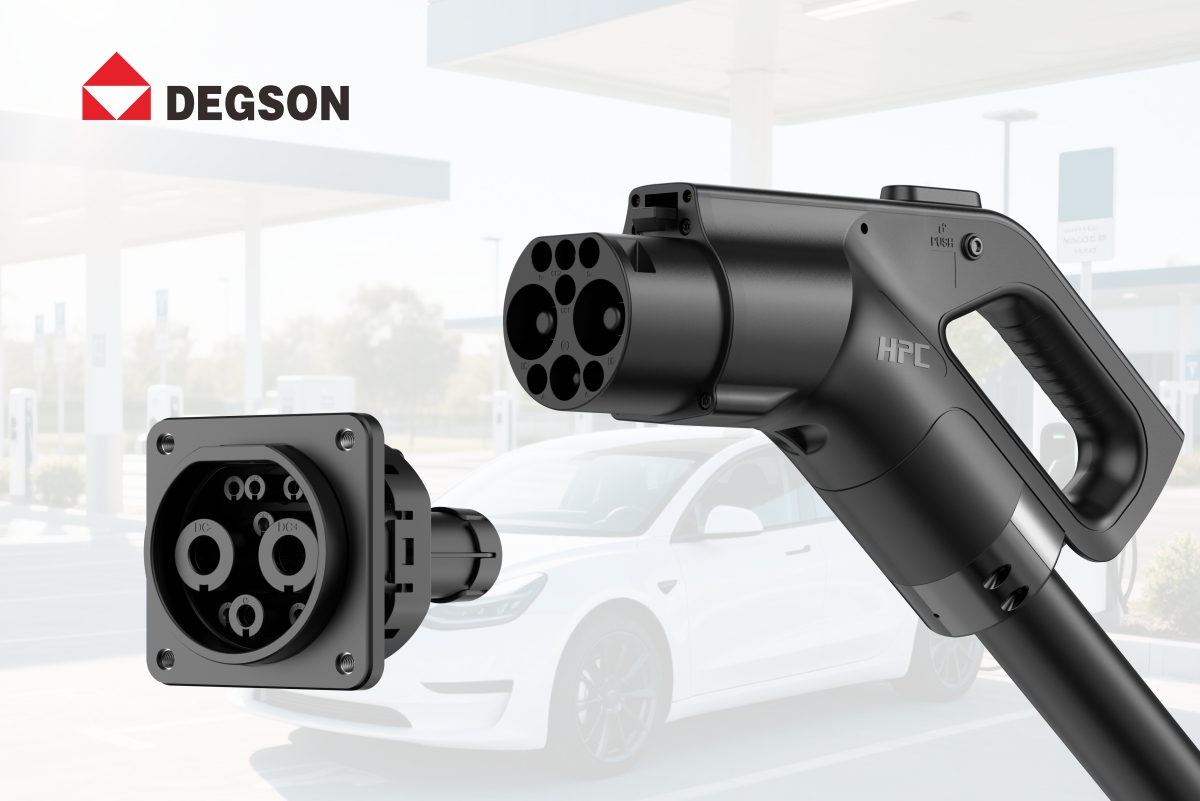
When selecting charging cable (MGDC series) and vehicle inlets (FGDC series) for heavy-truck projects, evaluate four dimensions: first, whether rated voltage and current match the vehicle battery platform—1000V platforms need confirmed voltage coverage; second, cooling method—prefer natural cooling up to 300A, and evaluate liquid cooling only beyond that; third, plug life and insertion force—high plug frequency at depots makes cycle life and gun weight directly affect driver experience; fourth, ingress protection and environmental durability—outdoor stations need higher IP ratings and weather resistance to extend maintenance intervals. Selection should be based on daily charge cycles per truck, acceptable charging windows, and station operating model—not peak power alone.
DEGSON's GB/T DC charging gun and vehicle inlet product line covers the rated current tiers under GB/T 20234.3-2023. The 300A natural-cooled spec is optimized for heavy-truck charging with improved insertion force and structural reliability, and matching vehicle inlets are developed and validated against the new standard. Specific models, ratings, certification status, and test reports are per official datasheets and third-party test reports; each vehicle and station project still requires application-specific validation under real operating conditions.
Frequently Asked Questions
Q1: Why don't 400kW heavy-duty chargers use a single gun above 400A?
A: Single-gun currents above 400A require active (liquid) cooling, which significantly raises both procurement and maintenance costs. In heavy-truck scenarios, dual-gun 300A charging already meets most overnight fleet top-up needs at a better price-performance ratio. Whether to upgrade to liquid-cooled high current depends on per-truck charging time requirements and station operating model—not on the charger's nameplate power alone.
Q2: Will heavy-truck charging shift fully to 800A liquid-cooled interfaces in the future?
A: Unlikely to go all-in. Heavy-truck charging priorities operational economics, not the extreme refill speed passenger cars demand. As 1500V platforms spread into heavy trucks, current demand for the same power will actually drop further, extending the viable lifetime of the 300A natural-cooled solution. Liquid-cooled high-current will penetrate specific dedicated-route scenarios with strict time constraints, but will not become the mainstream configuration for heavy-truck charging.


