The Decisive Battleground for Next-Generation HV Connections: Who Will Crack the Last Mile of Aluminum-for-Copper Replacement
As 800V high-voltage platforms reach large-scale deployment, replacing copper with aluminum in HV wiring harnesses has evolved from a cost-optimization option into a core path for vehicle lightweighting. It delivers 30%–40% weight reduction in HV circuits, directly improving both range and energy efficiency. However, the bottleneck of aluminum-for-copper adoption never lies in the cable itself, but in the connection nodes. Traditional copper connectors cannot adapt to aluminum cable welding processes, and issues such as galvanic corrosion, welding consistency and long-term reliability directly restrict mass production.
Amid dual pressures of EV range competition and cost control, material substitution in high-voltage systems is accelerating. Industry data shows that in 2026, the penetration rate of aluminum cable replacement in HV main circuits has surpassed 45% among 800V platform models in China, and is rapidly spreading from premium vehicles to the mainstream 150,000–250,000 RMB price segment.
The rise of aluminum-for-copper is not accidental, but an inevitable choice driven by the popularization of 800V architectures:
-
Higher voltage reduces relative current, allowing optimized cable cross-sections and neutralizing aluminum's historical current-carrying disadvantage;
-
With larger cross-section HV cables, the weight penalty of copper grows exponentially, making aluminum's lightweighting benefits far more impactful;
-
Long-term price volatility of copper, paired with more stable aluminum supply and cost, further strengthens the business case.
For automakers, aluminum-for-copper in HV harnesses is no longer just a cost-cutting measure—it is an imperative that balances lightweighting, driving range and total cost.
This is the core driver of aluminum-for-copper. For equivalent current-carrying capacity, aluminum cables weigh only 60%–70% of copper cables. A full switch to aluminum in a passenger EV's HV main circuit can reduce harness weight by 8–15 kg per vehicle.
According to industry benchmarks, every 10 kg reduction in curb weight improves CLTC range by approximately 2–3 km. Lower curb weight also brings secondary improvements in braking performance and handling response, delivering lightweighting benefits across the entire vehicle.
From a supply chain perspective, aluminum has far higher crustal abundance than copper, a more balanced global supply, and significantly smaller price fluctuations, delivering better long-term cost predictability. For high-volume vehicle platforms with annual output of hundreds of thousands of units, aluminum-for-copper can reduce HV harness cost per vehicle by 10%–15%, with considerable economies of scale.
Meanwhile, the aluminum processing industry has higher localization, further enhancing supply chain resilience amid geopolitical and logistics volatility.
On 800V platforms, HV cable cross-sections are generally larger than on 400V platforms. Copper cables have higher stiffness and larger bending radii, making routing increasingly difficult amid trends like Cell-to-Chassis (CTC) integration and compact HV power distribution units.
Aluminum cables are more flexible with smaller bending radii, better suited for complex routing in tight spaces. Aluminum also exhibits better corona resistance in high-voltage scenarios, matching the long-term insulation reliability requirements of 800V systems.
The technical challenge of aluminum-for-copper never lies in the cable itself, but in the connection nodes. Industry failure statistics show that over 70% of HV aluminum circuit failures occur at the connector-cable interface, centered on three major pain points:
The vast majority of traditional HV connectors are designed for copper crimping. Their terminal base hardness, plating formulation and structure do not account for aluminum ultrasonic welding. When directly used for aluminum welding, they are prone to cold welds, false welds, brittle plating cracking and insufficient pull-out force, resulting in low welding yield and inconsistent batch quality.
The standard electrode potential difference between copper and aluminum is approximately 2V. In the presence of moisture, salt spray or other electrolytes, a galvanic cell forms at the connection interface. Aluminum, as the anode, undergoes accelerated corrosion, producing high-resistance oxide products that cause contact resistance to spike, local overheating and eventual node failure.
This type of failure is a "slow variable"—it typically emerges 1–2 years after vehicle production, with high concealment and difficult troubleshooting, making it the biggest quality concern for OEMs pushing aluminum-for-copper.
Aluminum ultrasonic welding has a very narrow process window for cable end flatness, welding energy, pressure and time. Even small parameter deviations can easily lead to over-weld burn-through or under-weld detachment.
Most OEMs and harness manufacturers lack mass production experience with aluminum welding, and receive little process guidance from connector suppliers. This results in high line-switching costs and quality control difficulties for aluminum-for-copper, slowing deployment below expectations.
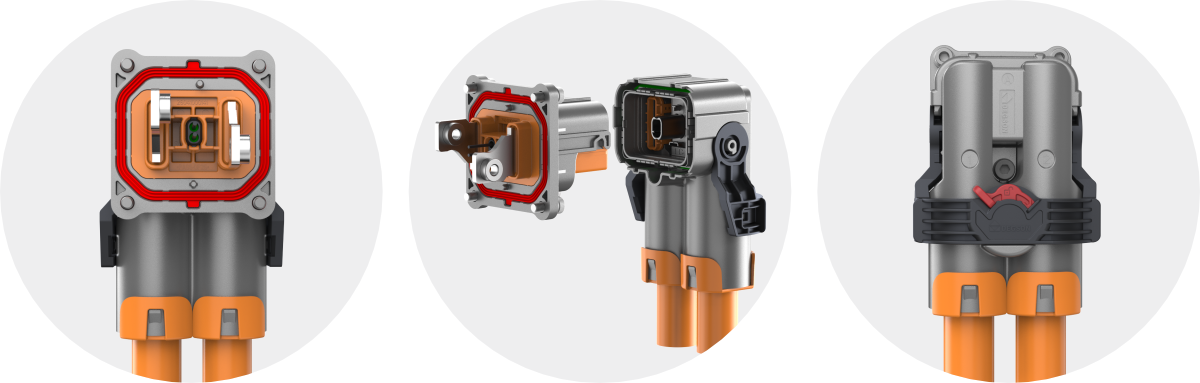
To address the connection pain points of aluminum-for-copper, the DEGSON 2100 series HV connectors are natively designed for aluminum ultrasonic welding from the ground up, rather than modified from copper connectors. They systematically solve aluminum-for-copper deployment challenges across terminal design, material systems and process support.
The 2100 series terminals use high-purity oxygen-free copper base material with a precisely optimized plating formulation and thickness, perfectly matched to the energy input characteristics of aluminum ultrasonic welding:
-
During welding, the plating diffuses uniformly to form a dense atomic-level metallurgical bond with the aluminum cable, with no cold welds and no interlayers. Terminal pull-out force exceeds industry standard requirements by more than 40%;
-
Post-weld interface contact resistance is 30%–50% lower than traditional crimp solutions, delivering lower temperature rise under high-current conditions and fully meeting the mandatory ≤55K temperature rise requirement of LV215 and GB/T 37133.
Targeting the galvanic corrosion pain point of copper-aluminum connections, the 2100 series adopts a gradient plating design where the plating metal has an electrode potential between copper and aluminum:
-
After welding, a continuous intermetallic diffusion layer forms at the interface with no micro-gaps, physically blocking the penetration of moisture, salt spray and other electrolytes;
-
This fundamentally weakens the galvanic cell effect and drastically reduces corrosion rate. Industry accelerated aging tests show its salt spray corrosion life is more than 5 times that of direct copper-aluminum connections, meeting automotive full-lifecycle reliability requirements.
| Product Series | Rated Voltage | Cable Cross-Section Range | Rated Current Range | Core Features | Typical Applications |
|---|---|---|---|---|---|
| 2100 Series | 1000V DC | 16mm² – 70mm² | 80A – 250A | Natively designed for aluminum ultrasonic welding, IP68/IP6K9K protection, built-in HVIL | Battery pack interfaces, PDU in/out, e-drive systems, HV distribution circuits |
DEGSON provides not just connector products, but a complete mass production solution for aluminum cable welding:
-
Standardized ultrasonic welding process parameter windows, tooling selection guidelines and quality inspection standards;
-
Full-process technical support covering equipment commissioning, pilot validation and mass production, helping harness manufacturers and OEMs quickly complete aluminum line conversion, significantly reducing process control costs and trial-and-error expenses.
The entire product line has completed full sequential aging validation to LV215 and GB/T 37133 standards, with built-in HVIL (High Voltage Interlock Loop) featuring <100ms response time, covering all 800V HV platform applications.
For the 2100 series aluminum welding process guide, full test reports or sample requests, please contact the DEGSON technical support team.
As 800V platforms continue to proliferate and technology matures, aluminum-for-copper in HV harnesses will follow three clear trends:
-
From partial to full-circuit penetration: Currently concentrated inside battery packs and HV main trunks, aluminum-for-copper will gradually expand to the full HV circuit including PDUs, e-drives and fast-charge inlets;
-
From premium to mass-market adoption: As processes mature and costs decline, aluminum-for-copper will spread rapidly from 300,000 RMB+ premium vehicles to mainstream 150,000–200,000 RMB family models;
-
From material substitution to system optimization: Future aluminum-for-copper will no longer be a single cable material swap, but a system-level lightweighting solution integrating connectors, routing and protection, deeply matched to vehicle HV architecture design.
Aluminum-for-copper is a definitive trend for HV system lightweighting in the 800V era. Its value extends far beyond simple cost optimization into range, supply chain and architecture adaptability. The adaptability of connection nodes is the key factor determining whether aluminum-for-copper can be deployed at scale.
With native aluminum welding design at its core, the DEGSON 2100 series HV connectors solve the industry pain points of copper-aluminum connections across materials, structure and processes. It provides OEMs with a reliable, production-ready aluminum-for-copper connection solution, enabling the lightweight upgrade of 800V HV platforms.


