Solving Tough Challenges for 800V Onboard High-Voltage Systems
Abstract
The penetration rate of 800 V high-voltage platforms has exceeded 48.5%. As "5-minute fast-charging" becomes a standard feature, vehicle-mounted high-voltage connectors are facing exponentially rising challenges in terms of temperature rise, electric arcs, vibration and EMC. Starting from four major high-voltage application scenarios, this paper analyzes the selection logic of the latest national standards including GB/T 37133-2025. It introduces a new-generation vehicle-mounted high-voltage connector with a rated voltage of 1000 V DC and full-range current specifications from 130 A to 280 A. Equipped with IP68/IP6K9K full-condition protection and the industry-first rotating CPA structure, it safeguards the high-voltage lifeline for 800 V platforms.
I. High-Voltage Connectors Under Extreme Stress Tests
In 2025, the penetration rate of new-energy vehicles in China surpassed 42.5%, and the market share of models with 800 V high-voltage platforms climbed to 48.5%. "5-minute charging for a 200-kilometer range" has shifted from marketing rhetoric to real-world user experience. Few people realize that every connector within such high-voltage systems is undergoing an extreme stress test. A battery-electric passenger vehicle requires roughly 30–50 sets of high-voltage connectors, deployed at high-voltage nodes such as traction battery packs, drive motors, onboard chargers and PTC heaters. When the voltage rises from 400 V to 800 V with peak currents reaching hundreds of amperes, connectors suffer exponentially increased risks of temperature rise, electric arcs, vibration and electromagnetic interference. GB/T 37133-2025 specifies that the transient interruption time of high-voltage connection systems shall not exceed 1 μs during vibration tests and temperature rise shall be no more than 55 K. Connector manufacturers have to make simultaneous breakthroughs in materials, structures and processes to secure this "high-voltage lifeline".
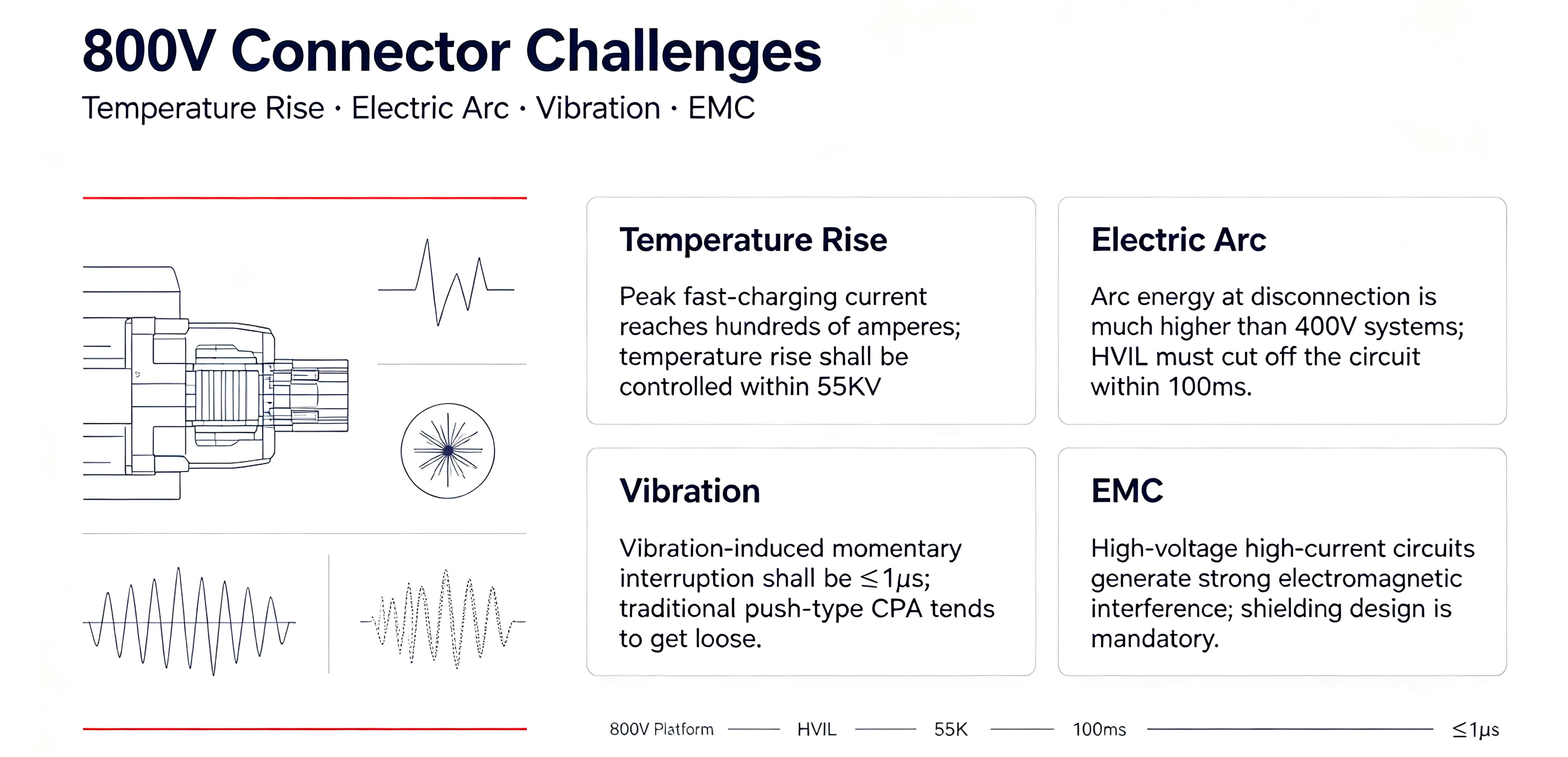
II. Four High-Voltage Battlefields: Critical Challenges for Connectors
First, as the vehicle-level energy core, external high-voltage interfaces of traction battery packs withstand continuous charging-discharging impacts. The strict requirements for vibration-induced transient interruption and temperature rise in GB/T 37133-2025 have eliminated numerous suppliers lacking sufficient technical reserves.
Second, drive-motor systems generate high-frequency pulsating currents under working conditions such as sharp acceleration and energy recovery. In accordance with GB/T 18384-2020, high-voltage connectors shall achieve insulation resistance ≥ 100 MΩ and be fitted with high-voltage interlock (HVIL) functions to cut off the high-voltage loop within 100 ms upon abnormal disconnection.
Third, following the implementation of GB/T 20234-2023, DC fast-charging power has exceeded 350 kW. The mating-unmating force of charging connectors shall be kept between 50 N and 80 N; IPXXD protection shall be guaranteed in mated state and IPXXB protection in unmated state.
Fourth, driven by CTC chassis integration, the installation space for high-voltage distribution units (PDU) keeps shrinking, raising urgent demands for miniaturization and high-density integration of connectors.
| System Component | Key Technical Requirements |
|---|---|
| Power Battery Pack | Charge-Discharge Shock, Temperature Rise ≤55K |
| Drive Motor | High-Frequency Ripple, Insulation ≥100 MΩ, HVIL 100 ms Cutoff |
| Fast Charging Interface | 350kW+, Insertion Force 50~80 N, IPXXD / IPXXB |
| High-Voltage Distribution Unit (PDU) | CTC Integration, Compact & High-Density |
III. What Do OEMs Evaluate When Selecting High-Voltage Connectors
For component selection, vehicle OEMs typically conduct assessments across five major dimensions: electrical safety complying with GB/T 37133-2025, environmental adaptability complying with GB/T 28046-2022, mechanical reliability complying with QC/T 1067, electromagnetic compatibility (EMC) per IEC 62153 series, and material flame retardancy per GB/T 5169.11. As of January 1, 2026, high-voltage connectors and wiring harness assemblies are formally covered by the CCC mandatory certification directory. Products without certification cannot leave the factory for sale.
IV. DEGSON 1800 Series: A Domestic Solution for 800 V Platforms
Against the abovementioned industry background, DEGSON, with over 30 years of experience in precision connection technology, has launched the 1800-series vehicle-mounted high-voltage connectors for 800 V and higher-voltage platforms, delivering a fully-validated domestic solution for the industry.
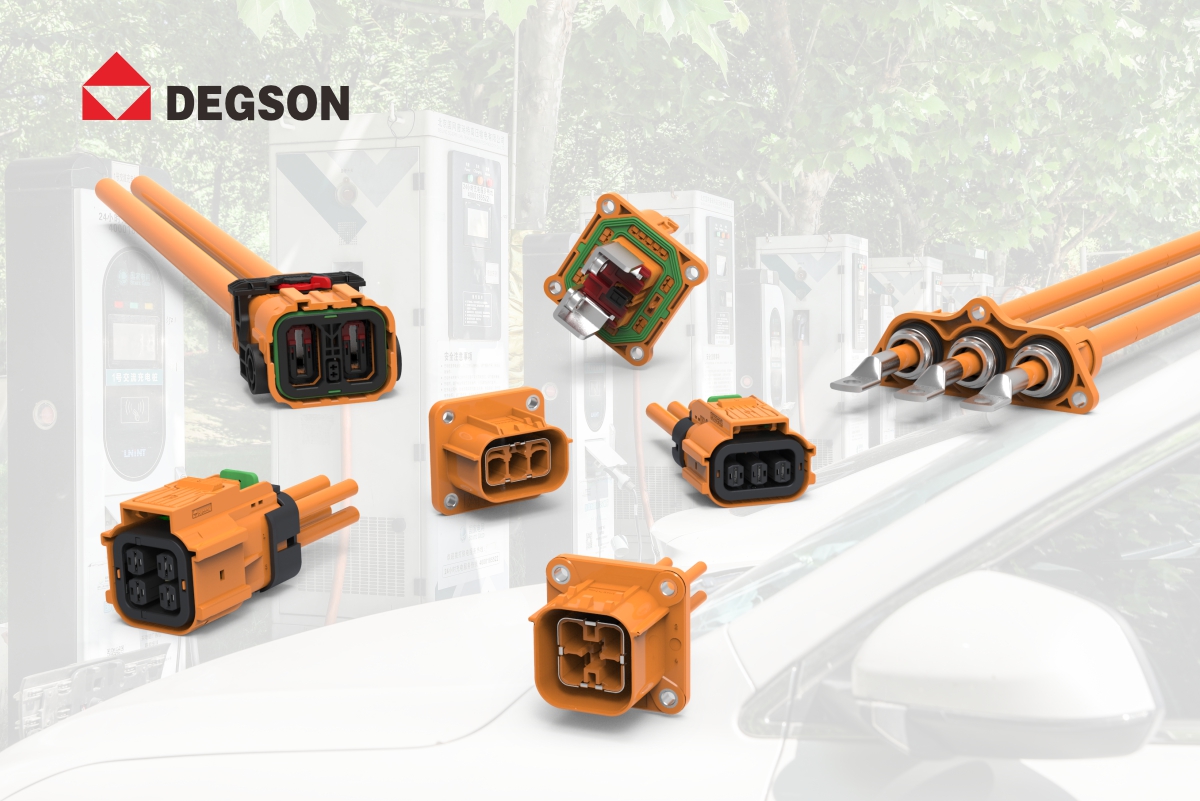
The DEGSON 1800-series features a rated voltage of 1000 V DC, covering full-range current ratings 130 A–280 A for different cable cross-sections: 130 A for 25 mm² cables, 200 A for 35 mm², 250 A for 50 mm², and maximum 280 A for 70 mm². Thanks to such broad current coverage, it can flexibly satisfy power demands of passenger and commercial vehicles, and is applicable to battery-pack internal connections, motor-controller interfaces, as well as input and output terminals of high-voltage distribution units (PDU).
| Cable Cross-section | Current Carrying Capacity | Typical Application |
|---|---|---|
| 25 mm² | 130 A | Battery Pack Internal / PTC |
| 35 mm² | 200 A | Motor Controller / OBC Output |
| 50 mm² | 250 A | PDU Inlet & Outlet Cable |
| 70 mm² | 280 A | Commercial Vehicle High-Power Fast Charging |
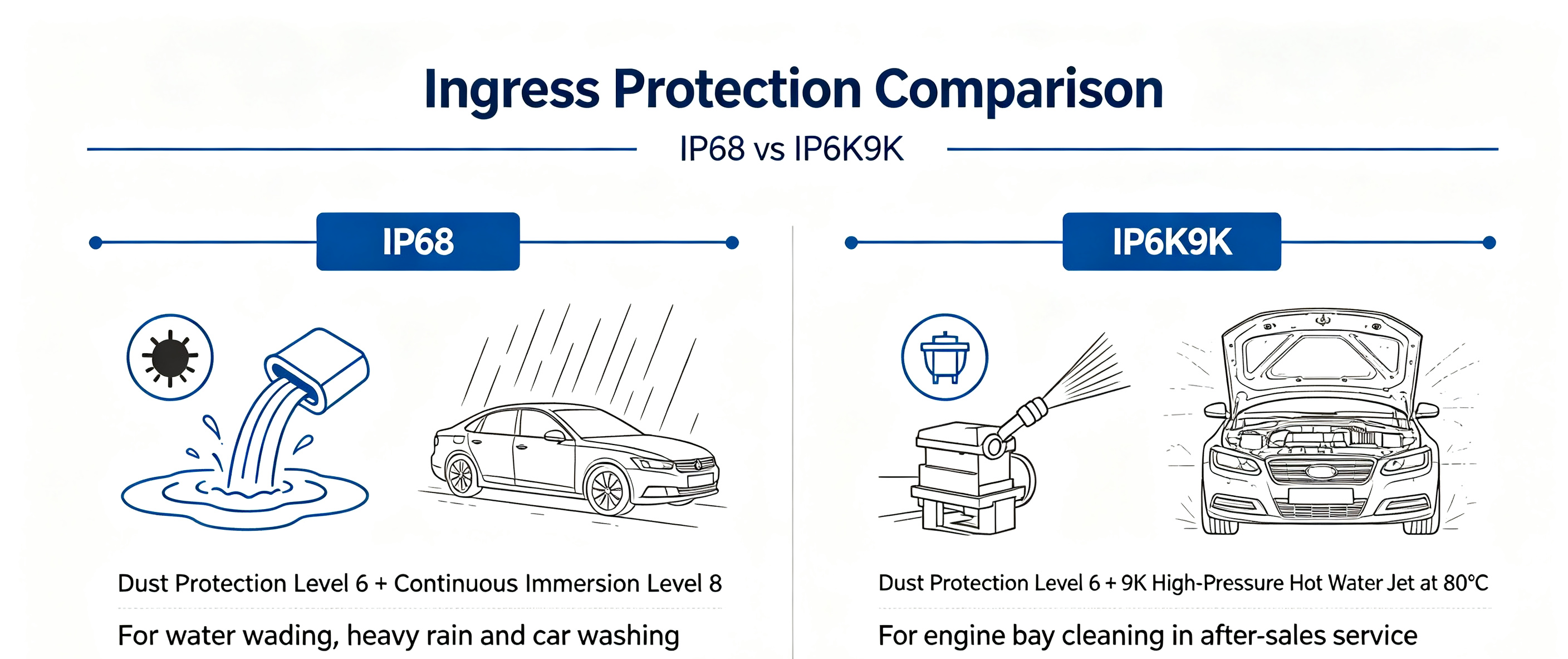
The 1800-series reaches IP68 and IP6K9K protection ratings: IP68 delivers complete dustproof performance and stable operation under continuous water immersion; IP6K9K enables resistance against high-pressure and high-temperature water-jet cleaning. Its operating temperature ranges from −40 °C to +125 °C, and vibration performance complies with USCAR-2 V2. For electrical safety, insulation resistance exceeds 200 MΩ at 1000 V DC. It passes the 3000 V AC / 60 s voltage-withstand test with leakage current below 5 mA. Standard-equipped high-voltage interlock (HVIL) can disable high-voltage output when incomplete mating is detected.
Multiple innovative designs are adopted: the industry-first rotating CPA device achieves better anti-vibration performance compared with conventional push-type structures; secondary locking mechanisms are added to jack contacts to provide dual anti-retention protection for terminals; split clamped rear cable glands are applied, which do not need to be threaded onto cables in advance and reduce production-line losses caused by missing glands. Both 90° and 180° cable-outlet orientations are available to facilitate flexible selection for OEMs.
Conclusion
The trends of high-voltage, intelligent and integrated new-energy vehicles are irreversible. Connector manufacturers need continuous investment in material science, precision manufacturing and simulation verification, to meet the compliance baseline specified by GB/T 37133-2025 and achieve zero-failure reliability under extreme operating conditions. The DEGSON 1800-series is a targeted response to the evolving requirements of high-voltage platforms. For OEMs developing 800 V architectures, selecting fully-validated high-voltage connectors complying with the latest national standards and CCC requirements is not only responsible for product safety, but also a basic commitment to end-users.
If your 800V platform is in search of a high-voltage connector with a rated voltage of 1000V DC, covering the full current range from 130A to 280A, complying with GB/T 37133-2025 and holding CCC certification — whether for internal battery pack connections, motor controller interfaces, or PDU input/output cables — the DEGSON 1800 series delivers a fully validated domestic solution. Technical teams from vehicle manufacturers are welcome to contact DEGSON for samples, selection support and complete certification documentation packages. Let the 1800 series safeguard the high-voltage safety of your 800V platform.
References
[2] State Administration for Market Regulation. GB/T 18384-2020 Safety requirements for electric vehicles[S]. Beijing: China Standards Press, 2020.
[3] National Technical Committee of Auto Standardization. GB/T 20234-2023 Connection devices for conductive charging of electric vehicles[S]. Beijing: China Standards Press, 2023.
[4] China Society of Automotive Engineers. T/CSAE 177-2022 Technical specification of high voltage connectors for electric vehicles[S]. Beijing: China Society of Automotive Engineers, 2022.
[5] National Technical Committee of Auto Standardization. GB/T 28046-2022 Road vehicles — Environmental conditions and testing for electrical and electronic equipment[S]. Beijing: China Standards Press, 2022.
[6] SAE International. SAE J1742: Connections for High Voltage On-Board Electrical Vehicle Wiring[S]. Warrendale: SAE International, 2020.
[7] State Administration for Market Regulation. Announcement of the State Administration for Market Regulation on Issuing the Description of the Compulsory Product Certification Catalogue (No. 50 of 2024)[Z]. 2024.
FAQ
FAQ 1: What are the core technical challenges of high-voltage connectors on an 800V platform compared to a 400V platform?
At 800V, connectors must withstand four challenges including temperature rise, electric arc, vibration and EMC. The peak fast-charging current can hit hundreds of amperes, and temperature rise shall be controlled within 55K. Arc energy generated at disconnection is far higher than that of 400V systems, so HVIL is required to break the circuit within 100ms. The momentary interruption under vibration shall be ≤1μs, while traditional push-type CPA is prone to loosening. High-voltage high-current loops act as strong sources of electromagnetic interference, so shielding design cannot be omitted.
FAQ 2: What new requirements does GB/T 37133-2025 impose on high-voltage connectors? How to verify compliance during selection?
Five key parameters shall be checked: vibration interruption ≤1 μs, temperature rise ≤55 K, insulation resistance ≥100 MΩ, leakage current <5 mA under 3000 V AC withstand test for 60 s, IPXXD protection rating in mated condition and IPXXB protection rating in unmated condition. Starting from January 1, 2026, high-voltage connectors and wiring harness assemblies fall under mandatory CCC certification. Valid CCC certificates from suppliers must be confirmed; otherwise, vehicles cannot be launched for sale.
FAQ 3: What advantages does the rotating CPA of the DEGSON 1800 Series have over conventional push-type CPA?
For traditional push-type CPA, the locking force acts in the same direction as vibration. Fretting wear and locking force degradation will easily occur under prolonged high-frequency vibration. The industry-original rotary CPA adopted by the 1800 series generates locking force perpendicular to vibration direction, achieving remarkably improved vibration resistance. Together with the secondary locking mechanism of socket terminals, it forms dual anti-backoff protection.
FAQ 4: The 1800 Series covers 130A~280A. How to select specifications for different vehicle models?
For reference in matched cable current rating selection: 25mm² (130A, battery pack internal / PTC), 35mm² (200A, motor controller / OBC output), 50mm² (250A, PDU inlet and outlet cables), 70mm² (280A, commercial vehicle high-power fast charging). During selection, a safety margin of 1.2~1.5 times shall be reserved relative to the vehicle's maximum continuous current, with ambient temperature derating taken into consideration. DEGSON can offer selection support according to your voltage platform and peak current.
FAQ 5: What is the difference between IP68 and IP6K9K? Why does the 1800 Series satisfy both ratings?
IP68 stands for dust protection level 6 plus continuous water immersion protection level 8, capable of handling water wading, heavy rain and vehicle washing. IP6K9K refers to dust protection level 6 plus 9K-grade high-pressure hot water spraying at 80℃, designed for after-sales engine compartment cleaning. Traditional connectors usually only satisfy IP67 or IP68 standards. The 1800 series meets both requirements, which ensures reliable sealing during the full lifecycle from assembly to end application and avoids insulation degradation or short-circuit failures induced by water intrusion.


