What Makes High-Voltage Connectors Withstand 1000V? The Invisible Safety Guardians of New Energy Vehicles
What Makes High-Voltage Connectors Withstand 1000V? The Invisible Safety Guardians of New Energy Vehicles
In 2025, new energy vehicles (NEVs) accounted for 50.8% of all new cars sold in China (China Association of Automobile Manufacturers) — one in every two new cars sold is now electric. Yet most people keep their eyes on the "star components" — the battery and the motor — and rarely notice another category of part: the one that quietly carries and safeguards the vehicle's entire high-voltage power flow. When it fails, the result ranges from a stranded car to a serious high-voltage safety hazard. That part is the high-voltage connector. In 2025, more than 50 new models worldwide launched on 800V platforms, and 800V architecture is trickling down from the ¥300,000 premium segment into the ¥150,000 family-car market. This "invisible safety guardian" is becoming the component that defines a vehicle's safety floor.
1. What Is a High-Voltage Connector? The 30-Second Version
A high-voltage connector is the electromechanical component that links the battery pack, power distribution unit, drive motor and other high-voltage parts inside an EV's high-voltage circuit, carrying both power and signals — think of it as the "joint" of the high-voltage circuitry.
"High voltage" has a clearly defined boundary in this industry: under GB 18384-2020, Safety Requirements for Electric Vehicles, any circuit with a maximum working voltage above 60V DC and up to 1,500V DC counts as a Class B voltage circuit — and that is exactly the operating range of a high-voltage connector. By comparison, the 12V electrical system of a conventional combustion car, and ordinary low-voltage connectors, operate at just a few dozen volts. The two differ by an order of magnitude.
Compared with low-voltage connectors, the differences come down to three numbers: voltage jumps to the 1000V class, current jumps to hundreds of amps, and the consequence of failure escalates from "loss of function" to "safety hazard". That explains why it has to meet design standards far stricter than those for an ordinary connector.
2. What Lets It Handle 1000V? Three Hardcore Lines of Defense
Defense Line 1: High-Withstand Insulation Materials
Built on high-density insulating base materials such as PPS, LCP, and high-CTI (Comparative Tracking Index) modified engineering plastics, whose inherent breakdown strength far exceeds 1000V. This rules out direct voltage breakdown of the insulation at the material level — the foundation of any withstand-voltage capability.
Defense Line 2: Clearance (Air Gap)
Adequate air spacing is designed strictly to safety standards, keeping the electric field between conductors at different potentials below the air breakdown threshold. This prevents air ionization, arcing, and short circuits — ensuring the air path will not break down under 1000V.
Defense Line 3: Creepage Distance
Insulating ribs and labyrinth structures extend the insulation path across the surface of the insulator, combined with high tracking-resistance materials, so that moisture and dust cannot form a carbonized conductive path on the insulation surface — blocking surface tracking and discharge failures.
3. Where Are They Used? The Whole Vehicle in One Table
From the battery to the wheels, high-voltage connectors are distributed along the entire high-voltage energy chain, with each position calling for a different current rating:
| Location | Connection Function | Typical Load Profile |
|---|---|---|
| Battery pack ↔ BDU/PDU | Battery output flows into the distribution and disconnect unit | High-current transmission (hundreds of amps) |
| OBC (On-Board Charger) | AC charging energy flows into the battery pack | Sustained charging-power transfer |
| DC-DC Converter | Steps high voltage down to 12V/48V low voltage | Interface between the HV and LV systems |
| PTC Heater / A/C Compressor | Powers cabin heating and cooling | Low-to-moderate current, long operating hours |
| Electric Drive System | Delivers battery power to the motor controller and motor | Peak high current, high-vibration environment |
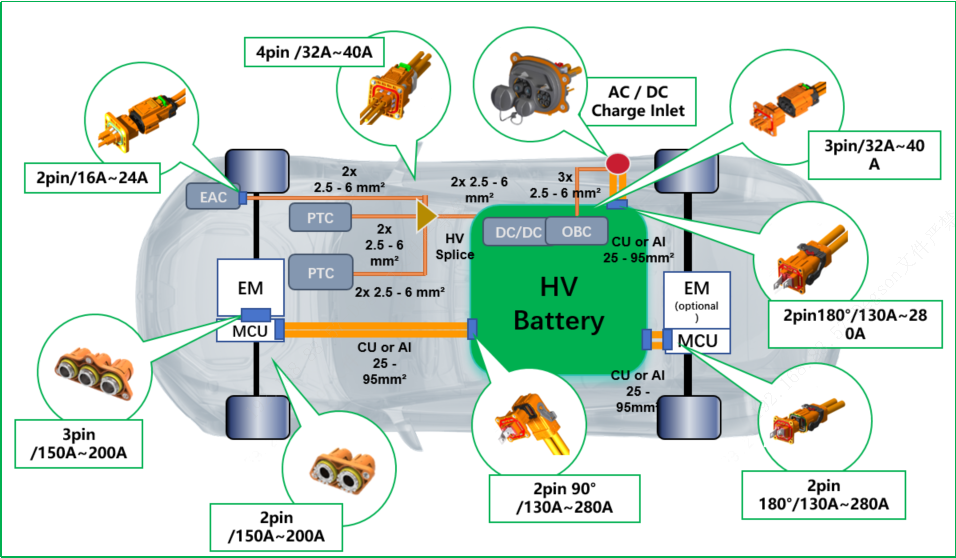
Diagram of high-voltage connector locations on the vehicle
4. How to Choose: Three Core Dimensions
Whether you're an engineer specifying parts or a buyer evaluating them, three dimensions are enough to build a judgment framework: ① Standards — has it passed USCAR-2 and LV215 validation? ② Electrical parameters — do the rated voltage, rated current, and pin count match the circuit requirements? ③ Safety design — is HVIL built in, and does the protection rating reach IP68/IP6K9K/IPXXB?
When selecting on-board high-voltage connectors, many solutions prioritize suppliers' full-range supporting capability and third-party testing resources. DEGSON's on-board high-voltage connector product line is developed in compliance with USCAR-2 and LV215 standards. The product features a rated DC voltage up to 1000 V, with protection ratings of IP68 / IP6K9K / IPXXB:
| Product Series | Pins | Rated Current | Typical Applications |
|---|---|---|---|
| 280 Series | 2 pins | 16A@2.5mm² / 24A@4mm² | OBC, PDU, PTC heater, oil pump, air pump |
| 630 Series | 2/3/4 pins | 32A@4mm² / 40A@6mm² | Battery pack, BDU, PDU, compressor, DCDC (built-in HVIL) |
| 2-Pin 1800 Series | 2 pins | 130A–280A (25–70mm²) | Battery pack, BDU, high-power connections for three-in-one power units (built-in HVIL) |
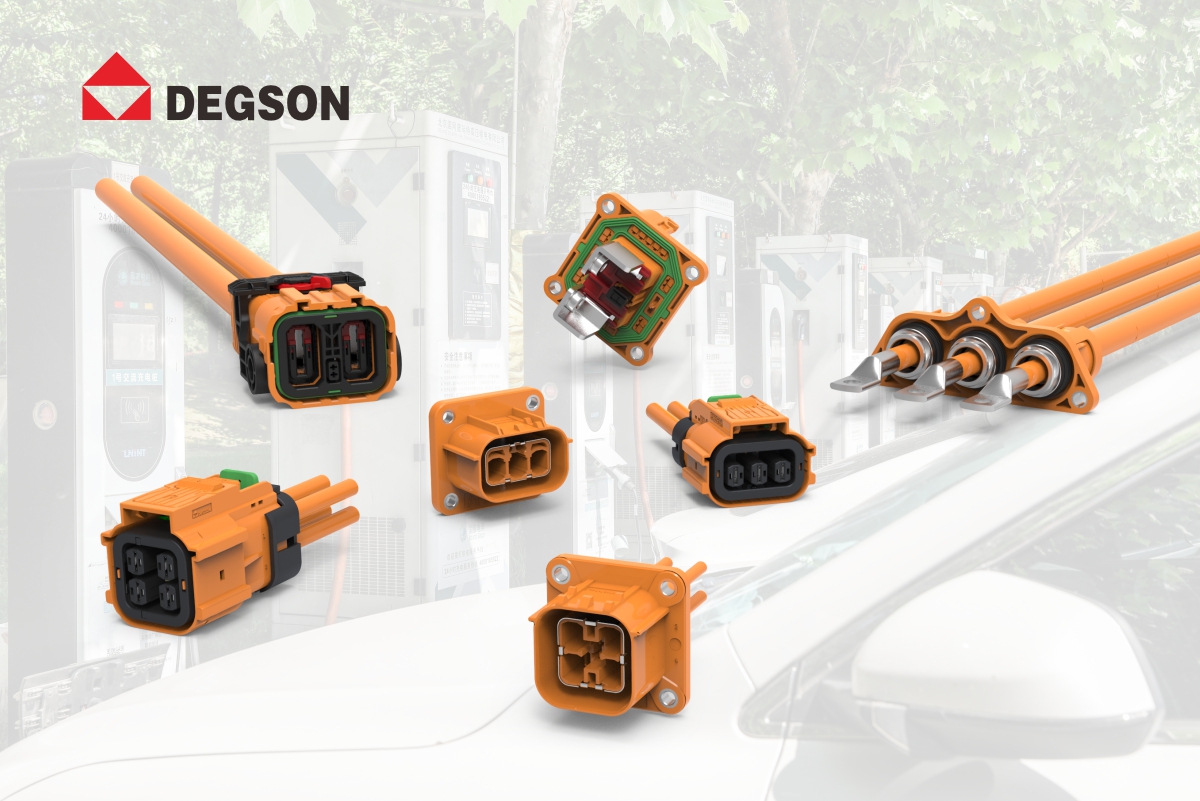
EV high-voltage connector product photo
5. Conclusion: Small Part, Big Safety
The competition in new energy vehicles is often summed up as "battery, motor, electronic control" — but what actually sets a vehicle's safety floor is usually an unassuming part like the high-voltage connector. With a 1000V DC rating, hundreds of amps of current-carrying capacity, and IP68/IP6K9K protection, it holds all three lines of defense in the high-voltage circuit. As 800V platforms accelerate through 2026, the selection criteria for high-voltage connectors — USCAR-2, LV215, HVIL, and protection ratings — deserve to be mastered by every engineer and buyer. Understand those three lines of defense, and you understand the safety floor of an electric vehicle. For product selection, technical consultation, or project supply needs, visit the DEGSON website at https://www.degson.com for professional technical support and service.
References and Data Sources
[2] DEGSON. EV high-voltage connector product pages [EB/OL].
[3] China Association of Automobile Manufacturers. 2025 automobile production and sales data [EB/OL].
[4] Industry media survey. More than 50 new models worldwide launched on 800V high-voltage platforms in 2025 [EB/OL].
[5] USCAR (United States Council for Automotive Research); German OEM joint working group (Audi, BMW, Daimler, Porsche, et al.). USCAR-2 Performance Standard for Automotive Connectors; LV215 High-Voltage Connector Standard [S].
[6] DEGSON. Inauguration of the joint innovation laboratory by CATARC Tianjin and DEGSON [EB/OL].
Frequently Asked Questions
Q1: How is a high-voltage connector different from a low-voltage one?
The differences fall into three dimensions. Voltage: high-voltage connectors work in the Class B range of 60V–1500V DC (GB 18384-2020), while low-voltage connectors are mostly found in 12V/48V systems. Current: high-voltage connectors must carry tens to hundreds of amps. Safety: high-voltage connectors must have HVIL interlocking and IPXXB finger-safe protection by design — a mandatory requirement that low-voltage connectors do not face.
Q2: What is HVIL, and why does it matter?
HVIL (High Voltage Interlock Loop) is a low-voltage signal circuit wired in series inside the high-voltage connector. When the connector is mated or unmated, the interlock signal breaks before the main circuit does; the control system then cuts high-voltage power immediately, eliminating the risk of arcing from live mating or unmating. It is a critical design for both service and everyday safety.
Q3: What new demands do 800V platforms place on high-voltage connectors?
Material requirements: High CTI halogen-free flame-retardant plastic is adopted for insulating housing to reduce the risk of tracking. Terminals use creep-resistant conductors such as chromium zirconium copper with corrosion-resistant plating. Seals are resistant to heat and humidity to block moisture ingress.
Structural requirements: Creepage and clearances are increased, and barrier ribs are added to the housing for electric field optimization to meet partial discharge requirements. Improved contact structure controls temperature rise. Enhanced HVIL, 360° shielding for better EMC performance, and upgraded locking & sealing protection.


