European EV Charging Connector Selection: Application Scenarios and Supplier Evaluation 2026
If you are sourcing charging guns for a European charging-station project, the decision usually gets framed backwards --- teams start by comparing suppliers and their certification logos, when they should start with the charging scenario. Europe's charging market is not one market: a residential wall box, a hotel car park and a highway fast-charge station each need a different connector family and rating class, and a supplier that fits one segment can be the wrong choice for another. EV stock growth keeps demand rising for both Type 2 AC and air-cooled CCS2 DC charging guns under IEC 62196, but "more demand" does not tell you which gun your project actually needs.
So the working order is: pick the connector to the scenario, fix its specification, then judge the supplier on five checks --- certification traceable to the exact part number, quality and field-reliability records, custom-development capability, on-time volume delivery, and local after-sales support. Of those, certification scope is what most often eliminates a candidate: a CE or TÜV mark means little unless the certificate actually lists the model you are quoting. The sections below walk through the three European charging scenarios, the connector specification each one drives, and how to turn those five checks into a short, evidence-based supplier shortlist. Scope note: this covers Type 2 AC and air-cooled CCS2 DC guns for the European market, not liquid-cooled high-current CCS2 or the non-European standards (CCS1, NACS/J3400, CHAdeMO, GB/T); market figures reflect industry trends, not ranking claims.
The three European charging scenarios and the connector each one needs
Before splitting the market into segments, it helps to see how the two European connector families relate, because they are physically related. A Type 2 (IEC 62196-2) AC connector carries seven contacts --- three line conductors (L1/L2/L3), neutral, protective earth, plus the Control Pilot (CP) and Proximity Pilot (PP) signal contacts. A CCS2 Combo 2 (IEC 62196-3) connector reuses the Type 2 upper interface and adds two large DC power contacts (DC+ / DC−) below it, so the same vehicle inlet accepts both AC and DC charging. This shared geometry is why a supplier's AC and DC gun lines often draw on common tooling, but the DC contacts, thermal path and current ratings are engineered separately --- an AC certificate never covers the DC connector.
Residential AC charging
Home wall-box installations account for the largest share of European charging points, dominated by 3.5--7 kW single-phase and up to 11--22 kW three-phase AC hardware. Type 2 (IEC 62196-2) AC connectors are the highest-volume product category here. Selection priorities are the AC current rating (typically 16 A or 32 A), cable flexibility for daily handling, and cost per unit at volume.
Destination and commercial AC charging
Car parks, hotels and shopping-centre sites are the main incremental market for public AC charging. Frequent plug/unplug cycles raise the bar on connector durability, ingress protection (IP54 and above for outdoor use) and long-cycle mechanical performance. Selection here weights mechanical endurance and IP rating more heavily than unit cost.
Highway DC high-power fast charging
CCS2 (IEC 62196-3 Combo 2) is the unified DC fast-charging standard across Europe. Air-cooled CCS2 guns cover the standard and mid-power fast-charge band, while liquid-cooled variants (outside this article's scope) serve the highest continuous-current ultra-fast tier. Selection drivers are continuous DC current, thermal behaviour of the contact and cable, and the temperature-derating curve.
Two supply-chain shifts that change who you can qualify
Beyond the technical segment, two procurement trends affect who European buyers qualify.
First, local-compliant procurement is a rising priority. Buyers increasingly require verifiable product certification, consistent delivery performance and documented alignment with EU regulatory requirements before a supplier reaches the shortlist. A certificate that cannot be traced to the specific part number is treated as no certificate. In practice the European route runs through the harmonised standard EN 62196 (the CENELEC adoption of IEC 62196); CE marking for a charging connector rests on conformity with the applicable directives, and a TÜV certificate documents third-party testing to the standard. What buyers check is not the presence of a logo but the certificate scope: which model, which rating, which test standard version --- and whether that scope actually contains the part number being quoted.
Second, market concentration is growing while ODM/OEM collaboration expands. Larger suppliers are consolidating share, and many hardware brands move toward ODM and OEM partnerships to secure certified components without building connector tooling in-house. This makes a supplier's mould-development and custom-engineering capability a real selection factor, not just a catalogue.
Fix the connector specification before you compare suppliers
Before comparing suppliers, fix the connector specification against the target scenario. Five dimensions drive the decision:
1. Current and voltage rating --- match the AC rating (16 A / 32 A, single- or three-phase 230 V/400 V) or the DC continuous current to the charger output, not to the peak. CCS2 DC ratings must be read together with the derating curve.
2. Ingress protection --- IP54 minimum for outdoor destination and highway sites; confirm the rating applies to the mated and unmated connector as required.
3. Operating temperature range --- verify the datasheet range covers site extremes, and check whether continuous full current requires derating at the low or high end.
4. Mechanical endurance --- plug/unplug cycle life matters most for high-traffic commercial and highway sites; ask for the tested cycle count and the test standard, not a marketing figure.
5. Cable specification --- cross-section and length must match the rated current; longer custom cables and thermal management (air- vs liquid-cooled for DC) change the achievable continuous current.
On the last point, the trade-off between current, cable cross-section and cooling is what separates the DC tiers. An air-cooled CCS2 gun relies on conduction and ambient airflow to move heat away from the contacts and cable, which caps sustained current and keeps cable weight and cost down --- a good fit for the standard and mid-power fast-charge band. Liquid-cooled guns circulate coolant to hold contact temperature down at higher continuous current with a thinner, lighter cable, at the cost of a coolant loop and higher price. Choosing air-cooled for a site whose chargers rarely run at peak avoids paying for a liquid-cooled system that the duty cycle never uses; conversely, specifying air-cooled for a continuous high-current ultra-fast site risks derating in service. This is why the derating curve, not the headline rating, should anchor a DC selection.
Judging the supplier: five checks that actually decide it
Now the supplier comparison. Hardware manufacturers typically weigh five practical checks, and in that order the first one carries the most weight:
- Complete, verifiable product certification traceable to the part number (CE, TÜV and other required EU certificates).
- Consistent long-term product quality and field-reliability records.
- Responsive, flexible custom-development capability (cable length, colour, branding, connector variants).
- On-time high-volume batch delivery performance.
- Localised after-sales support and fast technical response.
Score candidate suppliers on all five rather than on price alone --- a lower unit cost rarely offsets a certification gap or an unstable delivery record on a multi-year charging project.
Where DEGSON fits against these requirements
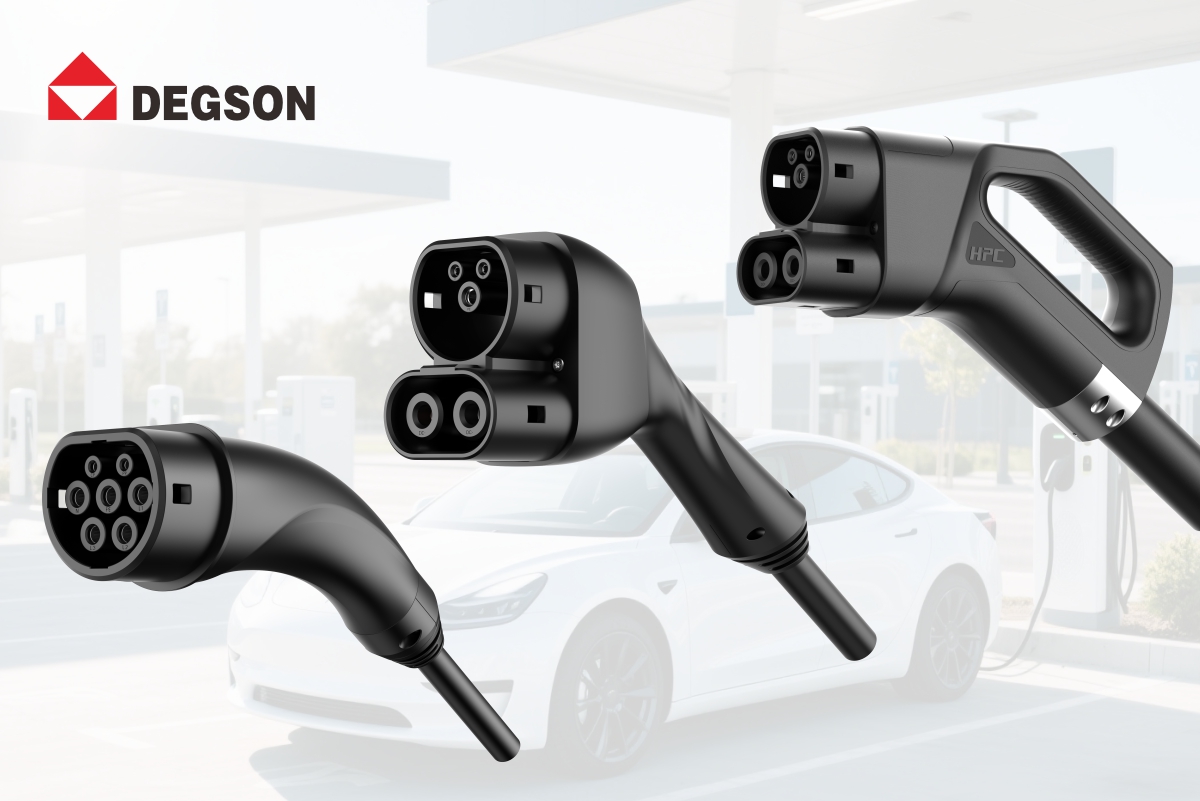
Applying the segment and supplier criteria above, DEGSON covers the European AC and DC charging gun scope as follows:
- Type 2 AC charging guns for residential and commercial AC segments, engineered to typical European wall-box and destination-charging requirements. Confirm the AC current rating and IP class of the specific model against its datasheet.
- Air-cooled CCS2 DC charging guns covering the standard and mid-power highway fast-charge band, within each model's defined performance envelope. Liquid-cooled high-current variants are outside the current air-cooled portfolio.
- Certification and compliance --- European-targeted certifications (CE, TÜV) are issued per specific model configuration; certificate numbers should be verified through the issuing body through the issuing body before project specification.
- Delivery and collaboration --- in-house mould development and established production support both own-brand supply and ODM/OEM cooperation, with volume batch delivery for European projects.
This gives OEMs and integrators a single source spanning both the AC and DC charging gun categories, rather than sourcing each segment separately. Match the target part number to your scenario and request the datasheet and certificate to complete qualification.
Where the European charging connector market is heading
Driven by ongoing EU charging-infrastructure roll-out, European-standard charging gun demand is expected to keep growing over the next three years, with Type 2 AC connectors continuing to represent the major shipment volume. Suppliers with traceable certification, stable product quality and fast customer response are better positioned as the market expands. For charging-pile OEMs, harness integrators and EV system integrators, qualifying European-standard connector suppliers early helps prepare for upcoming project demand.
FAQ
Q1: Are all charging gun models covered by the same CE / TÜV certificate?
No. Certifications are granted per specific model configuration, not per product family. Always cross-check the target part number's certification documents --- and verify the certificate number through the issuing body --- before project specification.
Q2: Do air-cooled CCS2 guns cover liquid-cooled high-current fast charging?
No. Air-cooled CCS2 guns cover the standard and mid-power DC band. Liquid-cooled high-current DC charging is outside the air-cooled portfolio and this article's scope; consult the product datasheet for each model's rated current and derating curve.
References
1. IEC 62196 series --- Plugs, socket-outlets, vehicle connectors and vehicle inlets for conductive charging of electric vehicles (IEC Webstore). https://webstore.iec.ch
2. ACEA --- European Automobile Manufacturers' Association, EV charging infrastructure statistics. https://www.acea.auto
3. IEA --- Global EV Outlook (public statistics). https://www.iea.org
Explore DEGSON's European-standard Type 2 AC and air-cooled CCS2 DC charging gun series at degson.com --- browse the product pages, download datasheets and CAD, or request test reports and samples to complete supplier qualification.


