Explosion Protection Certification in Industrial Equipment: A Practical Guide to ATEX, IECEx and the Ex Marking
Explosion Protection Certification in Industrial Equipment: A Practical Guide to ATEX, IECEx and the Ex Marking
When an equipment datasheet lists "ATEX II 2G" or "Ex d IIC T6 Gb," that claim is only as reliable as the certification behind it. The way to verify it is to read the complete marking string — the Ex code, the gas or dust group, the temperature class, and the Equipment Protection Level (EPL) — and confirm who certified it. This guide explains what explosion protection certification is, how ATEX and IECEx differ, how to cross-check a supplier's claim, and how the certification is applied across industries.
The single most important point: explosion protection is not a "higher grade" of IP protection. IP ratings answer "does water or dust get in?" Explosion protection answers a different question — "can this equipment become an ignition source in an explosive atmosphere?" And ATEX and IECEx are not two dialects of one certificate: they are a European law and an international certification system that share the same technical standards (IEC 60079) but run on different legal and verification paths.
This guide applies to electrical equipment certified under the IEC 60079 series for gas and dust explosive atmospheres — connector housings, junction boxes, terminal blocks, instruments, sensors, motors and control panels — sold into EU (ATEX) and international (IECEx) markets. It does not cover Group I mining-specific detail, non-electrical explosion protection, or hazardous-area classification itself (IEC 60079-10), which is the operator's duty.
What explosion protection certification actually certifies
An explosion needs three components present at once: combustible material, oxygen, and an ignition source. Remove any one and no exothermic reaction occurs. Protection works on three levels: primary protection avoids creating an explosive atmosphere; secondary protection — where most certified equipment operates — removes effective ignition sources (sparks, hot surfaces, arcs, static) through a certified protection type; tertiary protection limits the consequences by design.
Certification therefore does not make equipment "explosion-proof" in the sense of surviving an external blast. It proves, through type testing and factory audits, that the equipment cannot ignite the specific explosive atmosphere it is marked for, under both normal operation and defined fault conditions.
ATEX and IECEx — two systems built on one technical foundation
At a glance, the two systems diverge on every dimension that matters:
| Dimension | ATEX (EU) | IECEx (International) |
|---|---|---|
| Nature | Mandatory EU law — Directive 2014/34/EU | Voluntary international certification system |
| Issued by / market | European Union, CE marking | IECEx, globally recognized (incl. many non-EU countries) |
| Technical basis | EN 60079 series (identical to IEC 60079) | IEC 60079 series |
| Marking | Hexagonal "Ex" + group + category + G/D (e.g., Ex II 2 G) | Ex code + group + temperature class + EPL (e.g., Ex ia IIC T6 Ga) |
| Zone basis | Operator zones per Directive 1999/92/EC (0/1/2, 20/21/22) | Same zone system per IEC 60079-10 |
| Verification | EU-type examination by a Notified Body; the body itself is listed in the EU NANDO database | Certificate issued by an IECEx-accredited body under IECEx 001/002/003; certificate verifiable in the IECEx online database, 3-year validity with annual factory audits |
| Interchangeability | Placing equipment on the EU market requires ATEX | The IECEx–EU agreement lets an IECEx certificate be converted to ATEX without re-testing |
The table hides three points that decide selection. First, one is a law, the other a certificate: ATEX is mandatory for the EU market under the CE regime, while IECEx is a voluntary international system — a part sold into both carries both dossiers. Second, the same test dossier prints two different markings: ATEX marks equipment group, category and atmosphere; IECEx marks protection type, subgroup, temperature class and EPL. Third, they are verified on different paths: ATEX through a Notified Body (NANDO lists the body's accreditation and scope, not the certificate), IECEx through an accredited body with the certificate published in the IECEx online database. Because the standards are identical, the IECEx–EU agreement lets an IECEx certificate be converted into an ATEX certificate without re-testing — but the conversion must still happen; one does not automatically equal the other.
Reading the complete Ex marking — not the word "explosion-proof"
Terms like "explosion-proof" and "EX certified" are inherently ambiguous: they do not say which zone, which gas, which temperature, or which protection concept. The complete marking exists to make exactly that distinction.
Read an IECEx-style marking left to right. Take "Ex d IIC T6 Gb": Ex = certified to IEC 60079; d = flameproof; IIC = usable in all gas subgroups; T6 = max surface temperature 85 °C; Gb = EPL for Zone 1 (and therefore Zone 2, but not Zone 0). For dust the temperature class is replaced by a direct maximum surface temperature — e.g., "Ex ia IIIC 125 °C Da". Read ATEX the same way in a different language: "Ex II 1 G" = ATEX, equipment group II (non-mining), category 1 (for Zone 0/20), atmosphere G (gas). ATEX category and IECEx EPL map one-to-one: 1G = Ga, 2G = Gb, 3G = Gc, 1D = Da.
The protection types, groups and temperature classes at a glance:
| Type | Principle | Typical applications |
|---|---|---|
| d — flameproof | Ignition source may exist; explosion is contained by a type-tested enclosure | Motors, switchgear, high-power electronics |
| e — increased safety | Ignition sources excluded in normal operation | Motors, transformers, luminaires, terminal blocks, junction boxes |
| p — pressurized | Explosive atmosphere excluded by protective gas (Pᵢ > Pₐ) | Machines, motors, control cabinets |
| m / o / q — encapsulation / oil / sand | Ignition source exists but is contained by potting, oil or sand | Electronics, transformers, capacitors, relays |
| i — intrinsic safety | Sparks/thermal effects energy-limited under fault | Measurement & control, sensors, actuators, instrumentation |
| n — non-sparking | Reduced requirements for Zone 2/22 (nA now Ex ec, nL now Ex ic) | Zone 2/22 equipment |
| t — dust enclosure | Prevents dust ingress and surface ignition (IP6X) | Dust atmospheres per 60079-31 |
Gas subgroups run IIA (propane, lowest hazard) → IIB (ethylene) → IIC (hydrogen, acetylene, highest); dust subgroups IIIA (flyings) → IIIB (non-conductive, e.g. flour) → IIIC (conductive, e.g. aluminum). Temperature classes T1–T6 map to a maximum surface temperature of 450 °C down to 85 °C, which must stay below the atmosphere's ignition temperature.
Cross-check a supplier claim in three steps — and the five errors to avoid
The check needs no special access — a datasheet, a certificate and a certification database are enough.
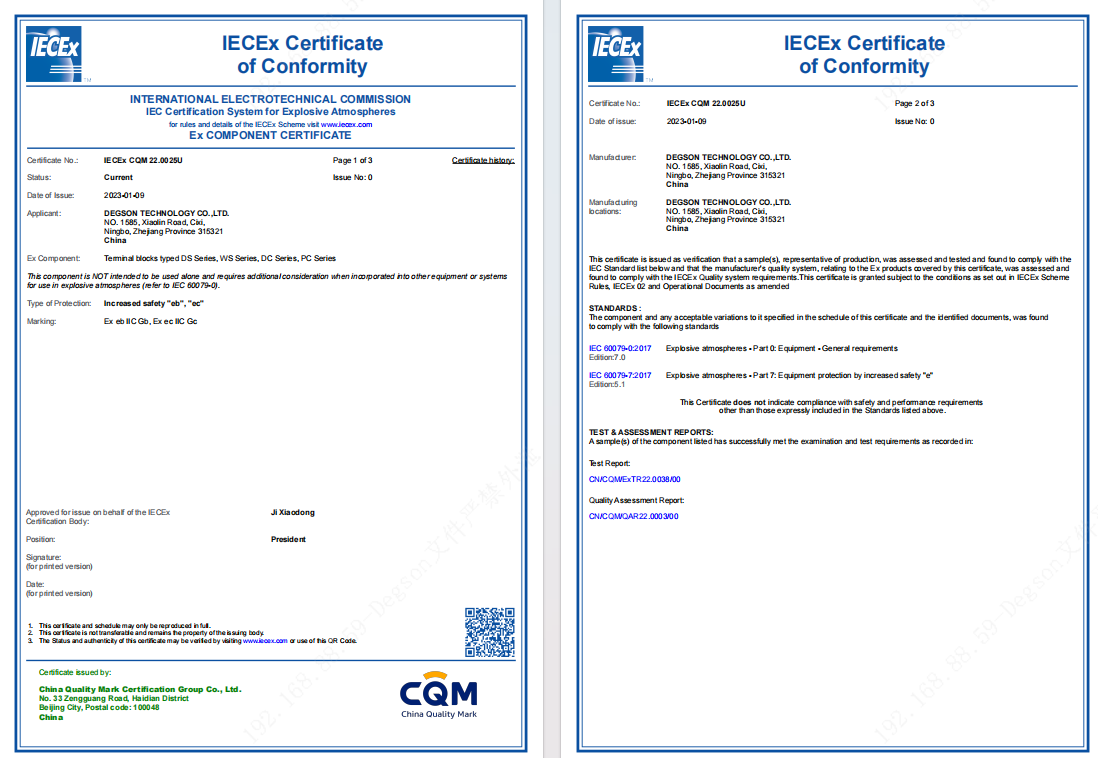
Get the complete marking, the system it belongs to, and who certified it. "Ex d IIC T6 Gb" without a certificate number is half a claim — and so is an ATEX marking with no Notified Body behind it. Ask for the full string, the certificate number, and the certifying body (a Notified Body for ATEX; an IECEx-recognized body for IECEx). If the supplier cannot produce a certificate, treat the claim as unverified.
Verify segment by segment against the actual environment. Zone first — an Ex d Gb device is not certified for Zone 0. Then gas/dust group — a IIB product cannot be used where hydrogen (IIC) is present. Then temperature class — a T3 device (200 °C) is invalid where the gas ignites at 135 °C (T4 territory). Then the whole assembly: an Ex d enclosure loses its certification with a non-certified cable gland, and an intrinsic safety loop is only as safe as its weakest parameter match.
Check the evidence in the right system. For EU-bound equipment, confirm the certificate traces to a Notified Body whose scope covers it (the body is listed in NANDO) and that the equipment carries both CE and Ex marks. For IECEx, verify the certificate in the IECEx online database (iecex.iec.ch) and confirm it matches the current design revision. For China, check the domestic explosion-proof certificate under GB 3836 (identical to IEC 60079) from CNEX or PCEC.
An Ex certificate describes what a specific tested configuration and loop survived, not what every configuration will survive. Five recurring errors follow from missing that:
Assuming IP68 makes a product explosion-proof. IP ratings verify ingress of solids and liquids only — nothing about ignition capability. IP is a supporting requirement inside IEC 60079-0, never a substitute for Ex certification.
Treating "designed to meet Ex" as certified. Self-declared ratings are verified by no one. Ex claims require type examination plus ongoing factory audits; a rating claimed only in the datasheet is a marketing statement.
Reading the temperature class backward. T6 (85 °C) can be used in all gas atmospheres, but T1 (450 °C) cannot be used where the gas ignites below 450 °C. Selecting "the most common class" without checking the ignition temperature is a field error certification cannot fix.
Mismatching group, EPL and zone. A 2G/Gb device is not certified for Zone 0; a IIB device cannot be installed where IIC gases are present. Every segment of the marking is a boundary condition, not decoration.
Rating the system by its best component. An Ex d enclosure with a non-certified cable gland is not an Ex d system. An intrinsic safety loop in which the field device's Ui/Ii/Pi/Ci/Li do not satisfy Uo/Io/Po/Co/Lo of the associated apparatus is not intrinsically safe. The finished installation inherits the weakest certified link.
Materials, installation and where the certification is applied
A certificate is earned on new parts under laboratory conditions; field performance depends on materials, installation and maintenance. Cable entries are where certification fails most often — use certified flameproof glands for Ex d, sealed entries for Ex e, and close unused entries with certified blanking plugs. Intrinsic safety is a system property, not a device property: per IEC 60079-11 and 60079-14 the user must document the assessment so the field device's input parameters satisfy the associated apparatus's output parameters (Ui ≥ Uo, Ii ≥ Io, Pi ≥ Po, Ci ≥ Co + Cc, Li ≥ Lo + Lc, including cable capacitance and inductance). And inspection is a legal duty: IEC 60079-17 defines scheduled inspections — a modified or poorly maintained certified part is unrated in service.
Certification is not a niche: any facility handling flammable gases, vapors, mists or combustible dusts must zone its hazardous areas and fit certified equipment.
| Industry | Typical explosive environment | Typical zones | Common equipment & types |
|---|---|---|---|
| Oil & gas (upstream, refining, stations) | Hydrocarbons, H₂S, gasoline vapor | 0/1/2 | Ex d motors & switchgear, Ex e junction boxes, Ex i instruments |
| Chemical & petrochemical | Solvents, ethylene, acetylene, hydrogen | 0/1/2 | Ex i transmitters, Ex d control panels, Ex e terminal blocks |
| Pharmaceutical | Solvent vapors + combustible dusts | 1/2, 21/22 | Ex t motors, Ex i sensors, Ex e lighting |
| Food & grain processing | Flour, sugar, starch dust | 20/21/22 | Ex t enclosures (IP6X), Ex i level sensors |
| Wastewater treatment | Methane (biogas) | 1/2 | Ex e pumps, Ex d generators, Ex i monitoring |
| New energy — hydrogen & charging | Hydrogen (IIC, T1 ignition) | 1/2 | Ex d compressors, Ex i instrumentation, Ex e connectors |
| Semiconductor & electronics | Specialty gases (silane, phosphine) | 1/2 | Ex i monitoring, Ex e distribution |
The selection logic is the same in any industry: the operator classifies the zone (per 1999/92/EC and IEC 60079-10) → the zone fixes the required EPL → the substance fixes the gas/dust group → the ignition temperature fixes the temperature class → the equipment type fixes the protection type. Only then does a marking like "Ex d IIC T6 Gb" mean anything.
How DEGSON applies this to component selection
The method above has nothing to do with the brand. For instruments, signal conditioning and connection technology, DEGSON follows the same sequence: confirm the complete marking of the exact component — the rating of an increased-safety DIN rail connector holds only when its parameters match the certified loop — verify the EPL, group and temperature class against the environment, and check the certificate in the system it was issued under.
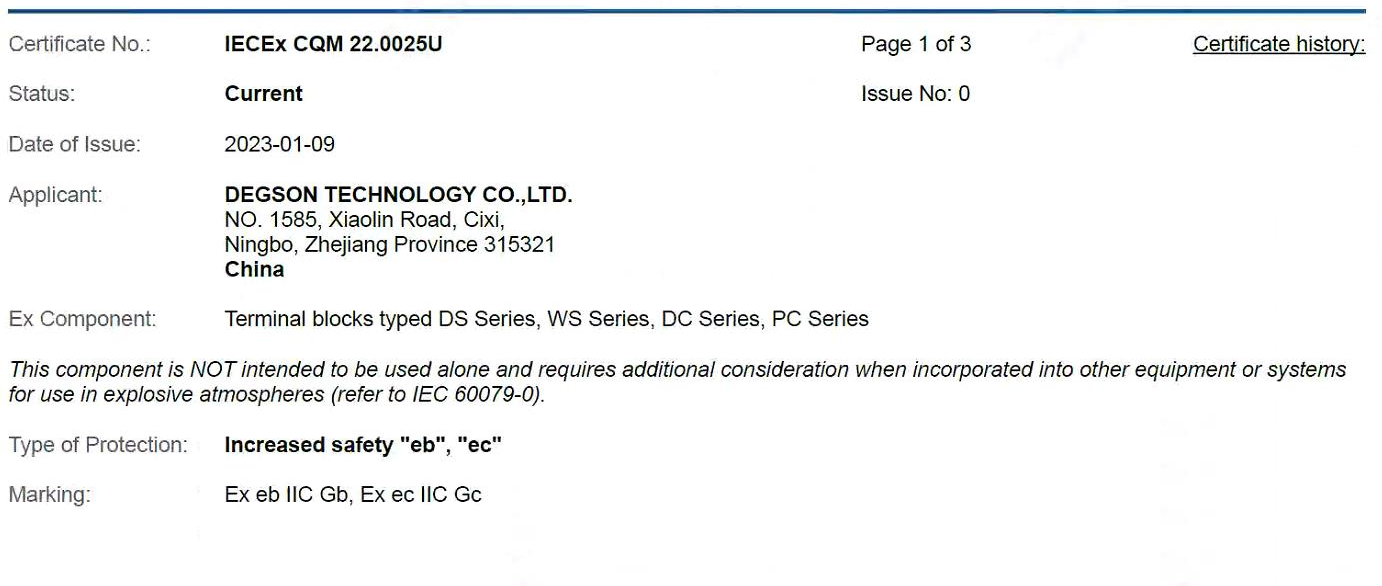
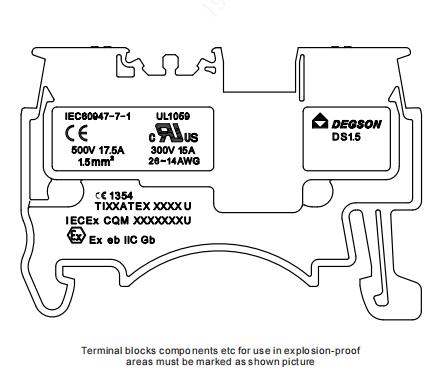
A concrete instance makes the rule specific. The DEGSON DIN rail connector DS1.5-01P-1Y-00Z(H) is marked "Ex eb IIC Gb, Ex ec IIC Gc" under ATEX: eb = increased safety at the higher level "b" (single-fault tolerant, Zone 1 and 2); ec = level "c" (Zone 2); IIC = gas group covering hydrogen and acetylene; Gb/Gc = the EPL for Zone 1 and Zone 2. Before designing this part into a Zone 1 installation, ask DEGSON for the ATEX/IECEx certificate number and issuing body, and verify the Notified Body's scope in NANDO or the certificate in the IECEx database (iecex.iec.ch) — rather than relying on the word "EX" alone.
FAQ
Q1: Can an IP68 connector be used in a hazardous area?
No. IP ratings certify only ingress of solids and liquids; they contain no information about ignition capability, surface temperature, or fault behavior. Hazardous areas require equipment certified to IEC 60079/GB 3836 with the correct protection type, group, temperature class and EPL. IP is a supporting requirement inside 60079-0, not a substitute.
Q2: The datasheet says "Ex" but gives no certificate number. How do I treat it?
As unverified. A valid Ex claim includes the certificate number and the issuing body — a Notified Body for ATEX (whose accreditation scope is listed in NANDO) or an IECEx-recognized body (certificate traceable in the IECEx database, 3-year validity with annual factory audits). Ask for the certificate and confirm it matches the current design revision.
Take the next step
Before you design in an instrument, junction box or connector for a hazardous area, ask the supplier for the complete Ex marking — protection type, group, temperature class and EPL, or the full ATEX group/category/atmosphere string — plus the certificate number and issuing body, then verify the claim segment by segment, component by component, against the zone, substance and ignition temperature the equipment will actually see. To evaluate DEGSON explosion-protection parts this way, browse the Ex range on www.degson.com and request the certificate and intrinsic-safety parameters for the exact part and loop configuration you intend to use.


