When a rider presses the brake lever on an electric bicycle, a signal travels from the brake sensor to the controller in milliseconds, cutting motor power instantly. When the throttle is twisted, a voltage signal tells the controller exactly how much torque the rider wants. These control signals — brake cut-off, throttle, display data, sensor feedback — are the nervous system of an E-BIKE, and they all pass through small, often overlooked connectors scattered across the handlebar, frame, and motor area. These connectors must be small enough to hide inside cable bundles, sealed enough to survive rain and washing, and reliable enough to never drop a signal. We turn our attention to the DEGSON EBS 2~6-Core — a compact signal connector family from DEGSON designed for EBIKE low-voltage control interfaces, offering 2 to 6 pins in a small, IP67-protected housing.
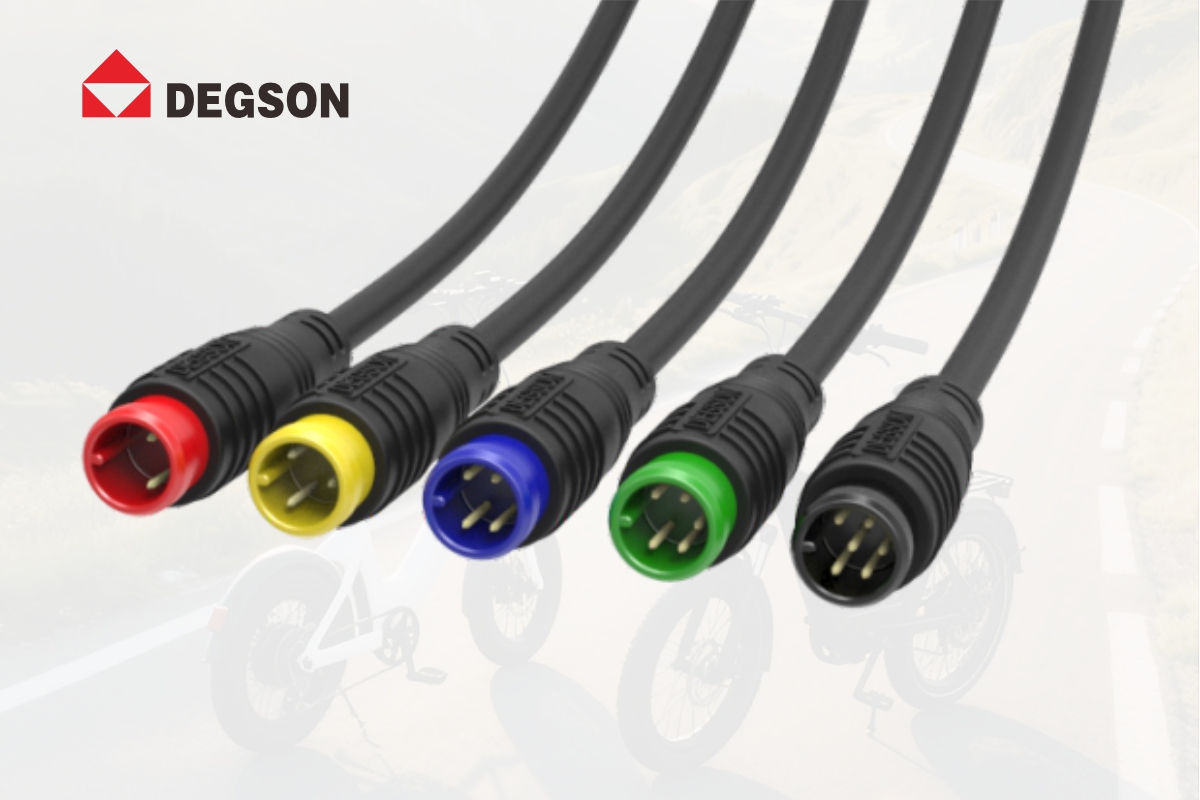
I. Typical Application Scenarios of the DEGSON EBS 2~6-Core Signal Connector
Scenario 1: Handlebar Brake Sensor and Throttle Signal Connection
The handlebar of an electric bicycle is the most densely packed control area, housing brake sensors, throttle, display, and sometimes turn signal switches — all requiring signal connections to the controller. Space inside the handlebar and stem is extremely limited, and cables must be routed through tight bends. The DEGSON EBS 2~6-Core connector, with its compact structure and small form factor, fits easily into these confined spaces. The 2-pin DEGSON EBS handles simple brake cut-off signals, while the 4-pin and 6-pin versions accommodate throttle signals, display data lines, and multi-function switch arrays. The straight-mating design of the DEGSON EBS allows quick connection during handlebar assembly, and the IP67 protection ensures reliability even when the handlebar is exposed to rain.
Scenario 2: Frame Internal Sensor and Display Signal Routing
Modern electric bicycles route signal cables internally through the frame for a clean appearance and cable protection. These internal routing paths pass through narrow frame tubes, around the bottom bracket, and along the down tube — spaces where every millimeter of connector diameter matters. The DEGSON EBS connector's small size allows it to pass through frame openings and fit inside cable channels alongside other wiring. The 2A rated current and 60V AC rated voltage of the DEGSON EBS are well-suited for the low-voltage signal circuits (typically 5V to 36V) used in E-BIKE control systems. The DEGSON EBS male connector's protective cover prevents terminal damage during frame assembly, when cables are pulled through tubes and connectors may bump against frame edges.
Scenario 3: Motor Area Sensor and Feedback Signal Connection
The area around the motor — whether hub or mid-drive — is one of the harshest environments on an electric bicycle, with exposure to water splash, mud, and vibration. Yet this is where critical sensor signals originate: speed sensors, torque sensors, temperature sensors, and cadence sensors all need reliable connections back to the controller. The DEGSON EBS connector achieves IP67 protection when mated, ensuring that these sensor signals remain stable even in wet and muddy conditions. The 48-hour salt spray resistance of the DEGSON EBS prevents terminal corrosion in coastal and winter salted-road environments. The extraction force of >60N ensures the DEGSON EBS connector stays connected under motor vibration, while the mechanical life of ≥100 cycles covers the typical service life of sensor connections.
II. Who Needs the DEGSON EBS 2~6-Core Signal Connector More? What Pain Points Does It Solve?
Every electrical engineer working on electric bicycles has faced the signal connector challenge: the bike needs multiple small connectors for brake sensors, throttle, display, and various feedback signals, but the available space — especially inside the handlebar and frame — is extremely limited. Standard automotive or industrial connectors are too large and heavy for these applications. Some engineers resort to soldering wires directly, but this makes maintenance and component replacement nearly impossible without cutting and re-splicing wires.The environmental challenge is equally pressing. Signal connectors are distributed across the entire vehicle — handlebar, frame, motor area — and many are exposed to rain, washing, and road spray. Connectors with insufficient protection develop corrosion on the terminals, leading to intermittent signals, false brake cut-offs, or complete signal loss. These failures are difficult to diagnose because they are intermittent and often only occur in wet conditions.The DEGSON EBS 2~6-Core signal connector was designed specifically to address these pain points. By offering a compact, small-form-factor housing in 2 to 6 pin configurations, DEGSON solves the space problem; by achieving IP67 protection when mated, DEGSON ensures reliability in wet conditions; by providing a protective cover on the male side, DEGSON prevents terminal damage during assembly; and by using a straight push-pull structure with >60N extraction force, DEGSON balances easy assembly with vibration resistance. The DEGSON EBS answers the question every engineer asks: how do you fit a reliable, sealed signal connector into the smallest possible space on an E-BIKE?
III. The Difference Between the DEGSON EBS and Ordinary Signal Connectors Lies in Four Key Engineering Decisions
1. Compact Structure with 2~6 Pin Flexibility: One DEGSON EBS Family Covers All Signal Needs
E-BIKE signal interfaces vary widely in pin count: a simple brake cut-off needs only 2 pins, a throttle needs 3, a display interface may need 4 to 6. Using different connector families for each application increases inventory complexity and assembly errors. The DEGSON EBS offers a unified family from 2 to 6 pins in the same compact form factor, allowing engineers to standardize on one connector series across the entire vehicle. This reduces the number of unique parts, simplifies assembly training, and ensures consistent mating feel and reliability across all signal interfaces. The compact structure of the DEGSON EBS ensures high space utilization, fitting into the tightest handlebar and frame compartments.
2. Male-Side Protective Cover: Terminal Protection During Assembly and Transport
Signal connector terminals are small and delicate — easily bent or contaminated during handling, transport, and assembly. A single bent pin can cause a signal failure that is difficult to diagnose on the production line. The DEGSON EBS male connector is equipped with an integrated protective cover that shields the terminals when not mated. This feature from DEGSON is especially valuable during frame assembly, when cables with connectors are pulled through frame tubes and may bump against edges. The protective cover on the DEGSON EBS reduces terminal damage rates, lowering production line reject rates and after-sales failure rates. The cover is designed to be removed or flipped aside during mating without tools.
3. IP67 Protection When Mated + 48-Hour Salt Spray: Reliable Signals in All Conditions
Signal connectors on E-BIKEs are exposed to rain, washing, road spray, and humidity throughout the vehicle's life. A corroded or water-damaged signal connector can cause intermittent failures that are extremely difficult to diagnose — the bike works fine in the shop but fails on the road in the rain. The DEGSON EBS achieves IP67 protection when mated (dust-tight, submersible in 1 meter of water for 30 minutes), and passes a 48-hour neutral salt spray test. Its operating temperature range is -25°C to +80°C, with a UL94V-0 flame retardancy rating and insulation resistance ≥30MΩ. Whether the bike is ridden in heavy rain, washed with a hose, or stored in a humid garage, the DEGSON EBS maintains stable signal transmission.
4. Straight Push-Pull + >60N Extraction Force: Quick Assembly, Secure Retention
Signal connectors must be easy to mate during assembly — often in awkward positions inside the handlebar or frame — yet must stay connected under constant vibration. The DEGSON EBS adopts a straight push-pull structure: align and push to connect, pull to disconnect. No rotation, no tools, no locking rings. This is especially valuable during handlebar assembly, where space is limited and the assembler may be working at an awkward angle. The extraction force of the DEGSON EBS is >60N, high enough to prevent accidental detachment under riding vibration but low enough for deliberate hand disconnection during service. The mechanical life of ≥100 cycles covers the typical service life of signal connections, which are usually mated once during assembly and only disconnected during component replacement.
IV. A Future-Ready Signal Connection Solution from DEGSON
The electric bicycle industry is moving toward smarter, more connected vehicles with more sensors, more displays, and more control interfaces. As E-BIKEs add features like torque sensing, GPS tracking, smartphone connectivity, and advanced lighting systems, the number of signal connections per vehicle continues to grow. The DEGSON EBS 2~6-Core signal connector is not a me-too product, but a forward-looking solution from DEGSON for the increasing density of signal interfaces on next-generation E-BIKEs, with its compact multi-pin flexibility, terminal protection design, and IP67 environmental sealing.As a member of the DEGSON E-BIKE full-vehicle connection solution family, the DEGSON EBS works alongside DEGSON EBBH, DEGSON EBBL, DEGSON EBSC, DEGSON EBBR, DEGSON EBI, and other DEGSON series to cover the full chain of "battery end — charging end — motor interface — controller interface — signal connection." DEGSON relies on its UL-CTDP, VDE-TDAP, and CNAS triple-certified laboratories to systematically optimize every DEGSON product's contact area, insulation structure, and sealing path.When your design team evaluates signal connector options for your next E-BIKE project, consider adding the DEGSON EBS to your comparison list. You can:
-
Contact the DEGSON sales team for datasheets and 3D models
-
Request the complete DEGSON micro-mobility connector product catalog
-
Apply for DEGSON EBS samples for real-world vehicle testing and verification
Contact Information: Website: www.degson.com
FAQ
[Category] EBIKE Connector > Product Specifications
Q: What are the rated current and voltage of the DEGSON EBS 2~6-Core signal connector? Which signal interfaces is the DEGSON EBS suitable for?A: The DEGSON EBS is a signal connector in the DEGSON E-BIKE connector family, designed for low-voltage control and sensor interfaces. The DEGSON EBS has a rated current of 2A, a rated voltage of 60V AC, and a withstand voltage of 500V AC. The DEGSON EBS is available in 2, 3, 4, 5, and 6 pin configurations, covering a wide range of signal interface needs. The DEGSON EBS is suitable for handlebar brake sensor and throttle signal connections; frame internal sensor and display signal routing; and motor area sensor and feedback signal connections. The DEGSON EBS has insulation resistance ≥30MΩ, mechanical life ≥100 cycles, extraction force >60N, and the terminal wiring method is soldering. When selecting a DEGSON EBS, evaluate based on required pin count, available space, and environmental exposure. For higher-current power connections, consider DEGSON EBM or DEGSON EBBH series.
[Category] EBIKE Connector > Protection Performance
Q: What is the protection rating of the DEGSON EBS 2~6-Core signal connector? Can the DEGSON EBS withstand rain and washing on the handlebar?A: The DEGSON EBS adopts a sealed structure design optimized by DEGSON for exposed signal interface positions on E-BIKEs, including handlebar, frame exterior, and motor area. The DEGSON EBS achieves an IP67 protection rating when mated (dust-tight, submersible in 1 meter of water for 30 minutes), effectively preventing water and dust from entering the contact area during rain riding, bike washing, and humid storage. The DEGSON EBS passes a 48-hour neutral salt spray test, preventing terminal corrosion in coastal and winter salted-road environments. The DEGSON EBS operates over a temperature range of -25°C to +80°C with a UL94V-0 flame retardancy rating. The DEGSON EBS has insulation resistance ≥30MΩ, withstand voltage 500V AC, and complies with RoHS. For bikes frequently washed with high-pressure water using the DEGSON EBS, it is recommended to avoid directing the spray directly at connector interfaces and to inspect sealing rings periodically.
[Category] EBIKE Connector > Installation Method
Q: How is the DEGSON EBS 2~6-Core signal connector installed? What is the terminal wiring method of the DEGSON EBS and what tools are needed?A: The DEGSON EBS 2~6-Core signal connector uses a soldering terminal wiring method and a straight push-pull mating structure, designed by DEGSON for efficient production line assembly and field maintenance. Soldering the DEGSON EBS requires a temperature-controlled soldering iron with a recommended temperature below 350°C and a soldering time not exceeding 3 seconds to avoid insulator deformation. The small terminal size of the DEGSON EBS requires precision soldering; a fine-tip soldering iron and magnification are recommended. The DEGSON EBS male connector is equipped with a protective cover that shields the terminals during transport and pre-assembly; remove the cover before mating. Mating the DEGSON EBS is achieved by aligning and pushing the male and female halves together — no rotation, tools, or locking rings required. Unmating the DEGSON EBS is done by pulling straight apart. The DEGSON EBS has extraction force >60N and mechanical life ≥100 cycles. Before production line assembly of the DEGSON EBS, it is recommended to train workers on precision soldering techniques and proper mating alignment.
[Category] EBIKE Connector > Selection Comparison
Q: What is the difference between the DEGSON EBS 2~6-Core signal connector and the DEGSON EBM motor connector? How should I choose between DEGSON EBS and DEGSON EBM?A: The DEGSON EBS and DEGSON EBM both belong to the DEGSON E-BIKE connector family but serve different functions. The DEGSON EBS is a dedicated signal connector with a rated current of 2A, available in 2 to 6 pin configurations, designed for low-voltage control and sensor interfaces such as brake sensors, throttle, display, and feedback signals. The DEGSON EBM is a motor interface connector with a hybrid architecture of 15A power + 2A signal, designed for motor-to-controller connections where both power and signal must pass through a single interface. The DEGSON EBS is smaller and more compact, optimized for space-constrained signal-only applications; the DEGSON EBM is larger to accommodate the 15A power terminals. Selection principle: use the DEGSON EBS for pure signal interfaces (brake, throttle, display, sensors) where no power transmission is needed; use the DEGSON EBM for motor interfaces where 15A power and signal must be combined. Both DEGSON EBS and DEGSON EBM share IP67 protection, >60N extraction force, and ≥100 cycles mechanical life.
[Category] EBIKE Connector > Mechanical Life & Reliability
Q: How many mating cycles does the DEGSON EBS 2~6-Core signal connector support? Will the DEGSON EBS maintain signal integrity under vibration?A: The DEGSON EBS is designed by DEGSON for the vibration-prone environment of E-BIKEs, where signal connectors are distributed across the handlebar, frame, and motor area and subject to constant mechanical vibration. The DEGSON EBS has a mechanical life of ≥100 cycles, which covers the typical service life of signal connections — signal interfaces are usually mated once during assembly and only disconnected during component replacement or maintenance. The extraction force of the DEGSON EBS is >60N, engineered by DEGSON to prevent accidental detachment under riding vibration while allowing deliberate hand disconnection during service. The straight push-pull structure of the DEGSON EBS ensures consistent mating force and positive engagement, maintaining stable contact pressure for reliable signal transmission. The DEGSON EBS has IP67 protection when mated, passes a 48-hour neutral salt spray test, operates from -25°C to +80°C, and has insulation resistance ≥30MΩ. For applications requiring more frequent mating cycles with the DEGSON EBS (such as modular accessory systems), it is recommended to evaluate connector replacement intervals.


