How PUSH-SNAP Spring Connection Technology Redefines Tool-Free PCB Wiring Efficiency | DEGSON
1. Pain Point Analysis: Why Traditional Spring Wiring Fails Modern Smart Manufacturing
In electrical connection applications, wiring efficiency, operational convenience and connection reliability are core requirements for industrial automation, new energy, smart buildings and intelligent equipment industries. Under the popularization of Industry 4.0 mass production, wiring efficiency directly determines production capacity and labor costs. The selection of PCB terminal blocks has become a strategic factor that critically affects equipment Overall Equipment Effectiveness (OEE), downtime duration and Total Cost of Ownership (TCO).
Traditional push-in spring terminals eliminated screw locking structures and reduced single-point wiring time from 10–15 seconds to 4–6 seconds, once serving as the mainstream solution for mass PCB wiring. Nevertheless, with continuously upgraded manufacturing standards, complex working conditions and higher efficiency demands, their inherent weaknesses have become prominent, failing to meet the refined, high-efficiency and high-reliability requirements of high-end smart manufacturing.
The biggest technical drawback is poor compatibility with fine-stranded flexible wires. Traditional push-in terminals require wire ferrules to secure reliable contact when connecting fine flexible wires. Without ferrules, scattered fine copper strands easily cause incomplete contact, increased resistance and equipment overheating risks. Additional crimping procedures bring extra working hours, material and tool costs, as well as extra quality control procedures, resulting in substantial cumulative losses for mass-production manufacturers.
Traditional push-in technology also faces obvious efficiency bottlenecks. Operators must overcome spring tension during insertion, which causes severe hand fatigue after long-term high-frequency operation. Uneven insertion depth leads to inconsistent wiring quality and hidden poor contact risks. Such latent faults usually break out after equipment field operation, bringing extremely high maintenance and rework costs for new energy and industrial automation enterprises.
Insufficient configuration flexibility is another critical shortcoming. Most traditional spring terminals adopt fixed-pin integrated structures with limited customization capability. Matching circuits with different port specifications requires splicing multiple terminal units, which wastes PCB space, increases material categories and inventory pressure, and extends delivery cycles. It cannot adapt to the current industry trend of rapid product iteration and shortened time-to-market.
Moreover, traditional terminals have no built-in error correction or verification mechanisms. Wiring quality is judged merely by manual visual inspection and tactile feeling. Missed wiring, incomplete insertion and poor contact are easily overlooked in high-speed production, causing rework, test failures and field equipment malfunctions. Post-fault troubleshooting and repair costs far exceed front-end quality control investment, hindering manufacturing efficiency improvement.
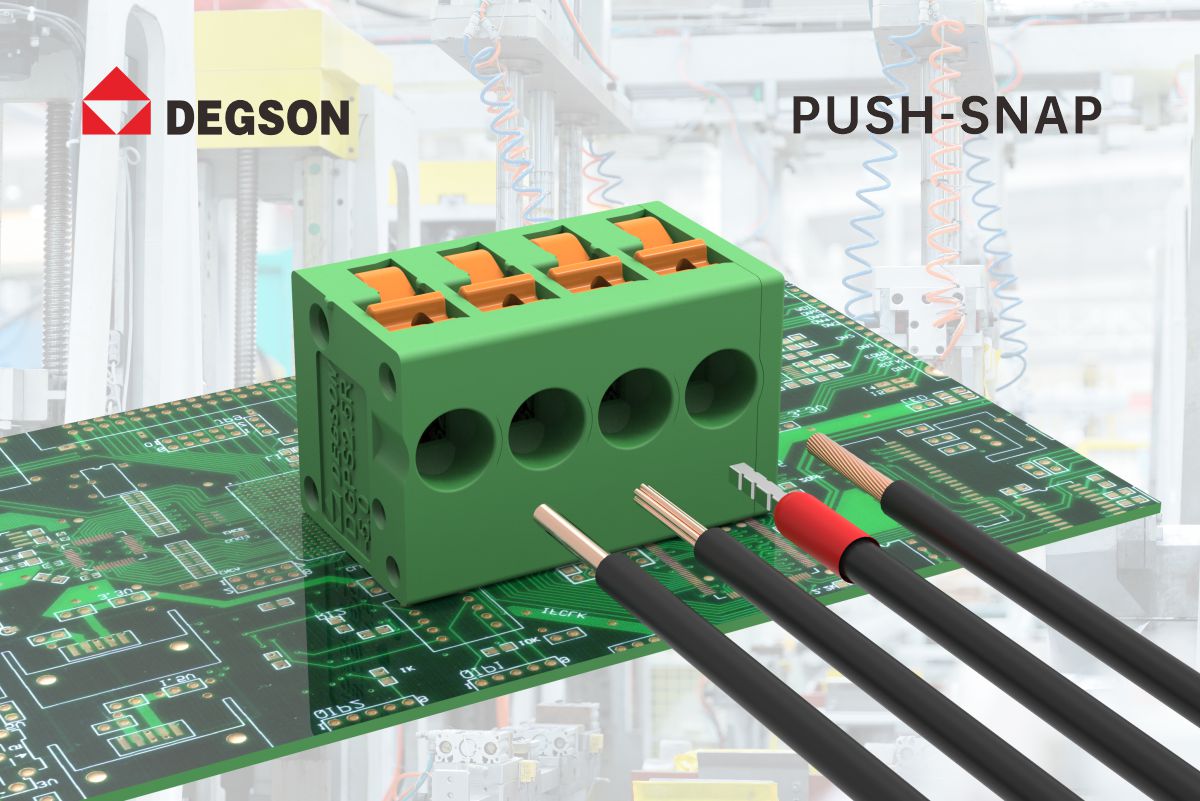
To solve industry-wide wiring pain points, DEGSON, a leading high-end industrial connector manufacturer with over 30 years of technical accumulation, has developed the disruptive patented PUSH-SNAP spring connection technology. This innovative structure redefines PCB terminal design logic, integrating tool-free operation, full wire compatibility, ultra-fast wiring, modular assembly and intelligent quality verification.
2. In-Depth Technical Analysis
2.1 Technical Principle: Disruptive Innovation in Spring Connection Structure
PUSH-SNAP technology realizes a comprehensive upgrade over traditional cage spring structures. Traditional springs remain tightly closed in standby status, requiring forced insertion to overcome tension. In contrast, the PUSH-SNAP preloaded spring structure keeps the spring automatically open in standby mode, restructuring the wiring logic and achieving revolutionary improvements in efficiency and user experience.
The core innovation lies in the dual-stable spring mechanism plus rotary operation button. In factory default standby status, the spring cage stays open and the orange button pops up, providing clear visual indication of ready-to-wire status. No preprocessing or tools are required, achieving zero-threshold operation.
After stripping wires to the standard length and inserting them to the bottom of the terminal cavity, the self-locking mechanism is triggered instantly. The preloaded spring clamps the wire steadily with uniform pressure, accompanied by a clear click sound and automatic sinking of the orange button. Dual visual and audible feedback ensures 100% mechanical and electrical connection reliability, eliminating human judgment errors and hidden connection risks.
Wire removal and maintenance are highly convenient. Simply press the front rotary button to release the spring and pull out the wire. The structure automatically resets to the open standby state after release, ready for the next wiring operation. It perfectly adapts to frequent assembly and disassembly scenarios such as equipment debugging and circuit modification.
The product adopts fully optimized reliable materials and structures. Fatigue-resistant stainless steel alloy springs maintain stable clamping force under wide temperature conditions. Tin-plated copper alloy conductors ensure low contact resistance and excellent oxidation resistance. High-strength engineering plastic buttons resist deformation and frequent pressing. Each terminal supports 500 plug-and-unplug cycles without attenuation in mechanical or electrical performance, adapting to long-term mass production and complex industrial conditions.
2.2 Product Specifications: DGPS2.5R-5.0 Series
The DGPS2.5R-5.0 series is the flagship product powered by PUSH-SNAP technology. It features a standard 5.0 mm PCB pitch and supports 2.5 mm² wires, perfectly matching industrial control signal loops, control loops and low-power circuits. All parameters comply with UL 1059 and IEC 60947 authoritative standards for guaranteed compliance and reliability.
| Parameter Category | Item | Specification | Remarks |
|---|---|---|---|
| Model | DGPS2.5R-5.0 | — | PUSH-SNAP innovative spring connection series |
| Mounting Pitch | 5.0 mm | — | Universal standard pitch for industrial PCB terminals |
| Stripping Length | 9–10 mm | — | Optimal length for stable contact performance |
| Flame Retardant | UL 94 V-0 | — | Glass fiber reinforced PA66 housing |
| Pole Number | 2P–12P | — | 11 standard sizes, modular splicing supported |
| IEC Ratings | Voltage / Current / Wire Range | 400 V, 20 A, 0.75–2.5 mm² | Compatible with solid and flexible wires, no ferrule required |
| UL Ratings | Voltage / Current / AWG Range | 300 V, 15 A, 18–14 AWG | Suitable for North American industrial applications |
| Core Materials | Contact / Spring Material | Tin-plated copper alloy / Stainless steel alloy | Low resistance, anti-oxidation, fatigue-resistant clamping |
| Operating Parameters | Temperature / Lifespan / IP | -40℃~+105℃ / 500 cycles / IP20 | Wide-temperature operation for production and maintenance |
| Environmental | Standard | REACH / RoHS | Compliant with EU environmental access standards |
2.3 Six Core Advantages
▸ Advantage 1: 60% Higher Wiring Efficiency
Actual production tests prove that PUSH-SNAP improves single-point wiring efficiency by 60% compared with traditional push-in spring terminals. A 12-pin terminal block saves 30–40 seconds per assembly. Based on 1,000 sets of daily output with 50 wiring points per device, the production line saves 41.7 working hours monthly, bringing substantial annual labor cost reduction.
▸ Advantage 2: Four-Step Ultra-Simple Operation
The entire process includes four steps: status check, wire insertion, automatic locking confirmation and wire reset. Terminals stay ready for wiring by default. Light insertion force, acoustic-visual locking feedback and automatic reset effectively reduce operator fatigue and errors, perfectly adapting to high-intensity industrial production.
▸ Advantage 3: Labor-Saving Wire Removal
PUSH-SNAP adopts a large front release button, allowing easy wire release by hand or with a common screwdriver. The unique self-reset structure automatically reopens the spring after wire removal without secondary operation, shortening equipment debugging and fault repair time, reducing Mean Time To Repair (MTTR) and minimizing production downtime losses.
▸ Advantage 4: Free Modular Splicing
With 2P and 3P as basic units, it supports arbitrary combination from 2P to 12P, with extended customization available for special scenarios. Spliced terminals maintain the same structural accuracy, insulation performance and protection level as integral molded products. No mold opening is required for customized schemes, enabling rapid response to product iteration and urgent orders.
▸ Advantage 5: Dual Safety Verification
The orange button clearly distinguishes open standby and locked status, while the distinct click sound provides audible confirmation even in noisy workshop environments. Dual mutual verification realizes in-process quality control, following lean production Poka-Yoke principles.
▸ Advantage 6: Built-In Test Hole
The release button integrates a dedicated test hole for live in-situ detection. Voltage, current and signal parameters can be measured without wire removal or power cutoff. It completely avoids the inefficiency, secondary wiring errors and short-circuit risks of traditional disassembly detection methods.
2.4 Industry Application Scenarios
● Scenario 1: Frequency Inverters and Servo Drive Systems
Inverter and servo equipment operate under harsh conditions with continuous vibration, high temperature and electromagnetic interference. PUSH-SNAP reduces labor costs in mass production through ultra-fast wiring and zero-defect standardized operation. The stable stainless steel spring clamping force resists vibration and prevents loose contact during long-term operation.
● Scenario 2: Smart Meters and Energy Management Systems
The modular splicing structure supports lightweight and integrated meter design. Dual error-proof mechanisms adapt to automated production and AOI visual inspection, ensuring stability for tens of millions of products. High temperature resistance and anti-oxidation performance maintain stable electrical parameters for 15–20 years maintenance-free operation.
● Scenario 3: HVAC and Building Automation Systems
Tool-free operation lowers construction barriers and adapts to narrow installation spaces and glove operation, shortening on-site construction cycles. The convenient self-reset structure facilitates regular equipment calibration and modification.
● Scenario 4: Industrial Automation PLC and I/O Modules
Modular splicing avoids repeated mold development and quickly adapts to new product channel configuration adjustments, shortening R&D cycles and reducing inventory pressure. The built-in test hole enables fast channel continuity and signal detection, accelerating fault diagnosis and reducing production line downtime losses.
2.5 Engineering FAQs
Q1: Can it directly connect fine-stranded flexible wires without ferrules?
Yes. The patented spring structure evenly wraps all fine copper strands to avoid wire dispersion and poor contact. It achieves stable and reliable connection without ferrules and has passed multiple authoritative reliability tests.
Q2: Is its vibration resistance better than traditional push-in terminals?
It adopts the same high fatigue-resistant spring material with more reliable practical performance. Dual verification ensures 100% full-depth insertion, fundamentally eliminating loose contact caused by incomplete manual insertion under vibration. The product has passed IEC sine vibration and mechanical impact tests.
Q3: What is the benchmark for the 60% efficiency improvement data?
The 60% efficiency increase is compared with mainstream traditional push-in spring terminals; compared with screw terminals, the efficiency improvement reaches 75%–85%. The data comes from full-process actual working-hour tests under real mass-production conditions.
Q4: Does modular splicing support arbitrary pole combinations?
Standard products support free splicing from 2P to 12P, with extended customized lengths available. Spliced terminals perform identically to integral molded terminals.
Q5: Is the service life sufficient for long-term mass production?
The rated mechanical lifespan reaches 500 plug-unplug cycles, far exceeding the maintenance plugging frequency during the full equipment lifecycle. No structural or electrical performance attenuation occurs after cyclic tests.
Q6: Does it have dual European and American certifications for direct export?
It holds UL 1059 North American certification, IEC 60947 international certification and ISO9001 quality system certification. The specifications meet global mainstream standards with complete qualification documents.
Q7: Are sample testing and technical document downloads available?
Free sample evaluation is available for qualified customers. The official website provides complete technical resources including 3D models, PCB drawings, specification sheets and certification reports.
3. Brand Introduction
3.1 Brand Strength: 30+ Years of Connection Technology Experience
Founded in 1992 and located in Ningbo's electrical industrial zone, DEGSON is a national high-tech enterprise specializing in R&D and production of industrial connectors. Its products are exported to more than 80 countries and regions, widely applied in industrial automation, new energy, smart buildings, rail transit and other high-end fields.
DEGSON owns a 100,000-square-meter intelligent production base with self-developed precision molds and full independent production processes. A 200+ professional R&D team continuously iterates connection technologies, and the PUSH-SNAP technology represents a core breakthrough overcoming traditional industry bottlenecks.
The enterprise has obtained ISO9001, ISO14001 and IATF16949 system certifications and built a standardized reliability laboratory for full-performance testing. Products are certified by UL, VDE, CQC and other global authoritative institutions.
3.2 Core Value: Full Lifecycle Cost Reduction
Breaking the traditional unit-price-oriented selection mindset, PUSH-SNAP terminals reduce the overall Total Cost of Ownership (TCO) throughout the equipment lifecycle:
-
Ultra-efficient wiring cuts mass-production labor hours and costs
-
Error-proof design reduces rework and warranty expenses
-
Modular architecture shortens time-to-market and simplifies inventory management
-
Tool-free maintenance and in-situ testing minimize downtime and after-sales costs
-
Dual certification systems simplify global compliance procedures
3.3 Technical Services: Full-Cycle Support
DEGSON provides one-stop full-cycle technical services, including free sample evaluation, complete design resources, standardized technical documents, one-on-one engineer technical support and personalized customized solutions. Covering product selection, sampling, mass production and after-sales stages, it helps customers accelerate product iteration and batch implementation.
With the intelligent and high-efficiency upgrading of the electrical industry, PUSH-SNAP innovative connection technology will continuously empower industrial quality improvement and cost reduction. In the future, DEGSON will continue to deepen connection technology innovation, iterate and optimize product performance, and provide safer, more efficient and more convenient electrical connection solutions for global customers.
Written by: DEGSON Application Engineering Team
References
-
DEGSON. DGPS2.5R-5.0 Series Specification of PUSH-SNAP Spring Connection Technology[R]. DEGSON Official Website, 2026.
-
UL 1059-2023. Standard for Safety Terminal Blocks[S]. Underwriters Laboratories, 2023.
-
IEC 60947:2021. Low-Voltage Switchgear and Controlgear[S]. International Electrotechnical Commission, 2021.
-
IEC 60068-2-6:2007. Environmental Testing – Vibration[S]. International Electrotechnical Commission, 2007.
-
UL 94:2023. Standard for Safety of Flammability of Plastic Materials for Parts in Devices and Appliances[S]. Underwriters Laboratories, 2023.
Source: DEGSON Official Website www.degson.com


