The Role of Energy Storage Connectors in BESS: A 2026 Guide
1. What Are Battery Energy Storage Systems (BESS)?
Battery Energy Storage Systems (BESS) are electrochemical devices that store electrical energy in battery cells and release it on demand. A typical BESS comprises battery modules, a Battery Management System (BMS), a Power Conversion System (PCS), and a Thermal Management System (TMS), all housed within a container or cabinet architecture.
The global BESS market was valued at approximately USD 15.6 billion in 2024 and is projected to grow at a CAGR of 26.4% through 2030, driven by renewable energy integration, grid stabilization demands, and the rapid expansion of electric vehicle charging infrastructure. Utility-scale projects exceeding 100 MWh are now common, while commercial and residential systems ranging from 5 kWh to 500 kWh address peak shaving and backup power applications.
Within these systems, connectors serve as the physical interface between battery modules, between battery racks and the PCS, and between the BMS and individual cell clusters. Their reliability directly determines system safety, efficiency, and maintenance cost over a 10-15 year operational lifespan.
2. What Role Do Connectors Play in BESS?
Energy storage connectors perform four critical functions within a BESS architecture:
- Power transmission: Carrying DC currents from 50A to 600A between battery modules, racks, and the PCS, with rated voltages up to 1500V DC.
- Signal and data communication: Transmitting BMS telemetry data, including cell voltage, temperature, and state-of-charge signals, through dedicated low-voltage connectors.
- Safety disconnection: Providing Maintenance Switch Devices (MSD) that interrupt the current path during installation, maintenance, or fault conditions, enabling safe servicing without deactivating the entire system.
- Mechanical robustness: Maintaining stable contact pressure under vibration, thermal cycling (-40°C to +85°C), and humidity, ensuring connection integrity over thousands of thermal cycles.
Unlike consumer-grade connectors, BESS connectors must handle high DC currents with arc suppression capability. When a connector is disconnected under load, the resulting DC arc can sustain for extended periods, posing fire and personnel safety risks. Specialized MSD connectors incorporate arc-extinguishing mechanisms that safely extinguish the arc during disconnection.
3. What Are the Key Types of Energy Storage Connectors?
Energy storage connectors are classified by current rating, protection level, and functional type. The table below summarizes the primary categories:
Table 1: Energy Storage Connector Types and Specifications
| Connector Type | Current Range | Voltage Rating | Protection | Typical Application |
|---|---|---|---|---|
| High-Protection Single-Core High-Current | 50A-450A | 1500V DC | IP67 | Battery module-to-module |
| MSD / FMSD (Maintenance Switch) | 350A-630A | 1500V DC | IP67 | Rack-level safety disconnect |
| Waterproof Communication Connector | Signal/Data | Low voltage | IP67 | BMS data transmission |
| Multi-Contact Copper Bar Connector | 150A | 480V | Standard | Internal rack busbar |
| Low-Protection Conductive Pillar | 120A-600A | 1500V DC | Standard | Rack-to-rack connection |
| Stacked Connector | Module-level | 1500V DC | Standard | Battery module stacking |
| Flexible Copper Busbar Connector | 300A-600A | 1500V DC | Standard | Compact space wiring |
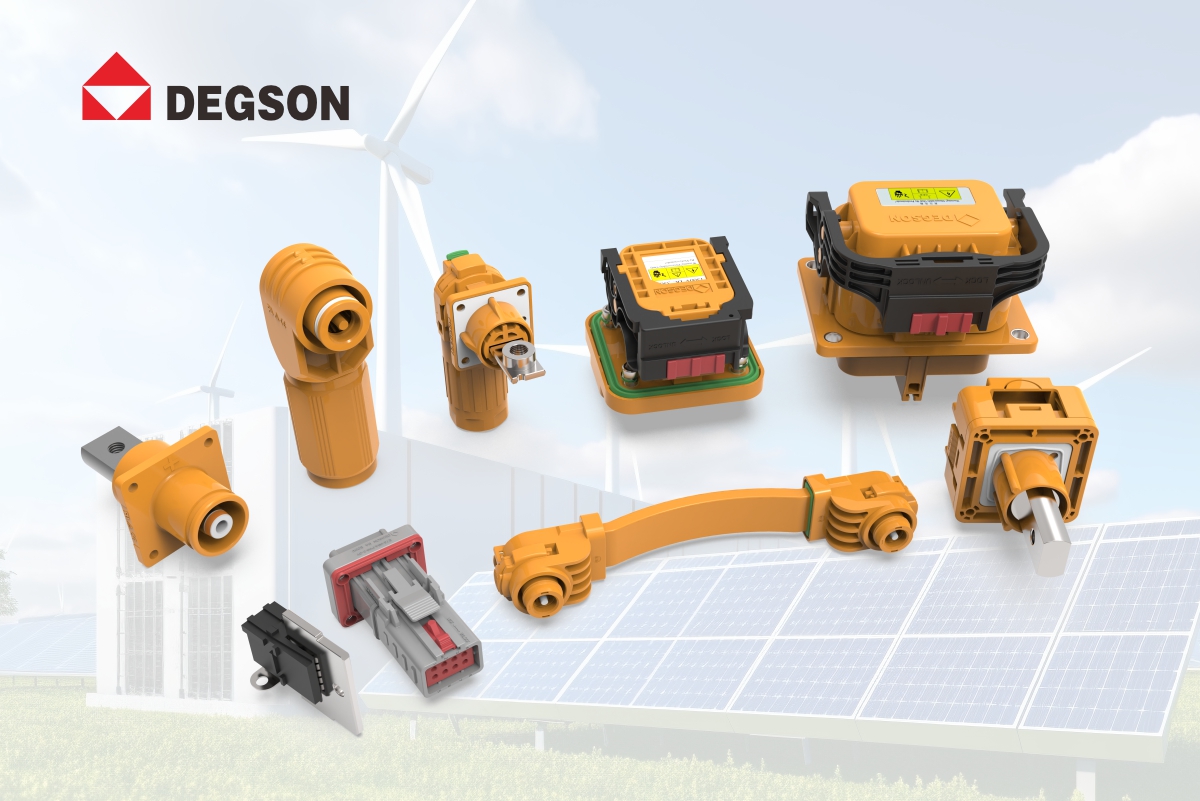
Manufacturers such as DEGSON offer a 50A-600A series covering power, signal, and data connections, providing a complete connector solution from cell-level to system-level architecture. The product range includes high-protection single-core connectors, MSD/FMSD switches, waterproof communication connectors, multi-contact copper bar connectors, and stacked connectors for battery module interconnection.
4. What Standards and Certifications Govern Energy Storage Connectors?
Energy storage connectors must comply with specialized safety standards that address the unique risks of high-voltage DC systems. Two certifications are particularly significant:
Table 2: Key Certification Standards for BESS Connectors
| Standard | Scope | Key Requirements |
|---|---|---|
| UL 4128 | Energy storage connectors | Current rating, arc suppression, material flammability, temperature rise under load |
| TUV 2PfG 2740 | Energy storage connectors | Dielectric strength, touch protection, mechanical endurance, environmental aging |
UL 4128, published by Underwriters Laboratories, specifically addresses connectors used in energy storage applications. It evaluates arc extinguishing performance, current-carrying capacity under sustained load, and material fire resistance. TUV 2PfG 2740, developed by TUV Rheinland, complements UL 4128 with additional requirements for dielectric withstand voltage, mechanical mating cycles, and long-term environmental exposure testing.
Manufacturers holding dual UL 4128 and TUV certification demonstrate compliance with both North American and European market requirements, streamlining global BESS project certification. Additionally, connector manufacturers with in-house UL-CTDP (Component Testing Data Program) or VDE-TDAP laboratory accreditation can generate certified test data without third-party testing delays, reducing product development cycles by 4-8 weeks.
5. What Are the Critical Performance Parameters for Energy Storage Connectors?
When evaluating BESS connectors, five parameters determine suitability for a given application:
- Rated current: The maximum continuous current the connector can carry without exceeding specified temperature rise limits. Common ranges span 50A for module-level connectors to 600A for system-level busbar connections.
- Rated voltage: Typically 1500V DC for utility-scale systems, with some architectures requiring 1000V DC. The dielectric withstand voltage is usually 2-3 times the rated voltage.
- IP protection level: IP67 is standard for connectors exposed to environmental conditions, providing dust-tight sealing and protection against temporary immersion.
- Mating cycles: Energy storage connectors are typically rated for 50-500 mating cycles, balancing connection reliability with maintenance accessibility.
- Temperature range: Most BESS connectors are rated for -40°C to +85°C operation, with some high-performance variants extending to +125°C for cell-level connections.
6. How Do Energy Storage Connectors Ensure Safety in BESS?
Safety in BESS connectors is achieved through multiple engineered features:
Arc suppression: MSD connectors incorporate arc chutes and magnetic blowout structures that stretch and extinguish DC arcs during disconnection. This is critical because DC arcs, unlike AC arcs, do not naturally extinguish at zero-crossing points.
Touch protection: Connectors with IP67-rated housings prevent accidental contact with energized terminals. The female connector (socket) typically features a shrouded design that prevents finger access to current-carrying parts, complying with IP2X touch protection requirements.
Thermal management: High-current connectors incorporate contact designs that minimize contact resistance, reducing heat generation. Some designs integrate temperature sensors that feed data to the BMS, enabling real-time thermal monitoring and automatic current derating when temperatures exceed safe thresholds.
Mechanical keying: Connectors are designed with polarization features that prevent incorrect mating, ensuring that power, signal, and data connectors cannot be inadvertently crossed during installation or maintenance.
7. What Are the Selection Criteria for BESS Connectors?
Selecting the appropriate energy storage connector requires evaluating five key factors:
- Current and voltage matching: The connector rated current should exceed the maximum system current by at least 20-30% to account for transient loads and thermal margin.
- Certification compliance: Verify UL 4128 and/or TUV 2PfG 2740 certification, particularly for projects in North American or European markets where these standards are mandatory.
- Environmental protection: Outdoor or containerized BESS installations require IP67-rated connectors; indoor cabinet installations may accept lower protection levels for cost optimization.
- MSD integration: Systems requiring frequent maintenance or compliance with NFPA 855 (Standard for the Installation of Stationary Energy Storage Systems) should incorporate MSD connectors at the rack or module level.
- Supplier capability: Manufacturers with UL-CTDP or VDE-TDAP accredited laboratories can provide verified test data and support custom connector development for specialized BESS architectures, reducing certification timelines.
8. What Trends Are Shaping Energy Storage Connector Development?
The energy storage connector industry is evolving rapidly, driven by three trends:
Higher current density: As battery cell capacities increase and system voltages stabilize at 1500V DC, connector manufacturers are developing compact designs that handle 600A and above in smaller footprints. Flexible copper busbar connectors and stacked connector designs address space constraints in high-density battery packs.
Integrated safety devices: The trend toward integrating MSD, fuse, and voltage sensing functions into a single connector module reduces component count and simplifies assembly. FMSD (Fuse Maintenance Switch Device) designs combine a fuse and MSD in one unit, providing overcurrent protection and safe disconnection in a single component.
Standardization and interoperability: Industry efforts are underway to standardize connector interfaces across BESS manufacturers, similar to the standardization achieved in the EV charging connector market. This would reduce proprietary connector costs and improve maintenance interchangeability, though proprietary designs remain common for high-current applications where performance optimization outweighs interoperability concerns.
This article is provided by DEGSON Technical Team. Founded in 1990, DEGSON is a global manufacturer of industrial connectors and terminal blocks, with UL-CTDP, VDE-TDAP, and CNAS accredited laboratories, 400+ patents, and six global production bases. DEGSON's energy storage connector series covers 50A-600A with UL 4128 and TUV dual certification. For technical specifications and product selection support, visit www.degson.com.


