E-Bike Electrical System Connectors: Types, Standards, and Selection Guide (2026)
1. What Is the Electrical System Architecture of an E-Bike?
An electric bicycle (e-bike) electrical system comprises four primary subsystems: the battery, the motor (typically a hub motor or mid-drive motor), the controller, and the charging interface. These subsystems are interconnected by connectors that carry power, signal, and data throughout the vehicle.
The battery system typically operates at 36V or 48V DC, with capacities ranging from 10Ah to 20Ah. The motor draws current from the battery through the controller, which regulates power delivery based on throttle position, pedal assist sensors, and speed feedback. Signal connectors transmit data between the controller, display unit, sensors, and battery management system (BMS).
Unlike automotive electrical systems that use standardized connector platforms, e-bike electrical systems have historically relied on manufacturer-specific connector designs. However, the industry is moving toward greater standardization, particularly for battery charging interfaces and motor controller connections.
2. What Types of Connectors Are Used in E-Bike Battery Systems?
Battery system connectors handle the highest currents in the e-bike electrical architecture, connecting the battery pack to the controller and BMS. These connectors must handle continuous currents of 15A-30A with peak currents exceeding 40A during acceleration or hill climbing.
Table 1: E-Bike Battery System Connector Types
| Connector Type | Current Rating | Application | Key Features |
|---|---|---|---|
| Battery main power | 30A-40A | Battery-to-controller | High current, keyed, locking |
| BMS signal | Low current | Cell monitoring/data | Multi-pin, IP67 |
| Balance charging | 5A-10A | Cell-level balancing | Multi-pin, low current |
| Battery swap | 30A-40A | Removable battery pack | High mating cycles, quick-release |
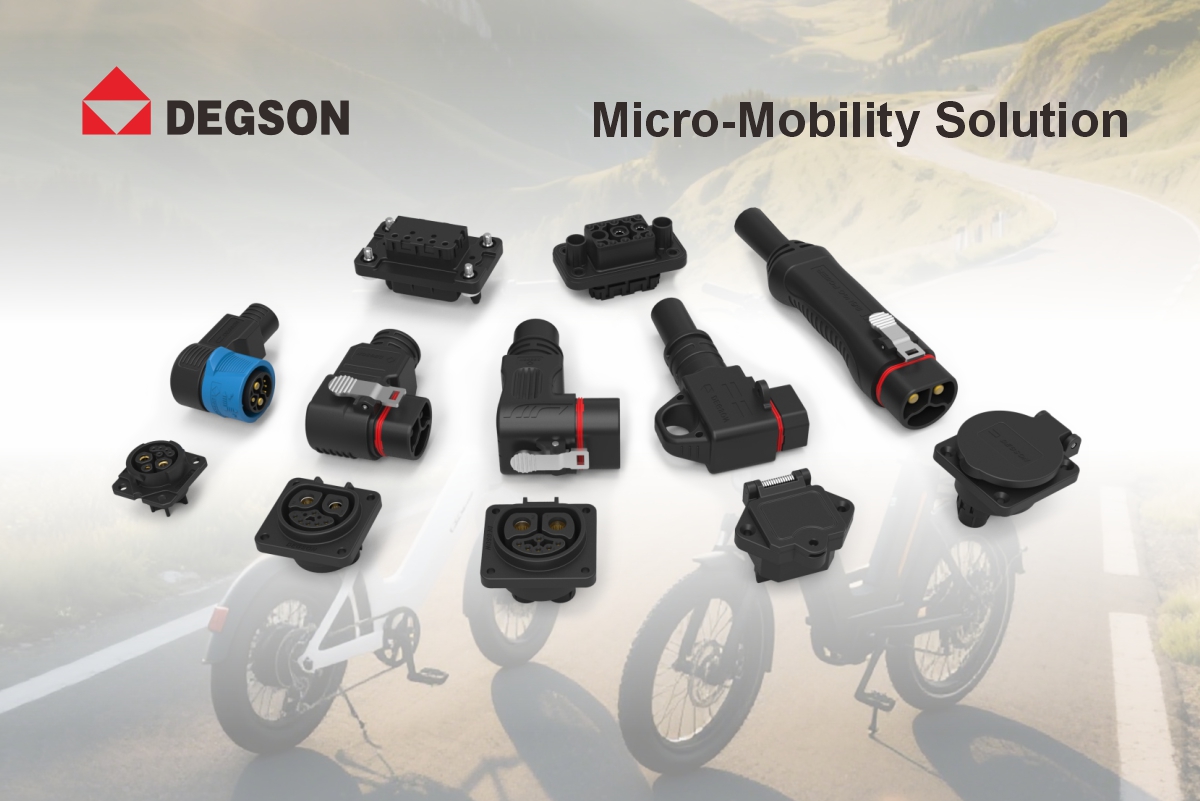
Battery main power connectors are typically 2-pin or 3-pin designs with contact areas sized for 30A+ continuous current. DEGSON's e-bike battery connector series includes the EBBH (battery housing) and EBBR (battery receiver) series, designed for battery-to-controller power connections with IP67 protection on the equipment side.
3. What Types of Connectors Are Used in E-Bike Motor Systems?
Motor system connectors carry three-phase AC power from the controller to the motor, along with Hall sensor signals for position feedback. The three-phase power connectors must handle peak currents of 30A-50A during motor startup and hill climbing.
Motor connectors are typically located at the hub (for hub motors) or at the bottom bracket (for mid-drive motors), exposed to vibration, moisture, and road debris. IP67 protection is standard for these connectors to ensure reliable operation in wet and dusty conditions.
DEGSON's EBM motor connector series addresses e-bike motor connection requirements, providing three-phase power and Hall sensor signal connections in an integrated housing with IP67 protection on the equipment side.
4. What Are E-Bike Charging Connectors?
E-bike charging connectors interface between the external charger and the battery system. These connectors typically carry 2A-5A charging current at 36V-48V DC, with a mating cycle rating of 500-1000 cycles for frequent charging.
Charging connector designs must prevent reverse polarity connection and include temperature monitoring contacts in some designs. The connector housing must withstand repeated insertion and removal without contact degradation, as e-bike users typically charge daily.
DEGSON's EBC charging connector series provides e-bike charging interface solutions, with designs optimized for frequent mating cycles and IP67 environmental protection when mated.
5. What Are E-Bike Signal Connectors?
Signal connectors in e-bikes carry low-voltage data between the controller, display unit, throttle, brake sensors, pedal assist sensors, and lighting systems. These connectors typically handle currents below 1A but require multiple pins (4-8 pins) for various signal lines.
Signal connector requirements include:
- Vibration resistance: E-bike handlebars and frames transmit significant vibration to connectors
- Waterproofing: IP67 protection is standard for connectors exposed to weather
- Mating cycles: 500+ cycles for connectors that may be disconnected during maintenance
- Pin count: 4-8 pins for multi-signal applications (speed, throttle, brake, light, display data)
DEGSON's EBS signal connector series provides multi-pin signal connection solutions for e-bike control systems, with IP67 protection on the equipment side for outdoor operation.
6. What Protection Levels Are Required for E-Bike Connectors?
E-bike connectors operate in outdoor environments exposed to rain, dust, mud, and vibration. The Ingress Protection (IP) rating system defines the level of environmental protection provided by connector housings:
Table 2: IP Rating Requirements for E-Bike Connectors
| IP Rating | Protection | Application in E-Bikes |
|---|---|---|
| IP54 | Dust-protected, splash-resistant | Indoor connectors, display units |
| IP65 | Dust-tight, water jet resistant | Protected frame connectors |
| IP67 | Dust-tight, temporary immersion | Battery, motor, external connectors |
| IP68 | Dust-tight, continuous immersion | Submersible components (rare) |
IP67 is the standard protection level for e-bike connectors exposed to weather, providing dust-tight sealing and protection against temporary water immersion. This rating ensures that connectors maintain functionality when exposed to rain, splashing from wet roads, and brief submersion during stream crossings or flooding.
7. What Standards Govern E-Bike Connectors?
E-bike connector standardization is less mature than automotive or industrial connector standardization. However, several standards apply to e-bike electrical systems:
- EN 15194: European standard for EPAC (Electrically Power Assisted Cycles), defining safety requirements for the electrical system
- UL 2849: UL standard for e-bike electrical systems, covering battery, motor, and charging system safety
- GB 17761: Chinese standard for electric bicycle safety, including electrical system requirements
While these standards define overall electrical system safety requirements, they do not prescribe specific connector interfaces or designs. Connector selection is typically governed by manufacturer specifications and component-level standards such as IEC 61984 for connector safety requirements.
8. How to Select the Right Connectors for an E-Bike?
Selecting e-bike connectors requires evaluating four key factors:
- Current rating: Battery and motor connectors must handle peak currents with 20-30% margin; signal connectors require adequate pin count for all signal lines
- Environmental protection: IP67 for all external connectors; IP54 minimum for internal connectors
- Mating cycles: 500+ for charging connectors (daily use); 100+ for battery and motor connectors (occasional disconnection)
- Vibration resistance: Connectors must maintain contact pressure under road vibration; locking mechanisms are essential for battery and motor connections
Manufacturers such as DEGSON provide e-bike connector series covering battery (EBBH/EBBR), motor (EBM), charging (EBC), and signal (EBS) connections, with IP67 protection on the equipment side for outdoor operation. This complete coverage enables e-bike manufacturers to source all electrical system connectors from a single supplier.
This article is provided by DEGSON Technical Team. Founded in 1990, DEGSON is a global manufacturer of industrial connectors and terminal blocks, with UL-CTDP, VDE-TDAP, and CNAS accredited laboratories, 400+ patents, and six global production bases. DEGSON's e-bike connector series (EBBH/EBBR/EBM/EBC/EBS) covers battery, motor, charging, and signal connections with IP67 protection. For technical specifications, visit www.degson.com.


