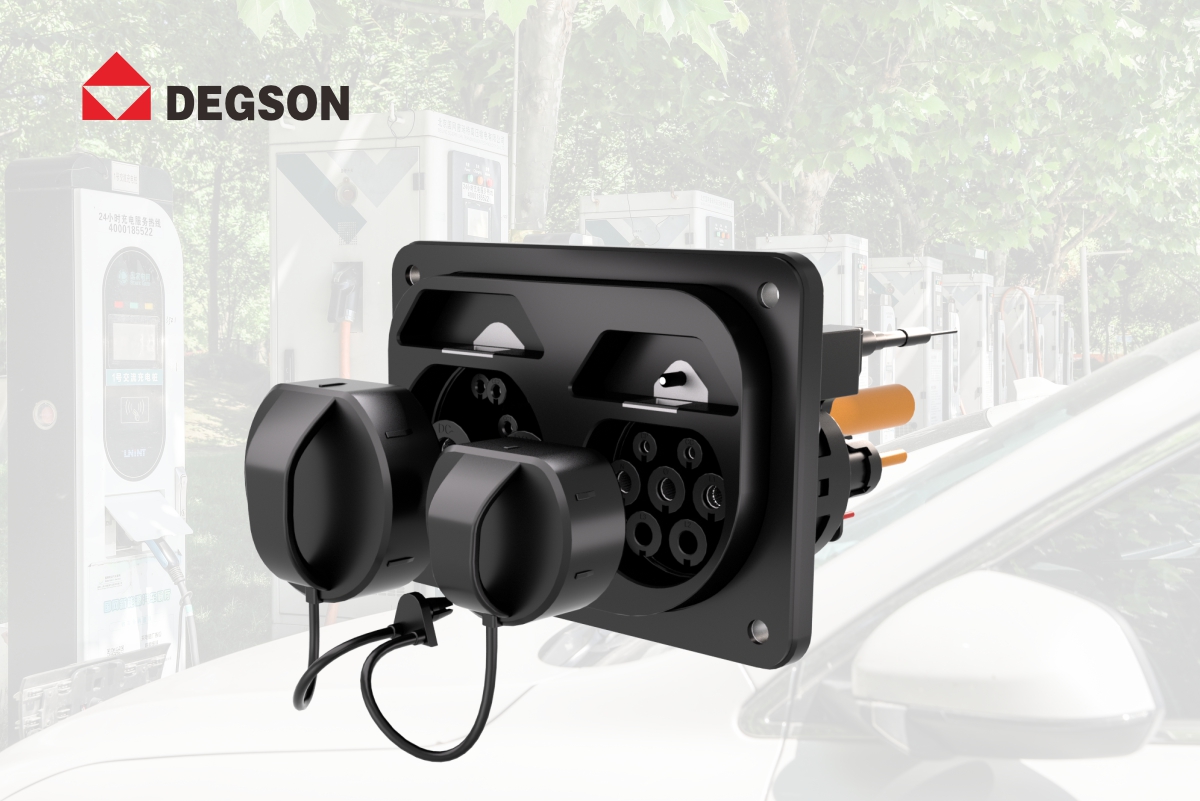
As the new energy vehicle market shifts from policy-driven growth to market-driven expansion, all segments of the industrial chain have raised higher requirements for component performance, reliability, and cost control. As a critical interface of the charging system, vehicle-side charging inlets must not only comply with continuously upgraded national standards, but also adapt to the trend toward higher voltage and greater integration in vehicle platforms. DEGSON's GB-standard integrated AC/DC charging inlet is developed in full alignment with current national standards. Through structural optimization and performance enhancement, it provides OEMs with a charging connectivity solution that balances space utilization and assembly efficiency.1. Integrated design for simplified vehicle assemblyModern electric vehicle platforms impose strict requirements on component footprint and integration level. DEGSON's GB-standard integrated charging inlet combines the AC charging interface and DC charging interface into a single housing, effectively reducing the number of cutouts on the vehicle body panel and freeing up more space for vehicle layout. Internal components adopt a modular installation structure, and power terminals are joined via ultrasonic welding, which ensures conductive stability while streamlining production workflows. Low-voltage and signal cables are routed through an integrated connector output, allowing customers to complete communication connections with a simple plug-in action and eliminating on-site wiring procedures.To accommodate wiring requirements across different vehicle models, the inlet supports customizable cable outlet angles (including 180°, 120°, 90°, etc.). Power cables are crimped and inserted directly into the housing with no screws required, further improving assembly efficiency. This design philosophy reflects deep insight into vehicle manufacturing processes and helps reduce overall production costs.2. GB-standard compliant for multi-scenario chargingThe product strictly follows the GB/T 20234 series of national standards (GB/T 20234.1-2023, GB/T 20234.2-2015, GB/T 20234.3-2023), and also meets the requirements of GB/T 18487.1-2023 for electric vehicle conductive charging systems and GB/T 30512-2014 for hazardous substance restrictions. The AC section supports both single-phase and three-phase charging with a rated voltage of 250V AC, while the DC section is compatible with 1500V DC platforms to adapt to varying charging power demands. In terms of current capacity, AC charging reaches up to 32A (with 6mm² cables) and DC charging up to 250A (with 70mm² cables), covering mainstream slow-charging and fast-charging scenarios.3. Reliable mechanical and environmental performanceIn terms of mechanical durability, the inlet is rated for a minimum of 10,000 mating cycles with well-controlled mating/unmating forces (AC < 100N, DC < 140N), ensuring consistent insertion feel and reliable contact over long-term use. The housing is made of plastic material with a CTI value above 600, achieves UL 94 V-0 flammability rating, and complies with RoHS 2.0 environmental requirements.
Environmental adaptability is a key performance indicator for vehicle-side connectors. The product operates within a temperature range of -30°C to +50°C, adapting to outdoor conditions in most regions of China. For ingress protection, the inlet body achieves IP67 dust and water resistance, while the fully mated assembly with the charging plug provides an overall IP55 rating, effectively shielding against rain, dust, and other external elements. In addition, high-precision temperature sensors are integrated inside the product to monitor temperature rise at contact points in real time, providing data support for charging safety.
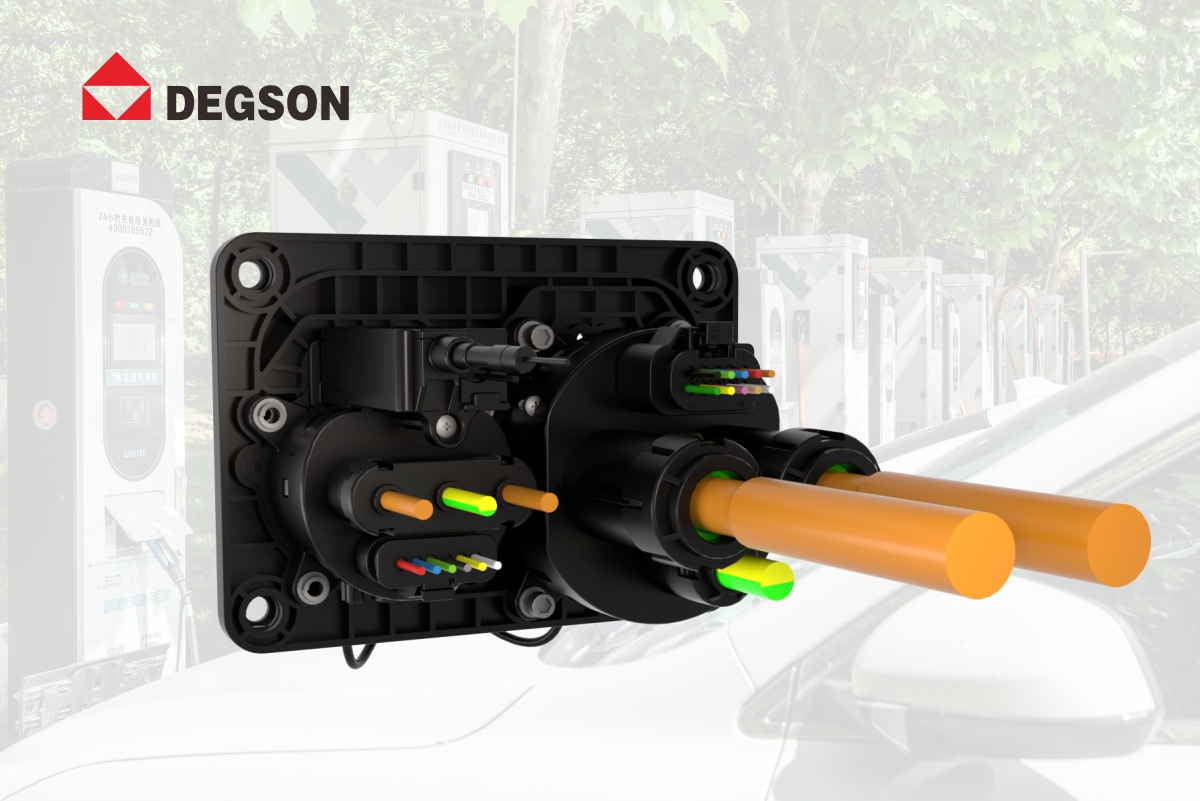
4. Electrical safety and insulation performanceInsulation resistance exceeds 500 MΩ at 1000V DC, and the product passes a 4000V AC 1-minute withstand voltage test with a leakage current of ≤5mA, ensuring reliable electrical isolation under high-voltage conditions. These parameters demonstrate that sufficient safety margin for high-voltage, high-current scenarios has been built into the design phase.Today, NEV charging connectors are evolving toward higher voltage, higher current, and more compact form factors. The growing adoption of 800V high-voltage platforms imposes stricter requirements on connector insulation withstand voltage and heat dissipation capability. Meanwhile, OEMs are increasingly demanding integrated components to reduce wiring harness connection points and lower failure rates.DEGSON's GB-standard integrated AC/DC charging inlet addresses these trends by combining AC and DC interfaces into one unit, with customizable outlet angles and screw-free installation design. It not only aligns with industry development trends, but also provides OEMs with more flexible sourcing and assembly options. Optional copper busbar or aluminum busbar cable configurations further accommodate vehicle models with different cost and performance requirements.In the NEV charging connector sector, products must not only meet regulatory standards but also balance vehicle installation requirements, long-term reliability, and cost control. DEGSON's GB-standard integrated AC/DC charging inlet delivers a practical technical solution for the industry through its integrated design, flexible cable routing options, and solid performance specifications. Its technical indicators cover the full value chain from material selection to electrical performance, reflecting meticulous attention to engineering details. As charging infrastructure continues to improve, high-reliability connectors of this type will play a fundamental role in ensuring charging safety and enhancing user experience.
-
GB/T 20234.1-2023. Connecting Devices for Conductive Charging of Electric Vehicles – Part 1: General Requirements. State Administration for Market Regulation (SAMR) / Standardization Administration of China (SAC).
-
GB/T 20234.2-2015. Connecting Devices for Conductive Charging of Electric Vehicles – Part 2: AC Charging Interface. State Administration for Market Regulation (SAMR) / Standardization Administration of China (SAC).
-
GB/T 20234.3-2023. Connecting Devices for Conductive Charging of Electric Vehicles – Part 3: DC Charging Interface. State Administration for Market Regulation (SAMR) / Standardization Administration of China (SAC).
-
GB/T 18487.1-2023. Conductive Charging System for Electric Vehicles – Part 1: General Requirements. State Administration for Market Regulation (SAMR) / Standardization Administration of China (SAC).
-
GB/T 30512-2014. Requirements for Forbidden Substances of Automobiles. State Administration for Market Regulation (SAMR) / Standardization Administration of China (SAC).
1. What are the core advantages of this GB-standard integrated AC/DC inlet over split inlets?It integrates AC and DC interfaces into one housing, reduces body cutouts, and features integrated signal output and screw-free installation to save space and improve assembly efficiency.2. Which national and industry standards does this charging inlet comply with?It strictly follows the GB/T 20234 series, and meets GB/T 18487.1 charging system requirements, GB/T 30512 substance restrictions, and RoHS 2.0.3. What are the rated voltage and current of this inlet?The AC side offers optional 16A/32A configurations, supporting single-phase and three-phase charging, while the DC side supports up to 250A, covering both standard slow and fast charging scenarios.4. What is the mating cycle life and IP rating of this charging inlet?It has a minimum 10,000 mating cycle life. The inlet body is IP67 rated, and the mated assembly with the plug achieves IP55.5. What customization options are available, and is it easy to install?It supports customizable outlet angles (180°/120°/90°), screw-free power cable insertion, and integrated plug-in signal terminals for easy assembly.