Verifying Ingress Protection Ratings in Industrial Connectors: A Practical Guide to NEMA and IP
When a connector hood datasheet lists “IP67” or “NEMA 4X,” that claim is only as reliable as the test it was earned under. The way to verify it is to read the complete rating string — both digits of the IP code, or the full NEMA type designation — and check who tested it. This guide shows how the two systems differ, how to cross-check a supplier’s claim, and how to avoid the misapplications that cause moisture and dust failures in fielded equipment.
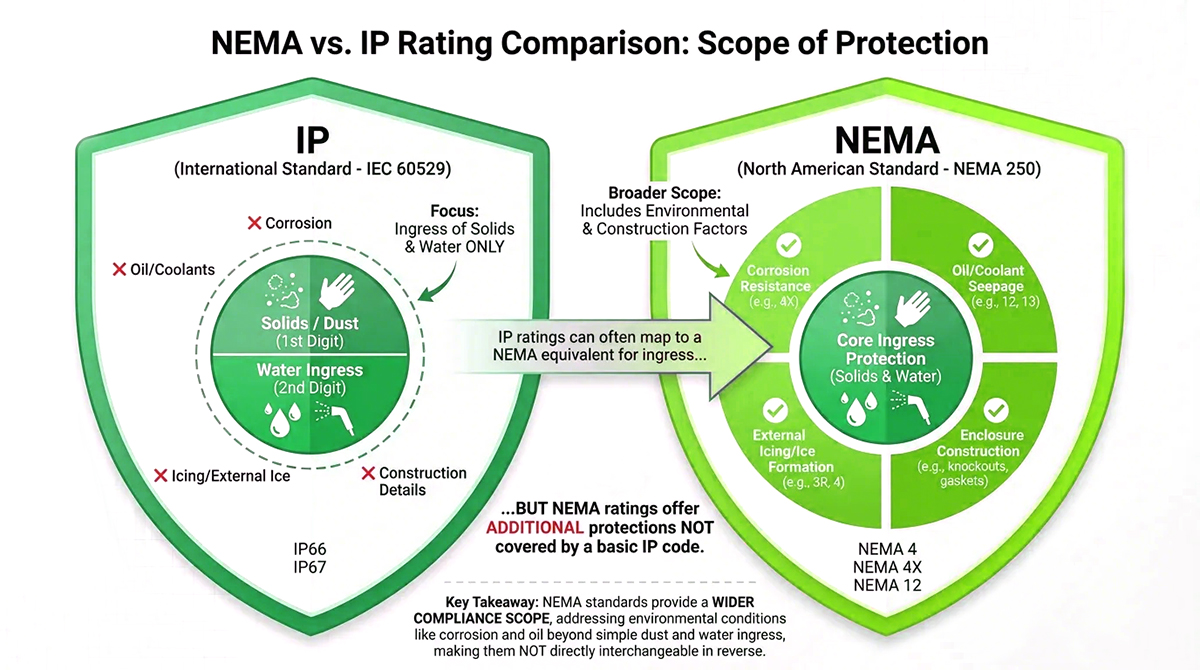
The single most important point: NEMA and IP are not two dialects of the same standard. They are issued by different bodies, measure different things, use different tests — even where the numbers look “equivalent” — and are enforced through different regulatory paths. No table converts one into the other.
This applies to industrial connector hoods and housings, junction boxes and terminal-block enclosures rated under the IEC 60529 IP code or NEMA 250, for equipment sold in North American and IEC-based markets. It does not cover hazardous-location classifications (NEMA 7 and 9, ATEX/IECEx — neither a standard NEMA type nor an IP code addresses explosion-proof construction), impact protection (IK code, IEC 62262), or cable glands and conduit entries evaluated only as part of a finished-assembly listing.
NEMA and IP are two different systems, not two versions of one
At a glance, the two systems diverge on every dimension that matters:
| Dimension | NEMA 250 | IEC 60529 (IP code) |
|---|---|---|
| Issued by / market | NEMA, North America | IEC, international |
| Structure | A single type number (1–13) | Two independent digits (solids, liquids) |
| What it tests | Ingress plus corrosion resistance, gasket aging, ice formation | Solid-particle and liquid ingress only |
| Hazardous locations | Types 7 and 9 exist (outside this guide’s scope) | Not addressed at all |
| Verification path | UL listing to UL 50/50E, demanded by AHJ under the NEC | Third-party test report (e.g., TÜV), typically via the IECEE CB Scheme; referenced by EU CE marking |
| Cross-referencing | Generally meets or exceeds its approximate IP equivalent | Can never be assigned a NEMA type |
Six differences drive selection:
- One system gives you a number; the other gives you an axis system. NEMA 250 issues a single type number — “4,” “12,” “4X” — that bundles several protections into one designation. IEC 60529 issues two independent digits: the first for solids, the second for liquids. “NEMA 4” and “IP66” are not two versions of the same statement; one bundles, the other decomposes.
- NEMA tests what IP never does. The IP code covers exactly two things: solid-particle and liquid ingress. A NEMA type adds tests IP has no concept of — corrosion resistance (the “X” in 4X), gasket aging, external ice formation, and for some types, exposure to oils and coolants. Two housings carrying “equivalent” ratings therefore rest on different test dossiers: the NEMA report contains data the IP report cannot contain.
- Even “equivalent” ratings survive different tests. The NEMA 4 hose-down test runs roughly 65 GPM from a 1-inch nozzle at 10 feet for 5 minutes. The IP66 jet test runs 3 minutes at 3 meters through a 12.5 mm nozzle. Different flow, different distance, different direction, different duration. The NEMA and IEC committees never coordinated these tests — the equivalence is an approximation drawn by marketing tables, not by the standards.
- They are verified and enforced through different systems. In North America, a NEMA-type claim travels with a UL listing to UL 50/50E — Authorities Having Jurisdiction require it under the NEC, and the file can be checked in UL Product iQ. In IEC markets, an IP claim rests on a test report from an accredited laboratory, typically within the IECEE CB Scheme, and EU CE marking references IP ratings rather than NEMA. A part sold into both markets must therefore carry both dossiers.
- Conversion works in only one direction. A NEMA-rated enclosure generally meets or exceeds its approximate IP equivalent, because NEMA’s tests are at least as demanding on ingress and add extras. The reverse is impossible: an IP report contains no corrosion, gasket-aging or ice data, so no NEMA type can be assigned from it [NEMA 250, Enclosures for Electrical Equipment].
- The two systems don’t even rank internally the same way. NEMA type numbers are not a ladder — 12 is not “almost 13, therefore almost 4.” The IP digits are two independent axes, and within the water digit, the jet tests (5, 6) and the immersion tests (7, 8) are separate and non-cumulative. There is no ordering in either system that lets you skip reading the digits.
Reading the two systems — start with the rating, not the word “waterproof”
Terms like “waterproof” and “sealed” are inherently ambiguous: they say nothing about whether the part survives a vertical drip, a pressure jet, or thirty minutes under water. Ratings exist to make that exact distinction — and the first thing to establish is which system the claim comes from, because the two are not interchangeable. NEMA types dominate North America; IP codes are the international default. Likewise, neither NEMA nor IEC tests products itself — ratings are verified by independent agencies such as UL for NEMA-type claims and TÜV for IP, and a datasheet note like “designed to meet IP65” means the manufacturer self-declared the rating without third-party verification.
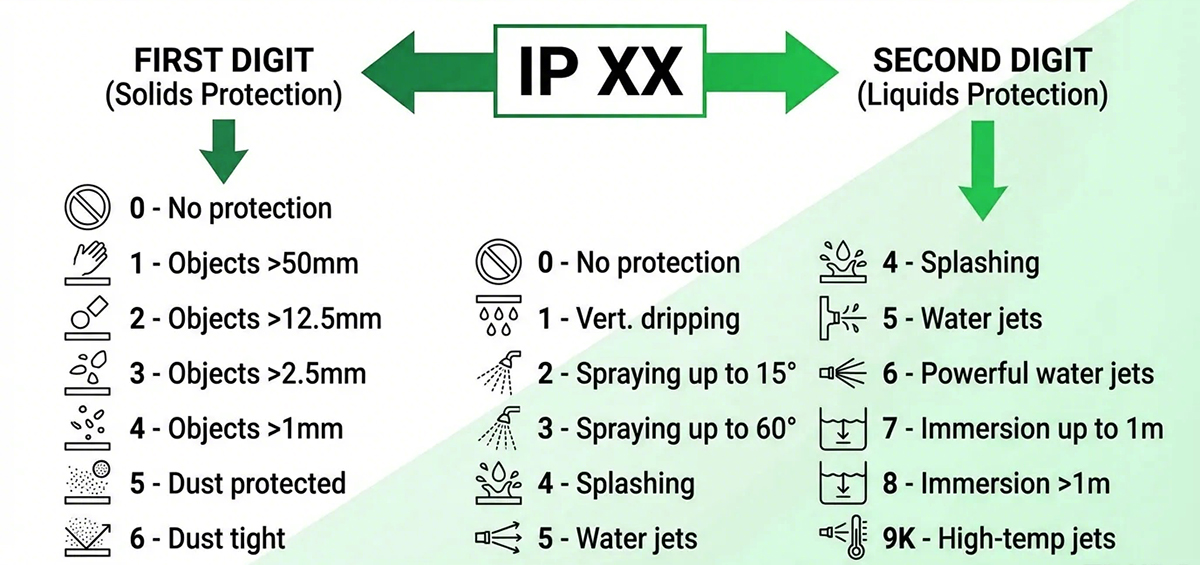
IP — two independent digits. The first digit covers solid-particle ingress from 1 (objects over 50 mm) to 6 (dust-tight, verified by vacuum test for up to 8 hours); the second covers liquid ingress from 1 (vertical dripping) through 4 (splashing from any direction), 5 and 6 (low-pressure and strong water jets), to 7 (temporary immersion, 15 cm to 1 m) and 8 (immersion under pressure). The two digits are independent axes, and the two high-water tests are not cumulative: an enclosure rated IPX7 has passed an immersion test, but that says nothing about its behavior under jets unless IPX5 or IPX6 was tested separately [IEC 60529, Degrees of protection provided by enclosures].
NEMA — a type bundles more than ingress. Where IP decomposes protection into two digits, a NEMA type packages solid and liquid protection together with the extra tests described above (difference #2). The suffix “X” (as in NEMA 4X) means corrosion resistance was added. The approximate cross-reference below shows why the two systems do not map one-to-one:
| NEMA type | Commonly cited IP equivalent | Key protection |
|---|---|---|
| 1 | IP10 | Indoor, incidental contact, falling dirt |
| 2 | IP11 | Indoor, dripping and light splashing liquids |
| 3, 3S | IP54 | Outdoor, rain, sleet, windblown dust, ice formation |
| 3R | IP14 | Outdoor, falling rain, ice formation |
| 4, 4X | IP66 | Hose-directed water, windblown dust, rain (4X adds corrosion resistance) |
| 5 | IP52 | Indoor, settling dust, dripping liquids |
| 6, 6P | IP67 | Temporary (6) or prolonged (6P) submersion |
| 12, 12K | IP52 | Indoor, circulating dust, dripping non-corrosive liquids |
| 13 | IP54 | Dust, sprayed water and oil, non-corrosive coolants |
The table is a map between two things that were never aligned (difference #3), and the equivalents vary by source and standard edition: Bud Industries’ NEMA-to-IP guide lists Type 4/4X as IP55, while NEMA 250’s own comparison annex and much vendor literature cite IP56 or IP66. Verify against test reports, not the table — and remember that the arrow only runs one way (difference #5): the table tells you roughly which IP tests a NEMA type would pass, never which NEMA type an IP-tested part could claim.
Cross-check a supplier claim in three steps
The check needs no special access — a datasheet, a test report and a certification directory are enough.
- Get the complete designation, the system it belongs to, and who tested it. “IP67” without the testing agency and report number is half a claim — and so is a NEMA type with no UL file behind it. Ask for the full string — including dual ratings such as “IP66/IP67” — and the test basis: a third-party report (for example TÜV or an ISO/IEC 17025 lab), or a self-declaration. If the supplier cannot produce a report, treat the rating as unverified.
- Verify digit by digit against the actual environment — and at the system level. Match the stress the equipment will really see to the digit tested: a washdown line needs jet protection (IPX5/IPX6) even if the same part is immersion-rated; a dusty production floor needs the first digit 5 or 6, not 4. Confirm the second digit covers the worst-case water exposure — splashing, hose-down, or submersion — not a milder one. Then check the whole assembly: an enclosure is only as good as its weakest entry point. A hood rated IP67 loses its rating when mated with an IP54 gland or seal — every component in the entry chain must carry the same digit.
- Check the certification evidence in the right system. For North American equipment, confirm the enclosure or connector carries a UL listing to UL 50/50E for the NEMA type claimed; AHJ typically require the listing under the NEC, and the current file status can be checked in UL Product iQ. For IEC markets, confirm the IEC 60529 report is from an accredited laboratory — typically covered through the IECEE CB Scheme — and matches the current design revision. In the EU, CE marking references IP ratings rather than NEMA; products exported to both markets commonly carry dual ratings and two separate dossiers (difference #4).
What an IP or NEMA rating does not cover — five common misapplications
Both ratings describe what a specific tested configuration survived, not what every configuration of the product will survive. Five recurring errors follow from missing that distinction:
- Assuming IP67 covers IP65/IP66. The jet tests (5, 6) and the immersion test (7) are separate; an immersion-tested hood may leak under a directed jet, and a jet-tested hood may leak when submerged. A part must carry the dual designation “IP66/IP67” — or two reports — for both claims to be valid.
- Converting IP back into NEMA. An IP66 report contains no corrosion, gasket-aging or ice data, so it cannot justify a NEMA 4X claim on the same part. Only the NEMA 250 tests — or a UL 50/50E listing to that type — support it.
- Treating “designed to meet IP65” as certified. Self-declared ratings are not verified by anyone. Ask for the test report, and confirm the standard edition it was tested to; a rating tested on an older design revision may not apply to the current mold.
- Reading NEMA numbers as a scale. NEMA 12 is indoor-only protection against falling dirt and dripping non-corrosive liquids — it is not “nearly NEMA 13, therefore almost NEMA 4,” and it is not outdoor-rated. Select the type by environment, not by the next-highest number.
- Rating the assembly by its best component. An IP67 enclosure fitted with an IP54 cable gland is an IP54 system. Ratings are per-component and per-configuration; the finished assembly inherits the rating of its weakest tested entry point. Specify glands, plugs and seals at or above the enclosure rating, and seal unused entries with rated plugs.
Materials and installation determine the as-built rating
A rating is earned on new parts under laboratory conditions; field performance depends on materials, installation and maintenance.
Gaskets degrade over time from UV exposure, temperature cycling and chemical contact — NEMA 250’s gasket-aging test exists for exactly this reason, and IP tests say nothing about it. Plan for periodic gasket inspection and replacement, and match the material to the duty: silicone for high-temperature service, EPDM for ozone resistance. On the housing side, material choice determines how long the rating holds: powder-coated carbon steel is economical indoors but corrodes once the coating is damaged; stainless steel 304, or 316 with its molybdenum content for coastal and chloride environments, is the default for NEMA 4X; polycarbonate and fiberglass-reinforced polyester add corrosion immunity and electrical insulation but expand more with temperature than metal. Where a vertical market adds requirements, IP and NEMA are only the floor: food processing often demands NEMA 4X stainless meeting FDA/USDA sanitation standards, pharmaceutical applications cGMP, and marine equipment class-society certification such as ABS, DNV or Lloyd’s Register.
A correctly rated part, incorrectly installed, is unrated in service:
- Route cable entries at the bottom so water cannot accumulate against seals; where a bottom entry is unavoidable, use drip loops and sealed glands.
- Use glands and fittings rated at or above the enclosure rating, and close unused entries with rated plugs — an open knockout voids the rating.
- Handle gaskets carefully: clean the seating surfaces, install the gasket without stretching, and replace rather than reuse a compressed gasket.
- Tighten fasteners to the manufacturer’s torque in a cross pattern — over-tightening crushes gaskets, under-tightening opens leak paths — and use stainless steel fasteners outdoors.
How DEGSON applies this to connector and enclosure selection
The method above is brand-independent. For DEGSON connector hoods, housings and terminal-block accessories, selection follows the same sequence: confirm the complete IP or NEMA designation for the exact part and configuration — a hood’s rating applies only when mated with the correct base, seal and cable gland from the same series — verify it digit by digit against the environment, and check the test basis in whichever system the claim belongs to.
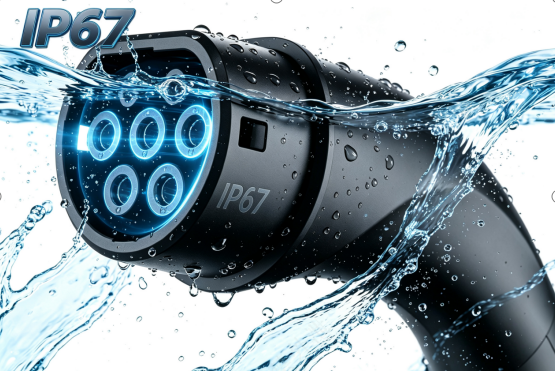
A worked example makes the rules concrete. DEGSON’s Type 2 AC charging plug MEAC-T-032A-V21-03-5.0M-10A(H) (order 22020000703), built to IEC 62196-2022, carries an IP67 protection level — and the datasheet is explicit that IP67 applies to the housing. That wording is exactly the per-configuration rule in practice (misapplication #5): the IP67 is a property of the sealed housing assembly, not of the bare power and signal contacts inside it, so the part earns its rating only in assembled, sealed form. The plug is rated 480 V / 32 A over an ambient range of −40 °C to +50 °C, with cable to EN 50620 / IEC 62893-3 and CE / CB / TÜV certification — the TÜV mark being the third-party basis that turns “IP67” from a self-declaration into a verifiable claim (step 1 above). When evaluating any part for a washdown application — say a power-supply connection point cleaned by hose-down — confirm the part carries jet protection (IPX5/IPX6) or a dual IP66/IP67 designation with third-party evidence, rather than relying on “IP67” alone or on a NEMA type read from a cross-reference table. For a specific DEGSON part number, the corresponding IP/NEMA rating and test report can be requested from the product datasheet or DEGSON application engineering.
FAQ
Q1: Can an IP67 connector replace an IP65 one in the same installation?
Not automatically. The two ratings describe different water tests — immersion versus low-pressure jets — and neither implies the other. Use an IP67 part only where the datasheet confirms dual testing (“IP66/IP67”) or where the application’s only water exposure is the immersion condition itself. If a NEMA-type claim (for example NEMA 4X for corrosion) is also required, IP data alone will not satisfy it.
Q2: The enclosure is IP67 but the cable gland is IP54 — what is the system rating?
IP54. Ratings are per-component; the finished assembly inherits the rating of its weakest entry point. Specify glands, seals and plugs rated at or above the enclosure, and keep unused entries sealed with rated plugs.
References
- IEC 60529 — Degrees of protection provided by enclosures (IP Code). IEC webstore.
- NEMA 250 — Enclosures for Electrical Equipment (1000 Volts Maximum).
- UL 50 / UL 50E — Enclosures for Electrical Equipment; file status verifiable in UL Product iQ (productiq.ulprospector.com).
- Bud Industries — NEMA vs. IP Enclosure Protection Ratings: What’s the Difference? https://www.budind.com/zh-CN/nema-vs-ip-protection-ratings/
- DEGSON — MEAC-T Type 2 AC charging plug (IP67 housing, IEC 62196-2022): https://www.degson.com/content/details_552_5206207.html?lang=en
Take the next step. Before you design in a connector hood or enclosure, ask the supplier for the complete IP or NEMA designation — both digits, any dual ratings, and the test evidence behind them — then verify the claim digit by digit, component by component, against the environment the equipment will actually see. To evaluate DEGSON parts this way, browse the relevant connector series on www.degson.com and request the IP/NEMA rating and test basis for the exact part and configuration you intend to use.


