Cut Down Equipment Carbon Footprint with Low-Carbon Certified Wiring Terminals
Driven by the European Green Deal, the whole European industrial sector is pushing forward low-carbon transformation and sustainable manufacturing at full speed. Supporting policies such as the Carbon Border Adjustment Mechanism (CBAM), stricter environmental compliance codes and surging global demand for green machinery have forced electrical equipment manufacturers to launch systematic carbon reduction strategies covering every link from product R&D, raw material procurement, production assembly to post-sale operation and waste disposal. Many manufacturers overlook a critical carbon-cutting breakthrough: upgrading standard wiring terminals to high-performance, eco-friendly connection terminals, which can slash the overall carbon emissions of complete equipment across its entire lifecycle in multiple tangible ways.
Layered Carbon Reduction Across the Equipment Lifecycle
High-quality low-carbon connection terminals deliver layered carbon reduction benefits throughout the cradle-to-grave lifecycle of electrical devices, starting with energy conservation during long-term equipment operation. These terminals are engineered to maintain ultra-stable low contact resistance under long-duration load, which drastically suppresses Joule heat loss at wiring junctions — one of the most overlooked sources of continuous power waste in control cabinets, power distribution boxes and industrial automation equipment. In conventional wiring solutions with loose contacts or poor conductive performance, persistent heat loss creates constant unnecessary power consumption that accumulates massive carbon emissions over the equipment's 10–20 year service life. By cutting thermal generation at connection points, low-resistance terminals lighten the operating burden of built-in cooling fans, heat sinks and auxiliary cooling systems. The lowered power draw of auxiliary cooling hardware generates extra cumulative energy savings, further shrinking the operational carbon footprint of the whole unit year after year.
Beyond runtime energy efficiency, optimized material formulas and compact structural design of sustainable terminals effectively reduce embodied carbon locked in raw material extraction and component manufacturing — the so-called upfront carbon emissions. Traditional wiring terminals rely heavily on virgin fossil-based polyamides and bulky metal frameworks, consuming large volumes of non-renewable resources and generating high greenhouse gas output during plastic granulation, metal stamping and injection molding. In contrast, eco-focused terminal lines adopt circular, low-carbon material portfolios paired with miniaturized integrated structures. Less raw material input per unit directly cuts down emissions from mineral exploitation, chemical synthesis and factory processing, laying a solid foundation for lowering the embedded carbon value of finished electrical equipment.
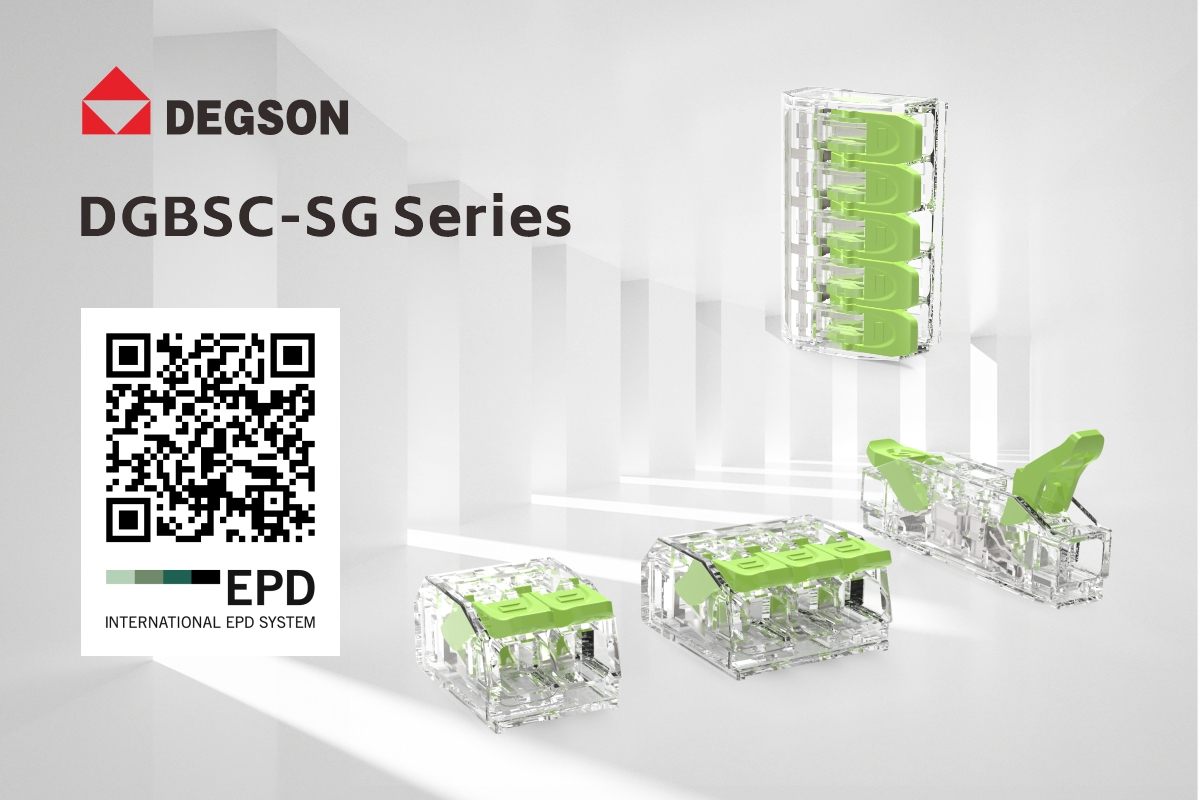
The tool-free push-in quick connection design featured on DEGSON DGBSC-SG splicing wire terminals also generates indirect carbon savings during factory assembly and post-market maintenance. Equipped with an easy-to-operate rotary green handle, the terminals eliminate screwdriver tools for wire insertion and locking, cutting wiring assembly time by more than half on production lines. Shorter assembly cycles reduce factory electricity consumption from production equipment, shorten workshop operating hours and curb carbon emissions linked to mass manufacturing. Meanwhile, stable push-in clamping eliminates the need for periodic re-tightening of wiring joints during equipment maintenance. Fewer on-site service trips, reduced labor transportation and lower replacement part consumption all jointly cut the indirect carbon output generated in the after-sales phase of equipment operation.
Why EPD Certification Matters
To turn scattered carbon-saving advantages into quantifiable, audit-ready carbon reduction data for green project compliance, manufacturers must prioritize terminals with official EPD certification. EPD, short for Environmental Product Declaration, is a third-party verified Type III environmental statement standardized under ISO 14025 and the European PCR rule EN 50693 for electronic components. Unlike vague self-declared eco-marketing claims, a valid EPD relies on rigorous full-life-cycle assessment (LCA) to quantify all environmental impacts, with carbon footprint as the core indicator. It delivers standardized, comparable, traceable environmental data that enterprises can directly use for internal carbon accounting, EU green tender bidding, LEED/BREEAM green building certification and CBAM carbon declaration — eliminating the risk of unsubstantiated greenwashing and meeting rigid cross-border sustainable regulatory requirements.
We strongly recommend DEGSON's DGBSC-SG series low-carbon splicing wire terminals as a verified carbon reduction solution for global equipment manufacturers. This terminal lineup, covering 01P, 02P, 03P and 05P specifications, holds a fully valid official EPD certification with the registration number EPD-IES-0027231:002, valid until December 10, 2030, with its full lifecycle carbon data publicly accessible via the Environdec database (environdec.com/library/epd27231). Issued and audited by independent third-party institutions, this EPD document supplies credible, granular carbon emission data covering raw material processing, terminal production, transportation, in-service use and end-of-life recycling, which can be fully incorporated into customers' full-equipment carbon evaluation reports to satisfy all sustainable certification and carbon compliance criteria for European and global green projects.
Dual Circular Material Formulas, Double GWP Cuts
The core low-carbon advantage of the DGBSC-SG series lies in its dual circular material formulas that slash Global Warming Potential (GWP) — the standard metric for measuring greenhouse gas warming impact relative to CO₂ equivalent emissions. First, bio-based Bio-PA partially replaces traditional fossil PA raw materials. Derived from renewable biological feedstocks within the fast carbon cycle, Bio-PA cuts the product's GWP by 20% compared to conventional virgin polyamide, accelerating clients' progress toward corporate carbon neutrality roadmaps. Second, the terminals integrate post-consumer recycled PET sourced from waste plastic bottles. This closed-loop recycled material avoids massive carbon emissions generated during virgin PET petroleum synthesis, delivering a 45.8% reduction in material-phase GWP versus standard fossil plastics. Both material variants retain full electrical insulation, flame retardancy and mechanical stability required for industrial wiring, with no compromise on safety or service lifespan while delivering verifiable embodied carbon cuts.
From Component to Competitive Edge
In the current global push for industrial decarbonization, wiring terminals are no longer trivial passive components but core carriers to realize systematic carbon reduction of complete electrical units. By selecting EPD-certified low-carbon terminals like the DEGSON DGBSC-SG series, equipment makers can achieve multi-dimensional carbon cuts spanning manufacturing, operation and maintenance, obtain transparent, audit-compliant carbon footprint evidence, and build long-term green competitiveness to navigate increasingly strict international low-carbon trade and regulatory barriers.


