Choosing a Terminal Block You Can Wire by Hand on Site
If wiring out a junction box with screw terminals feels slow — strip, insert, torque each screw, then recheck them all — the faster route on site is a tool-free terminal block you can wire by hand. But speed alone is not the whole decision: a block worth standardizing on also lets you undo a mistake without wasting a conductor, fits the box you actually work in, and still holds up later on vibration, current, mixed conductor types and testing. This guide sets out what to check for hand wiring on site, then shows where the DEGSON DGBSC series — a building-wiring terminal block that uses push-in spring connection with a rotating operating handle — fits, after the selection criteria, not before.
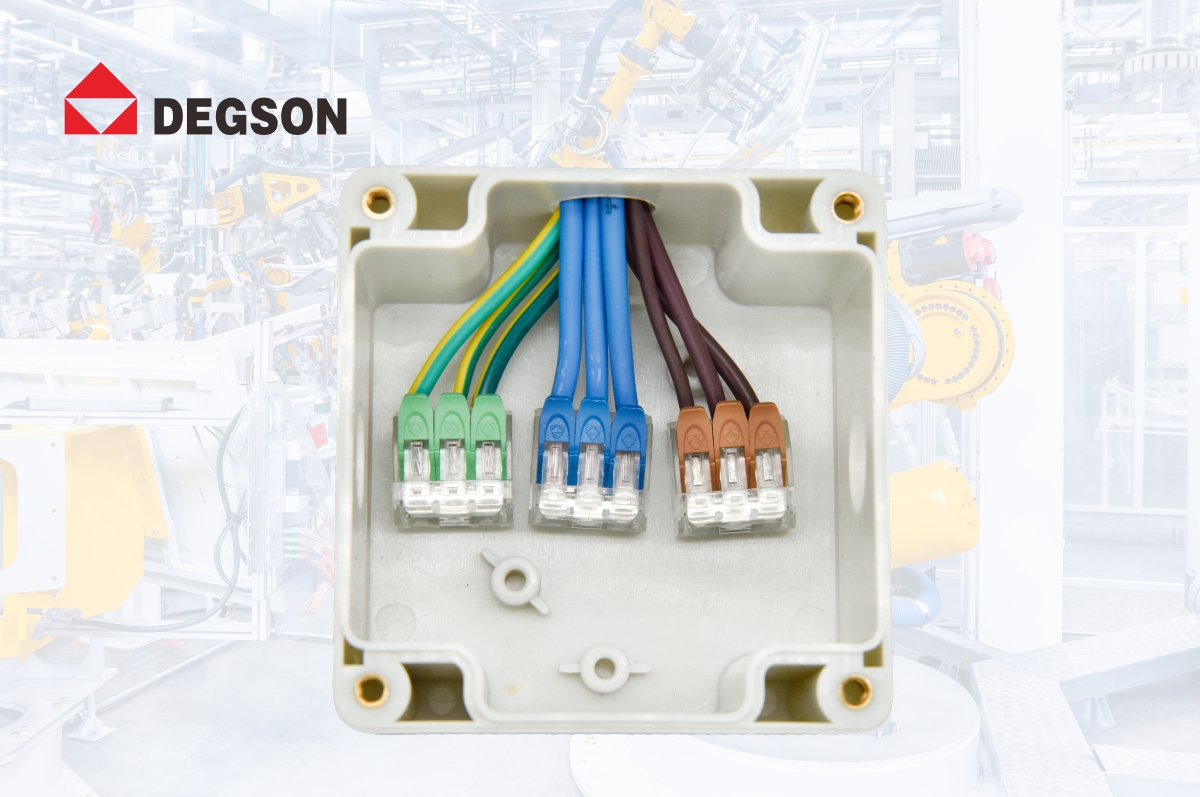
Hand wiring: check the connection method and whether you can undo it
The reason to reach for a tool-free block on site is simple: methods like wire nuts and screw terminals need manual twisting or screwdriver torque at every point, and across a large job that time adds up. Rework from wiring errors adds more.
What to check: whether the block wires without a tool (push-in / spring clamp) and whether its operating handle is re-openable for non-destructive wire removal. A re-openable handle means a wiring error costs a re-seat, not a wasted conductor — which is what makes hand wiring in a crowded box forgiving. The DGBSC series uses push-in spring connection with a rotating operating handle — strip, press to insert, release to clamp, lift the handle to release — so verify that action against your own on-site workflow.

Available space: check body width and height against the enclosure
Fixtures and enclosures keep shrinking — ultra-thin LED housings, ceiling boxes, junction boxes and dense distribution boxes all constrain the footprint. A bulky connector either won't fit or is awkward to operate once forced in.
What to check: the block's actual width and height against the tightest enclosure you use, and its pitch if you are placing several poles side by side. The compact DGBSC-SG02/4 uses a fine pitch for its class, and the higher-current DGBSC-SG01/6 is on a 6.9 mm pitch — confirm the exact overall dimensions for the variant you place from its datasheet or CAD file, since they decide whether the block seats with room to work.
Vibration: check the clamping principle and the test standard
Continuous low-frequency vibration can gradually loosen screw terminals; as contact degrades, contact resistance rises and can trigger relay chatter or false alarms. Thermal expansion and contraction can loosen traditional joints over time as well.
What to check: whether the terminal maintains contact force by a spring clamp rather than a screw, and which vibration standard it was tested to. A spring-clamp structure applies continuous force to the conductor, which removes the screw-loosening failure mode; verify this is backed by the relevant test data rather than assumed. Check the insulation's flame rating too — and note it varies by series: the DGBSC-SG building-wiring blocks use a transparent PC housing rated UL 94 V-2, whereas the DG271V power series uses a PA66 housing rated UL 94 V-0. Match the rating to what your end-product standard requires. Both are approved to UL and VDE.
Heat under load: check current rating and full-section contact
High-current circuits — HVAC and PV among them — carry enough continuous current that a poor contact heats up, and accumulated temperature rise is a fire risk. Incomplete conductor coverage at the terminal is one of the more common high-current hazards.
What to check: the nominal current, rated voltage and — importantly — the UL rating separately, since IEC and UL figures differ. The DGBSC-SG01/6 is rated 41 A / 450 V to IEC but 30 A / 600 V under its UL class C, with 0.5–6 mm² (20–10 AWG) wire and a stated test spec of UL 1059 / IEC 60998; so a design at 35 A that looks fine on the IEC number is over the UL rating. For higher current or where a V-0 housing is required, the DG271V push-in series reaches 76 A / 1000 V (IEC), 70 A / 300 V (UL class B), 0.2–16 mm² (20–4 AWG), PA66 UL 94 V-0, to IEC 60947 / UL 1059. Pick against your worst-case load on the rating that governs your market, and confirm the clamp seats the whole conductor section rather than an edge.
Mixed conductors: check for an independent spring per point
Real installs mix solid, stranded and fine-stranded conductors at one location. Traditional connectors can nick or break stranded cores, and finer conductors can work loose when gauges are mixed — both lead to poor contact and overheating.
What to check: whether each connection point has its own independent spring, and the block's full wire-gauge window. An independent spring per point lets solid, stranded and fine-stranded wires be held independently. Across the DGBSC push-in range the windows run from 0.2–4 mm² (24–12 AWG) on the SG02/4 to 0.5–6 mm² (20–10 AWG) on the SG01/6, with the DG271V reaching 0.2–16 mm² (20–4 AWG) — match the window to the conductors you actually land, and note that both solid and flexible conductors are specified over the same range.
Testability: check for test points and a visible insertion window
After install, key points need voltage, current and continuity checks. Methods that force you to disconnect wires to measure are slow and accelerate wear through repeated re-termination.
What to check: whether the block offers test/probe points and a way to confirm insertion visually. The DGBSC series provides a transparent housing to confirm insertion and strip length, plus a top potential-detection hole and front/rear test holes for measuring continuity, voltage and current without disconnecting — features to verify on the specific part you choose.
FAQ
Q1: For push-in terminal blocks, is the current rating the only spec that matters for a high-current circuit?
No. Alongside nominal current and rated voltage (checked against your worst-case load and target market's UL rating), confirm the clamp contacts the full conductor cross-section and that the wire-gauge window brackets your actual conductors. Full-section contact is what prevents localized heating at high current.
Q2: Can I mix solid and stranded wires in the same push-in block?
Only if the block provides an independent spring at each connection point and its wire-gauge window covers all the conductors involved. Check both on the datasheet; an independent clamp per point is what lets different wire types and stiffnesses each hold reliably.
References
-
UL 94 — Tests for Flammability of Plastic Materials for Parts in Devices and Appliances (UL Solutions).
-
UL Product iQ — verify UL file numbers and certification scope. https://productiq.ulprospector.com/
-
IEC 60947-7-1 — Low-voltage switchgear and controlgear – Terminal blocks for copper conductors. https://webstore.iec.ch/en/publication/63730
-
IEC 60998 — Connecting devices for low-voltage circuits for household and similar purposes (test spec cited on the DGBSC-SG01/6 page); UL 1059 — Standard for Terminal Blocks.
Take the next step
Work the six checks in order — connection method, footprint, clamping principle, current and full-section contact, independent spring per point, and test access — against the enclosure and load you actually have. To evaluate a push-in option this way, compare the DGBSC building-wiring blocks — SG02/4 and SG01/6 — and, for higher current or a V-0 housing, the DG271V on degson.com; confirm each variant's dimensions, IEC and UL ratings and wire-gauge window on its datasheet or CAD file, and request the certification file and samples for your circuit.


