Selecting Connectors for Elevator Control, Power and Safety Circuits
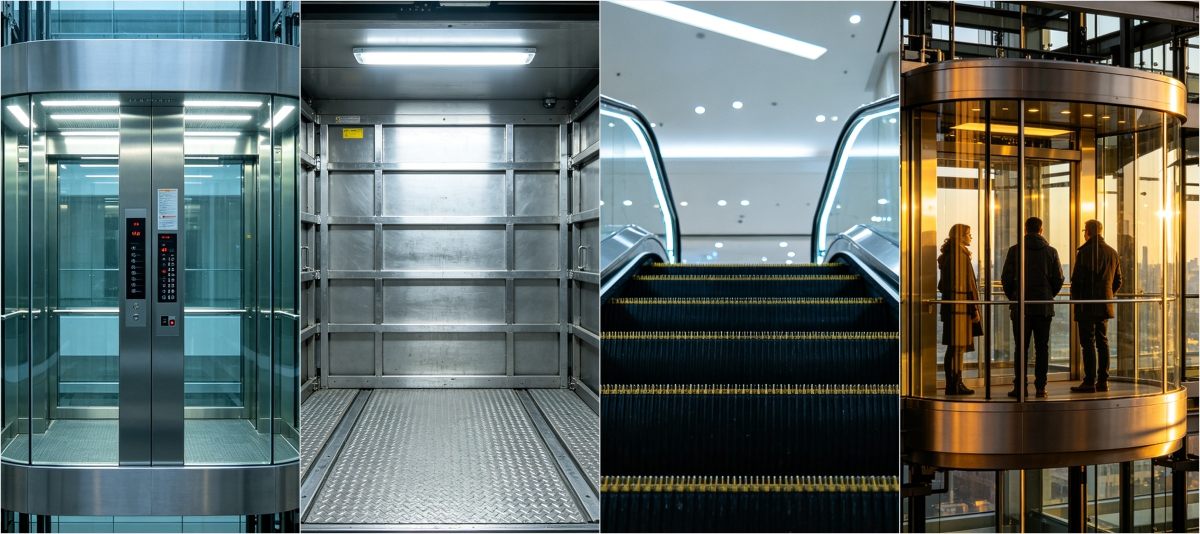
An elevator is not one connection problem but several, and the right connector is chosen per circuit rather than for the machine as a whole. Match each connector to the standard that actually governs it — IEC 61984 for pluggable connectors, IEC 60947-7-1 for DIN-rail terminal blocks, and UL 1059 for board-mounted terminal blocks in North American designs — then layer on the two constraints the elevator environment adds: an ingress rating suited to where the part is mounted, and verified resistance to the continuous vibration and shock of a running car. Get those right first; the brand and series decision follows.
Match the connector to the standard that governs it
The first decision is not brand or IP rating — it is which connector family each circuit needs, because that determines which product standard applies and what a certificate actually covers.
Signal and control connections between the controller, floor-position modules and door logic are low-current but numerous, so a pluggable connector is common. A pluggable connector for equipment use is evaluated to IEC 61984, not to the terminal-block standards. DIN-rail terminal blocks inside the control cabinet — used to land and distribute field wiring — are governed by IEC 60947-7-1. Board-mounted terminal blocks on a control PCB, for North American designs, are typically rated to UL 1059, which can be checked by file number in UL Product iQ.
The point of separating these is scope. A UL, IEC or VDE certificate covers a specific series, rating and configuration — not "the whole catalogue." Confirm the certificate applies to the exact part, current/voltage rating and pole count you are placing, for the market you ship to.
Set the ingress rating by where the part is mounted
Elevators mount connectors in very different environments, so a single IP target for the whole machine is the wrong approach.
For exposed positions — the hoistway, the car top, escalator truss cabinets — dust, condensation and cleaning water are realistic, and a housing rated IP65 or higher is the usual requirement. Inside a closed control cabinet, a lower rating such as IP20 is normally acceptable and can help with heat dissipation. For heavy-duty rectangular connectors specifically, note that the ingress rating is a property of the metal hood/housing, not of the insert alone: the insert carries the electrical ratings, and the mated assembly with its hood provides the sealed IP65 protection. Specify both parts together.
Treat vibration and shock as a first-class requirement
A running elevator subjects every connection to start/stop cycles, ride vibration and braking shock over a service life measured in years. This is where an elevator connector differs most from a benign cabinet application, and it should be verified against test standards rather than assumed.
Two mechanical test references are directly relevant: vibration to IEC 60068-2-6 and mechanical shock to IEC 60068-2-27. Ask the supplier which levels the connector was tested to. Alongside the test data, the connection technology itself matters: the clamping and contact-retention requirements in the IEC 60947-7 series (screw, screwless and insulation-displacement terminals under parts 7-1/7-2/7-3) exist so that a terminated conductor keeps a stable contact force under load — which is exactly what vibration tends to degrade. A positive locking mechanism on a pluggable or heavy-duty connector guards against the mated halves working loose. Mating-cycle life, by contrast, describes how many times a connector can be unplugged and re-plugged during service and maintenance; it is a serviceability figure, not a vibration rating, so keep the two separate when reading a datasheet.
Where DEGSON connectors fit — a heavy-duty example
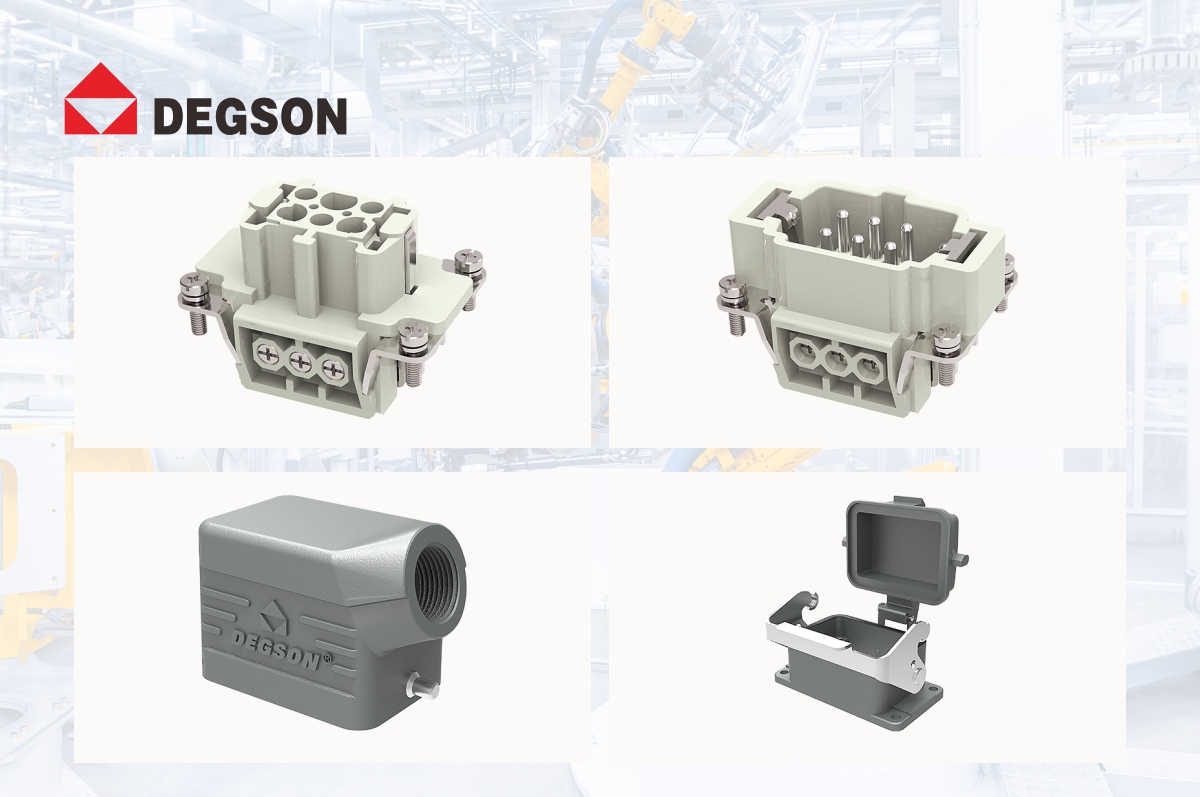
DE-006 series
Applying the method above to an elevator power or inspection circuit points toward a heavy-duty rectangular connector. As a concrete example, the DEGSON DE series heavy-duty insert set — DE-006-M (pin insert) mated with DE-006-F (socket insert) — carries verifiable ratings suitable for such a circuit:
| Parameter | DE-006 insert (per DEGSON SKU page) |
|---|---|
| Rated current / voltage | 16 A / 500 V (UL/CSA 600 V), rated impulse 6 kV, pollution degree 3 |
| Contacts | 6 poles + PE, 6B form size |
| Connection | Screw clamp, 0.75–2.5 mm² (18–14 AWG), 7 mm strip, 0.5 N·m torque |
| Temperature | −40 °C to +125 °C |
| Materials | PC housing, UL 94 V-0; silver-plated copper-alloy contacts |
| Mating cycles | ≥ 500 |
| Standards / approvals | IEC 61984, IEC 60664; VDE and UL/CSA |
Because the insert itself does not carry an IP figure, it is paired with a 6B-size metal hood to reach IP65 for exposed escalator or hoistway positions, and the PE contact provides the protective-earth connection. DEGSON's matching 6B hoods — for example the D6B-SE-2g-M20 (die-cast aluminium, RAL 7037, IP65, −40 °C to +125 °C), with sibling variants differing only in thread size, cable-outlet direction, latch-versus-screw fixing and single-versus-double ear — all carry IP65 or higher. Pick the hood variant that fits the cabinet entry, keeping the same 6B insert. For the vibration/shock test levels of a specific mated configuration, request the corresponding test report from DEGSON application engineering.
Adoption across the elevator industry
The selection method above is not theoretical: DEGSON's connection and terminal products are used in elevator and escalator programs by a number of established manufacturers in the sector, among them TK Elevator (TKE), Wittur, Hitachi and Schindler. These are supply relationships rather than an endorsement of any one part — the specific series, ratings and configurations differ by program, and each is chosen the same way this article describes, against its own product standard and the mounting-position and vibration requirements of the circuit it serves. What the breadth of these relationships does indicate is that the products have been qualified against the documentation and test evidence that elevator OEMs typically require before a connector enters a passenger-carrying system.
FAQ
Q1: For an elevator, should I select one connector to a single IP rating for the whole machine?
No. Select per mounting position. Exposed hoistway, car-top and escalator-cabinet positions typically need IP65 or higher, while connections inside a closed control cabinet can use a lower rating such as IP20. For heavy-duty rectangular connectors, remember the IP rating comes from the mated hood/housing, not the insert alone.
Q2: Does a high mating-cycle rating mean a connector will survive elevator vibration?
Not directly. Mating cycles measure plug/unplug durability for service and maintenance. Vibration and shock survival is a separate property, verified against IEC 60068-2-6 (vibration) and IEC 60068-2-27 (shock), together with the contact-retention requirements of the IEC 60947-7 series and a positive locking mechanism. Check both sets of data.
References
-
IEC 61984 — Connectors – Safety requirements and tests. https://webstore.iec.ch/en/publication/6223
-
IEC 60947-7-1 — Low-voltage switchgear and controlgear – Terminal blocks for copper conductors. https://webstore.iec.ch/en/publication/63730
-
IEC 60068-2-6 (vibration) and IEC 60068-2-27 (shock) — Environmental testing. https://webstore.iec.ch/en/publication/510
-
UL Product iQ (public database, for UL 1059 and file-number verification). https://productiq.ulprospector.com/
Take the next step
Start from the circuit, not the catalogue: list each elevator connection, decide whether it needs a pluggable connector (IEC 61984), a DIN-rail terminal block (IEC 60947-7-1) or a board-mounted block (UL 1059), then set the IP target by mounting position and ask for vibration/shock test data. To evaluate a heavy-duty option, browse the DE series inserts on degson.com — including DE-006-M and DE-006-F — and pair them with a 6B IP65 hood such as the D6B-SE-2g-M20, then request the matching CAD and test report for your configuration.


