A Practical Guide to DC EV Charging Connectors: Selection Criteria, Global Certification and Reliability Basics
To choose a DC EV charging connector, you need to answer three questions at the same time: which interface standard the target market uses, whether the rated current and voltage can cover the real charging power, and whether the reliability features such as protection rating and temperature monitoring meet the installation environment. In Europe, the mainstream is CCS2 (IEC 62196-3:2022). In North America, the market is moving fast to NACS (SAE J3400, and it needs UL 2251 certification). On rated parameters, 1000V DC has become the common voltage platform. Air-cooled products cover 200A to 380A, with max power from 200kW to 380kW. For reliability, IP67 connector body, IP55 when mated, over 10000 mating cycles, and built-in Pt1000 temperature sensors are the common baseline for commercial DC charging guns today. This article is for charging station integrators and procurement engineers. It explains the core logic of selection, certification and reliability.
1. Main Types and Target Markets
There is no global unified interface for DC charging connectors. Different regions are led by different standard organizations. The first step of selection is not to compare parameters, but to lock the target market and the vehicle-side inlet. Otherwise, the connector cannot mate physically.
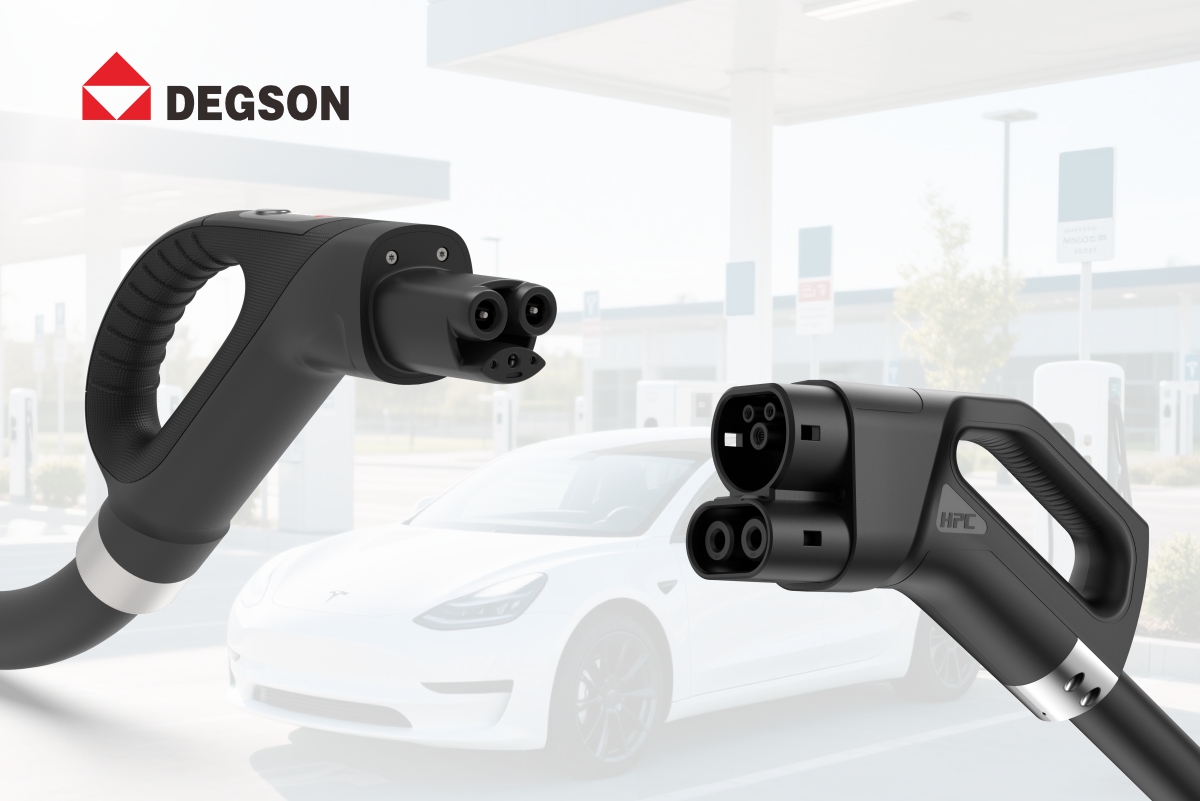
CCS2 (Combined Charging System Type 2) is the main DC fast charging interface in Europe, Southeast Asia and parts of the Middle East. It adds two DC high-current contacts to the Type 2 AC interface. It has 3 power contacts (DC+, DC-, PE) and 2 signal contacts (CP control pilot, PP proximity). Its physical dimensions and compatibility are defined by IEC 62196-3:2022, and general safety requirements by IEC 62196-1:2022. The European Commission Delegated Regulation (EU) 2025/656 states that newly installed or renewed recharging points should apply at least EN IEC 62196-2:2022 and EN IEC 62196-3:2022.
NACS (North American Charging Standard) was opened by Tesla and standardized by SAE as SAE J3400 in December 2023. It uses only 2 current-carrying contacts to support both DC fast charging and single-phase AC, so it is more compact. Many major automakers in North America have announced NACS vehicle inlets, and charging infrastructure is switching fast. The safety certification for NACS connectors follows UL 2251, "Plugs, Receptacles, and Couplers for Electric Vehicles". This standard has been updated to cover NACS/J3400 geometry.
Note that CCS2 and NACS have different physical interfaces and communication protocols. They cannot be used directly with each other. Cross-standard use needs a special adapter, and the adapter itself must pass certification such as UL 2252. This article does not cover CHAdeMO or the Chinese GB/T interface.
2. Key Selection Criteria: Current, Voltage and Power Matching
After the interface type is fixed, the next step is to match the rated parameters with the real output of the charging station. Choosing too large increases cost. Choosing too small limits charging speed and may even cause overheating.
Rated voltage: Today, most DC charging guns have 1000V DC on power contacts and 30V DC on signal contacts. The 1000V platform covers both 400V and 800V vehicle architectures. It is the safe choice for selection now.
Rated current and max power: DC charging power = voltage × current. At 1000V DC:
-
200A = about 200kW
-
250A = about 250kW
-
300A = about 300kW
-
350A (NACS air-cooled upper limit) = about 350kW
-
380A (CCS2 high-current air-cooled) = about 380kW
Air-cooled products near 350A–380A are close to the cooling limit. Higher current (above 500A) usually needs liquid-cooled or oil-cooled designs. When purchasing, check the max output current of the charging modules and keep 10%–20% margin. This avoids too high temperature rise during long full-load operation.
Signal contacts: CP (Control Pilot) handles charging handshake and power negotiation. PP (Proximity) detects that the connector is plugged in and identifies the cable rating. Both are rated 30V / 2A. They are the core of charging safety logic and cannot be omitted or shorted.
Ambient temperature: Operating temperature is usually -30℃ to +50℃ (CCS2) or -40℃ to +50℃ (NACS). Storage and transport can go down to -40℃. In cold markets like Northern Europe or Canada, check cable flexibility at low temperature. A too-stiff cable makes plugging difficult.
3. Global Certification Rules
Certification is not just a label. It is the legal threshold for a product to enter the target market. Different regions have different certification systems, standard versions and test scopes. When purchasing, you must ask the supplier for certificates for the exact model, not a general "meets the standard" statement.
Europe:
-
Standards: IEC 62196-1:2022 (general requirements) + IEC 62196-3:2022 (DC dimensional compatibility)
-
Certification: CB certificate (IECEE system, base for multi-country certification), CE mark (covers LVD and EMC), UKCA (UK market)
-
Note: EU Regulation (EU) 2025/656 has updated the standard reference to the 2022 version. Products with the old IEC 62196-3:2014 may no longer be accepted in new installation projects.
North America:
-
Standards: SAE J3400 (NACS interface physical and performance requirements) + UL 2251 (safety certification)
-
Mark: UL Listing or RU (Recognized Component) mark
-
Protection: NEMA Type 3R (when mated, rain and ice resistant), Type 4 (connector body, water splash and dust resistant)
-
Note: UL 2251 certification must cover the exact current rating and cable configuration. It cannot be extended from a 200A model to a 350A model automatically.
General environmental requirements: The EU market also needs REACH SVHC (Substances of Very High Concern) and RoHS (Restriction of Hazardous Substances) compliance. These are not the core of charging safety, but they are the baseline for market access.
Purchasing tip: Ask the supplier to provide certificate copies at the quotation stage. Check that the model, current rating and standard version on the certificate match the purchased model exactly. Expired certificates or model mismatches can cause problems at customs inspection and project acceptance.
4. Reliability Basics
DC charging guns work outdoors with high-frequency plugging for a long time. Reliability directly decides the maintenance cost. The following items are the core metrics to evaluate product durability.
Protection rating (IP / NEMA Type):
-
Connector body (unmated): IP67 means full dust protection and short immersion in 1-meter water (30 min). It is good for rainy days and washing.
-
Mated state: IP55 means dust protection and low-pressure water jet protection. It meets daily use of outdoor charging stations.
-
NACS products use NEMA Type 4 (body) and Type 3R (mated). The meaning is similar to IP, but the test method is different.
Temperature monitoring:
Contact heating during high-current charging is the main safety risk. Most products put one Pt1000 platinum temperature sensor on each of DC+ and DC- contacts to monitor temperature rise in real time. When temperature exceeds the threshold, the station can reduce output current or stop charging. For CCS2 high-current products, the sensor range can reach -40℃ to +150℃. For NACS products, it can reach -50℃ to +130℃. A DC charging gun without temperature sensors should not be used above 200A.
Mechanical life and mating force:
The common industry minimum is over 10000 no-load mating cycles. For mating force, CCS2 products are usually below 100N, and NACS products below 90N. Too high force gives bad user experience. Too low force may cause accidental disconnect if the vehicle moves during charging. Replaceable terminal and gun-head design allows replacing only the front part after contact wear, which reduces maintenance cost.
Connection process and insulation: The connection between power terminal and cable affects contact resistance and long-term temperature rise. Compared with traditional crimping, ultrasonic welding has larger contact area, lower resistance and better anti-vibration performance. Insulation resistance should be above 100MΩ. Housing material needs UL94 V-0 flame rating. Contact material uses copper alloy with tin or nickel plating to resist oxidation.
Under this selection and reliability framework, some manufacturers have launched product series covering both markets. For example, DEGSON's CCS2 DC charging gun offers 200A/250A/300A/380A current options. The 380A model meets IEC 62196-2022 and has CB, CE and UKCA certification. It has IP67 body, IP55 mated, 2×Pt1000 temperature sensors (-40℃~+150℃), over 10000 mating cycles, ultrasonic welding and replaceable terminal design. The NACS 350A model in the same series meets SAE J3400 and UL 2251, with RU component recognition. Its protection is NEMA Type 4 (body) / Type 3R (mated), sensor range -50℃~+130℃, and mating force below 90N. Both products support custom gun-body logo and cable specs, and are suitable for charging station integrators who need to serve both European and North American markets.
Reference
-
IEC 62196‑1:2025, Plugs, socket‑outlets, vehicle connectors and vehicle inlets — Conductive charging of electric vehicles — Part 1: General requirements.
-
IEC 62196‑3:2026, Plugs, socket‑outlets, vehicle connectors and vehicle inlets — Conductive charging of electric vehicles — Part 3: Dimensional compatibility requirements for DC and AC/DC pin and contact‑tube vehicle couplers.
-
SAE J3400‑202409, North American Charging System (NACS) for Electric Vehicles.
-
UL 2251‑2022, Standard for Safety for Plugs, Receptacles, and Couplers for Electric Vehicles.
FAQ
Q1: Can CCS2 and NACS charging guns be used interchangeably with an adapter?
A: Physically, a special adapter can be used. But the adapter must pass safety certification such as UL 2252. It also adds extra contact resistance and temperature rise. It is not recommended for long-term high-frequency use. The station side and vehicle side should use the same standard when possible.
Q2: How to choose between air-cooled 350A and liquid-cooled 500A+ products?
A: If the station power per gun is below 350kW and daily charging sessions are under 40, an air-cooled 350A product is enough and costs less. If per-gun power exceeds 400kW, or the station is in a high-load place like a highway service area (over 60 sessions per day), choose liquid-cooled or oil-cooled solutions to control temperature rise and extend life.
Technical parameters in this article are based on DEGSON public product datasheets and official standard documents from IEC, SAE and UL. Certification status is subject to valid certificates provided by the supplier.


