What Really Drives Diverse Electrification – Is It the Energy Source Itself?
As new energy vehicles, energy storage systems and industrial equipment move toward higher voltage and greater electrification, power transmission requirements continue to increase while operating environments become more demanding. Connectors must deliver stable power in limited spaces and withstand vibration, shock, temperature changes, moisture, dust and repeated assembly throughout their service life.
Across vehicles, energy storage, construction equipment and marine platforms, DEGSON provides flexible high-voltage connector products and customized connection solutions to help customers build safer, more efficient and service-friendly high-voltage systems.
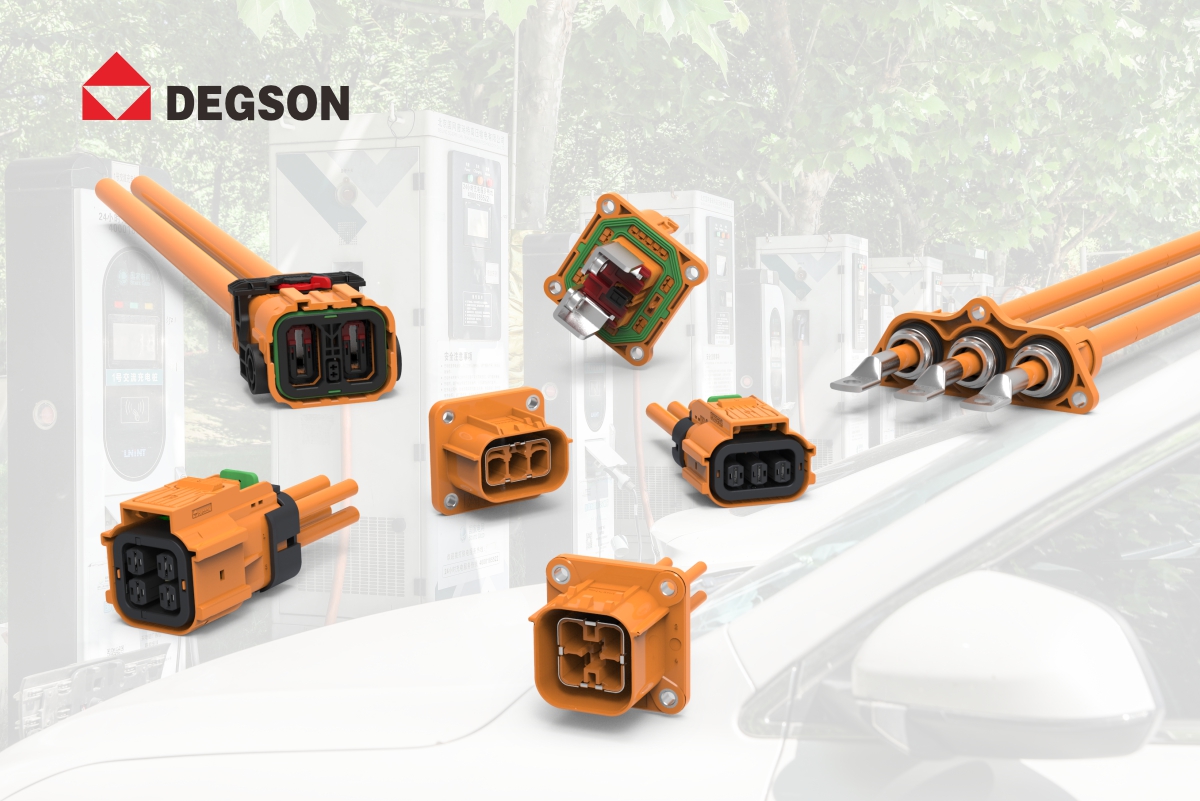
Application Landscape
| Application | Typical equipment | Main connection points | Core requirements |
|---|---|---|---|
| Passenger EVs | BEVs and PHEVs | Battery packs, PDU, motor, inverter, OBC and DC/DC | Compact packaging, HVIL, shielding and assembly efficiency |
| Logistics & commercial | Vans, light trucks, buses and heavy trucks | Battery, e-drive, HV distribution, HVAC and charging | Continuous current, thermal control, durability and maintenance |
| Construction machinery | Excavators, loaders, forklifts and mining vehicles | Battery, e-drive, electric hydraulics and HV cabinets | Vibration resistance, sealing, dust protection and serviceability |
| Small electric mobility | Motorcycles, three-wheelers and battery-swap equipment | Battery pack, controller, charging and swap interfaces | Compact size, keying and repeated mating |
| Energy storage | C&I, containerized and residential ESS | Modules, racks, PCS, busbar and control units | Standardization, modularity, expansion and maintenance |
| Marine & ports | Yachts, ferries, sightseeing vessels and port equipment | Traction battery, propulsion, distribution and charging | Sealing, corrosion resistance, flame resistance and environment |
| Rail & special vehicles | Rail vehicles, GSE, fire trucks and AGVs | Traction, auxiliary power, HVAC and HV control units | Platform adaptation, custom structures and long-term reliability |
Electric Passenger Vehicles: Critical Connections Across the Three-Electric System
In battery electric and plug-in hybrid vehicles, high-voltage connectors are widely used between the traction battery, motor controller, drive motor, on-board charger, DC/DC converter, electric air-conditioning compressor and power distribution unit.
Passenger vehicles offer limited installation space and compact harness routing, while continuously experiencing vibration, shock and temperature variation in service. High-voltage connectors therefore need to balance compact design, shielding, mechanical locking, keying and convenient assembly to provide stable connections throughout the vehicle platform.
Electric Logistics Vehicles and Light Commercial Vehicles: Built for High-Frequency Operation
Urban delivery, express transportation and cold-chain logistics vehicles typically operate for long hours, stop and start frequently, and recharge often. High-voltage connectors can be deployed in traction batteries, electric drive systems, high-voltage distribution boxes, charging systems, electric HVAC and refrigeration equipment.
For different chassis and electrical architectures, flexible cable sizes, outlet directions, locking methods and mounting structures can optimize harness routing while improving connection stability and maintenance efficiency under intensive fleet operation.
Electric Buses and Heavy-Duty Trucks: Supporting High-Power Energy Transfer
Electric buses, heavy trucks and mining transport vehicles are usually equipped with larger traction batteries and higher-power drive systems. High-voltage connectors can be used for series or parallel links between battery boxes, battery-to-distribution connections, motor controller interfaces and high-voltage auxiliary equipment.
Reliable contact structures, mechanical locking and high-voltage interlock designs help the vehicle identify connection status and support safe power-up, shutdown and fault protection, reducing risks associated with abnormal connections and unexpected live operation.
Electric Construction Machinery: Ready for Vibration, Dust and Heavy-Duty Conditions
Excavators, loaders, forklifts, cranes and mining machines are rapidly transitioning to electric power. These platforms often operate in environments with dust, mud, vibration and severe impact, placing demanding requirements on the environmental performance of the connection system.
High-voltage connectors can be used in traction batteries, electric drive systems, electro-hydraulic systems, high-voltage control cabinets and charging systems. Modular, quick-connect structures can shorten manufacturing and service time and reduce operational losses caused by equipment downtime.
Electric Motorcycles and Small Mobility: Reliable Connections in Limited Space
Electric motorcycles, three-wheelers, low-speed vehicles and other small electric mobility platforms have tight packaging constraints and are sensitive to connector size, weight and cable outlet direction. High-voltage connectors can link battery packs, motor controllers, charging interfaces and high-voltage auxiliary equipment.
Battery-swap platforms must also tolerate repeated mating, different user habits and outdoor operation. Compact design, clear keying, dependable locking and stable electrical contact are essential to long-term swap-system reliability.
New Energy Storage Systems: Connecting Battery Modules and Power Equipment
In commercial and industrial storage, containerized systems, residential storage and integrated charging or swapping equipment, high-voltage connectors are widely used between battery modules, racks, busbar units, PCS, BMS and high-voltage control cabinets.
Energy storage systems include many connection nodes. Standardized, modular and pluggable connection solutions reduce on-site wiring, improve installation consistency and simplify system expansion, module replacement and long-term maintenance.
Electric Vessels and Port Equipment: Addressing Humidity and Corrosion
Electric yachts, ferries, sightseeing vessels, port tractors and terminal handling equipment are becoming important applications for new energy connection technology. High-voltage connectors can serve traction batteries, propulsion motors, onboard charging, high-voltage distribution and electric deck equipment.
In humid, salt-spray, vibrating and temperature-variable environments, connection solutions need to consider sealing, corrosion resistance, flame resistance, mechanical protection and long-term stability, with cables and accessories selected for the actual installation position.
Rail Transit and Special-Purpose Vehicles: Adapted to Complex Platforms
Rail vehicles, airport ground support equipment, fire engines, autonomous transport vehicles and other special-purpose platforms differ significantly in electrical architecture, available installation space and operating environment. Standard products may not always meet project requirements directly.
For specialized platforms, connector orientation, panel structure, cable length, shielding method, locking mechanism and signal configuration can be adapted so the high-voltage connection solution integrates more effectively with the complete machine or vehicle system.
From Standard Products to Customized High-Voltage Connection Solutions
Different industries prioritize different connector characteristics. Passenger vehicles focus on compact packaging and automated assembly; commercial vehicles emphasize continuous current capability and durability; construction machinery requires vibration resistance and environmental protection; energy storage equipment values standardization, modularity and maintenance efficiency.
Based on the customer platform, DEGSON can provide:
-
Selection support for high-voltage connectors, terminals, cables and accessories;
-
Adaptation of mounting direction, cable outlet, shielding and sealing solutions;
-
Configuration of high-voltage interlock, mechanical locking and keying features;
-
Customized development around packaging space, harness routing and maintenance requirements;
-
Support for sample verification, interface matching and project implementation.
From vehicle three-electric systems to energy storage equipment, and from urban logistics to electric vessels, high-voltage connectors are more than links between batteries and devices. They are essential pathways that enable new energy technologies to enter diverse application environments. DEGSON continues to focus on new energy connectivity, using reliable connections to carry efficient power and unlock more possibilities for electrified equipment.


