The Unsung Hero of Smart Lighting Systems: Why Connectors Determine Project Success
In smart‑lighting projects, designers carefully plan dimming logic, scene modes and control systems. Yet installation teams often stumble at the final step --- wiring.
Lamp flickering, open circuits, signal interference, or total lamp failure... When faults are traced to root cause, connectors are frequently to blame. According to industry research, connector‑related failures account for over 23 % of total LED‑system breakdowns. Among on‑site warranty cases for outdoor LED lighting systems, up to 68 % of failures occur at connection points. Though these tiny components represent a negligible share of total project cost, they act as the "unsung hero" that makes or breaks a project.
I. Why Connectors Are the Weakest Link in Smart‑Lighting Systems
Smart‑lighting systems carry not only power supply but also dimming signals, colour‑temperature control and DALI bus communications. Poor connector contact leads to signal loss and renders the whole intelligent‑control logic ineffective.
Traditional wiring methods suffer three critical flaws:
- Loose / unreliable connections: Screw terminals and tape wrapping are hard to execute properly in confined spaces such as ceiling junction boxes and luminaire housings. Installers cannot guarantee every conductor is fully clamped. Over time, thermal expansion‑contraction and minor building vibration worsen loose contacts. Higher contact resistance generates heat, ranging from lamp flickering to potential fire hazards.
- Mismatched wire gauge: Sampling tests by CQC (China Quality Certification Centre) show 28 % of LED connectors on‑market are incompatible with the wire cross‑sections they serve. Smart‑lighting mixes power cables and control‑signal cables of varying specs; mismatched connectors directly cause bad contact.
- Difficult maintenance: Conventional wired joints are hard to disconnect once assembled. Smart‑lighting requires frequent commissioning and luminaire replacement. Each rework means stripping and re‑wrapping conductors, driving high maintenance costs.
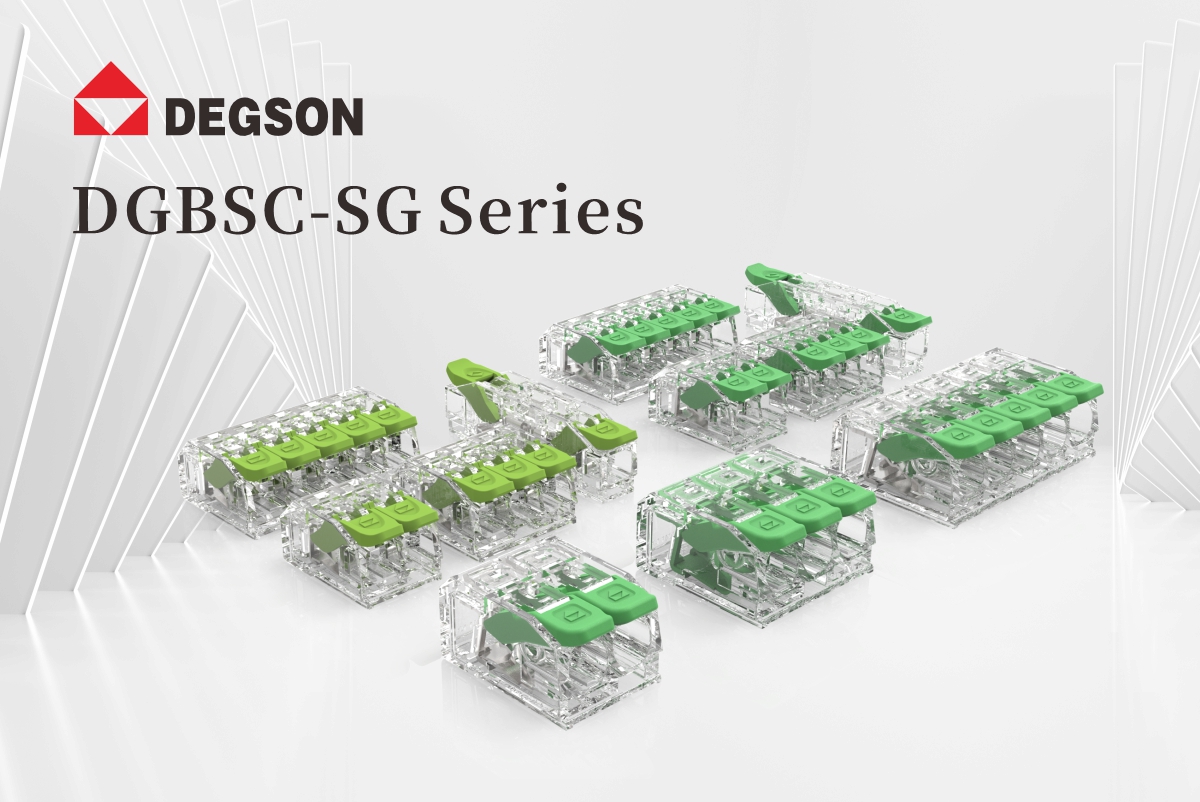
II. DGBSC‑SG Series: Connection Solutions Built for Smart Lighting
DEGSON has developed the DGBSC‑SG series push‑in terminal blocks to address above pain points. Optimised for internal power distribution inside luminaires, they are fully compatible with downlights, spotlights, LED floodlights and mainstream lighting fixtures.
- Core innovation: Tool‑free Push‑In connection technology. Strip conductors, depress the green actuator, insert wire and release --- connection completed. Compared with traditional screw‑type wiring, field‑wiring efficiency improves by more than 70 %, and factory assembly‑line throughput rises by 60 %. No screwdriver required; less‑experienced electricians can operate reliably.
- Ultra‑compact footprint for confined enclosures. The 4 mm² variant measures only 10.2 mm in height × 7.5 mm in width. It fits neatly inside ceiling boxes, downlight cavities and junction boxes without reworking existing cabling infrastructure.
- Transparent housing & visual connection inspection. Installers directly observe wire insertion depth and contact condition, eliminating hidden risks of incomplete or missed connections. Built‑in test ports on top allow voltage checks without disassembly, using standard test probes.
- Broad wire‑gauge compatibility: 0.2--6 mm² (24--10 AWG). Supports solid single‑core, solid multi‑core and fine‑stranded flexible conductors. One product family covers applications from domestic flexible lighting wiring to heavy‑gauge outdoor floodlight cabling.
- Comprehensive safety certifications. DGBSC‑SG holds UL, VDE, UKCA, CE and other international approvals, fully compliant with building‑electrical safety standards.
Additionally, DGBSC‑SG has obtained international EPD (Environmental Product Declaration) certification. Its low‑carbon variant adopts bio‑based resin and post‑consumer recycled (PCR) materials, cutting carbon emissions by 45.8 % versus conventional materials, and supporting green‑building assessment criteria.
III. Real‑World Validation: Full‑Scale Verification from Downlights to Floodlights
For recessed downlights and spotlights, ceiling luminaire can spaces are extremely compact. Thanks to its compact footprint and tool‑free connection technology, the DGBSC‑SG series rapidly connects driver power supplies and light‑source leads, substantially lowering operational difficulty for on‑site assembly and subsequent luminaire replacement.
For power distribution inside high‑power LED floodlight enclosures operating under harsh outdoor conditions, DGBSC‑SG works together with FR‑4 epoxy‑fiberglass insulating divider plates to implement feed‑through isolated wiring, preventing ingress of rainwater and dust. Its wide operating temperature range of ‑40 °C to 85 °C suits outdoor environments with scorching summer heat and frigid winter cold. No loose connections, overheating or flickering occurs even during long‑hour continuous operation.
For centralised wiring in commercial complexes, DGBSC‑SG offers multi‑pole variants including 2P / 3P / 5P to clearly distinguish live, neutral and control wires. Custom‑coloured push‑buttons deliver intuitive wiring logic for straightforward maintenance in later phases.
IV. Selection Guide: How to Pick the Right Connectors for Smart‑Lighting Projects
Three core criteria for connector selection in smart‑lighting projects: current‑carrying capacity, wire‑gauge compatibility and installation convenience.
- Residential / small‑scale commercial lighting (downlights, spotlights, LED strips): Choose DGBSC‑SG01/4 series, wire range 0.2‑4 mm², rated 32 A / 450 V.
- Large‑scale commercial / industrial lighting (floodlights, factory lighting): Choose DGBSC‑SG01/6 series, wire range 0.5‑6 mm², rated 41 A / 450 V.
- Alternative wiring orientations: Select DGBSC‑SG02 series feed‑through straight‑through connectors.
Conclusion
Every precise dimming action and stable output within smart‑lighting systems would not be possible without connectors, these "unsung heroes". Featuring tool‑free fast connection, ultra‑compact dimensions, flame‑retardant safety and eco‑friendly properties, the DEGSON DGBSC‑SG series delivers reliable assurance for an increasing number of smart‑lighting projects. In smart‑lighting projects, choosing the right connector largely determines project success or failure.
FAQ
Q1: What smart‑lighting scenarios are compatible with the DGBSC‑SG series?
It is designed for internal power distribution in mainstream luminaires such as downlights, spotlights, LED floodlights and LED strips. It also covers junction‑box wire splitting, centralised commercial‑building wiring, smart‑home lighting and other full‑range applications.
Q2: What efficiency improvement is achieved by DGBSC‑SG compared with traditional screw‑type terminal blocks?
Adopting Push‑In direct‑insert technology for tool‑free wiring, it improves field‑wiring efficiency by over 70 % versus conventional screw‑tightening wiring. Factory assembly‑line throughput rises by 60 %.
Q3: What safety certifications has the DGBSC‑SG series obtained?
The full product line holds international certifications including UL, VDE, UKCA, ENEC and CE
Q4: Can DGBSC‑SG perform stably under extremely hot or cold outdoor conditions?
Yes. Operating temperature spans ‑40 °C to 85 °C, adapting to outdoor exposure under summer sun and winter frost. No loosening or overheating arises during long‑term service.
Q5: Is DGBSC‑SG eco‑friendly and eligible for green‑building certification?
This series holds international EPD (Environmental Product Declaration) certification. Its low‑carbon variant uses bio‑based resin and post‑consumer recycled (PCR) materials, cutting carbon emissions by 45.8 % compared with conventional materials. It fully meets specifications for green‑building and ultra‑low‑energy‑building construction.


