How to Select Building Electrical Connectors in the Nordic Region: 4 Key Dimensions for Right Terminal Selection, Up to 55 % TCO Reduction
Terminal selection for building applications should not focus merely on unit price. Instead, a comprehensive assessment shall be performed across connection technology, certification coverage, environmental adaptability, environmental compliance and Total Cost of Ownership (TCO). Represented by the DEGSON DGBSC series, PUSH‑IN spring push‑in terminals deliver approximately 55 % savings compared with traditional screw‑type terminals and mainstream competing products.
I. Why Terminal Selection for Building Projects Has Become Increasingly Challenging
In building electrical systems, connectors (terminals) serve as the "joints" for current transmission. Proper selection directly determines power‑distribution reliability, maintenance costs and compliance risks. According to IEC 60364‑series statistics, roughly 30 % of electrical faults in low‑voltage power‑distribution systems stem from poor contact at connection points, over half of which are directly caused by improper terminal selection.
Current terminal selection for building projects faces three major challenges: ‑ Fragmented regulations: France NF, Nordic ENEC and Germany VDE each impose distinct market‑access requirements, leading to complex certification pathways. ‑ Extreme climate conditions: Nordic winters drop to ‑40 °C while summer temperatures in Southern Europe can reach +70 °C; ordinary terminals cannot meet such wide temperature ranges. ‑ Mandatory low‑carbon requirements: France RE2020 and the EU EPBD Directive demand a minimum 30 % reduction in whole‑life‑cycle carbon emissions for new buildings.
Drawing on DEGSON's more than ten‑year engineering expertise in building electrical applications, this article systematically breaks down terminal‑selection methodology from four dimensions to help you identify well‑matched terminals.
II. Dimension 1: Connection Technology ‑ PUSH‑IN vs Screw‑Type, Generational Gaps in Efficiency and Reliability
PUSH‑IN spring push‑in technology is a tool‑free connection solution that delivers constant contact pressure via stainless‑steel spring clips. Wires are automatically locked upon insertion without screw tightening. Compared with conventional screw‑type terminals, PUSH‑IN technology cuts installation time by around 60 %, boosts vibration resistance by three times, and supports ≥ 50 reconnection cycles, far exceeding the ≤ 10 cycles of screw‑type alternatives.
| Comparison Item | Screw‑Type Terminal | PUSH‑IN Spring Push-in (DEGSON DGBSC Series) |
| Installation Method | Tightened with screwdriver; torque control required | Direct wire insertion, tool‑free |
| Installation Time per Connection Point | Approx. 30 seconds | Approx. 12 seconds |
| Vibration Resistance | Screws prone to loosening; periodic re‑inspection required | Constant spring pressure, maintenance‑free |
| Re‑mating Cycles | ≤ 10 times | ≥ 50 times |
| Contact‑Resistance Stability | Highly susceptible to torque fluctuation | Consistent spring pressure, high uniformity |
For instance, roughly 200 connection points are required on one standard floor for lighting circuits in commercial buildings. PUSH‑IN technology saves about 1.5 hours of installation labour per floor. Re‑wiring during subsequent luminaire maintenance will not degrade contact force. The DEGSON DGBSC series has passed vibration testing per IEC 60998‑2‑2.
Accordingly, PUSH‑IN technology is preferred for frequently‑maintained lighting systems, KNX smart‑building bus systems and data‑centre power‑distribution cabinets. Hybrid solutions combining screw‑type and spring‑clamp terminals are recommended for high‑current power circuits (> 32 A).
III. Dimension 2: Certification Compliance ‑ Priority and Accelerated Pathways for NF / ENEC / VDE
Terminals for the European market must obtain relevant national or regional certifications. NF (France), ENEC (pan‑European) and VDE (Germany) are the three core market‑access qualifications. NF certification (per NF EN 60998‑2‑2) is mandatory for the French market; ENEC suffices for Nordic market entry. Products holding VDE certification may obtain NF certification faster under the CENELEC Certification Bodies Cooperation Agreement (CCA), shortening certification cycles to 3‑6 months.
| Market | Mandatory Certification | Relevant Standard | Typical Lead Time |
| France | NF | NF EN 60998‑2‑2 | 6‑12 months |
| Germany | VDE (voluntary yet widely expected by the market) | VDE 0611 / EN 60998 | 4‑8 months |
| Nordic (Sweden / Finland / Norway) | ENEC | EN 60998‑2‑2 | 4‑6 months |
| EU overall | CE (self‑declaration) + ENEC | LVD Directive 2014/35/EU | Depends on certification body |
The DEGSON DGBSC series holds VDE, ENEC, UL and CQC certifications. It leverages the CCA mutual‑recognition mechanism to satisfy French NF market requirements. For France‑bound projects, confirm at the specification stage whether products carry NF or qualify for CCA conversion, to avoid rejection during local electrical inspection after delivery.
For export projects, adopt dual‑track selection: mandatory certification for target markets plus baseline VDE certification. For multi‑market projects, prioritise products with both ENEC and VDE certifications to maximise certification reusability.
IV. Dimension 3: Temperature Range ‑ Low‑Temperature Reliability under Nordic Climates
A terminal's operating‑temperature range defines the ambient‑temperature window within which electrical and mechanical performance is guaranteed. Spring stress relaxation at low temperatures constitutes the primary failure mode leading to poor contact.
For example, extreme winter temperatures can drop to ‑40 °C in Sweden and Finland. Ordinary terminals rated for ‑25 °C ~ +70 °C suffer 15‑20 % spring‑stress decay under cold conditions, driving higher contact resistance. By contrast, the DEGSON DGBSC‑SG series operates from ‑40 °C to +85 °C. Case reference: A residential project in Helsinki, Finland, experienced intermittent lighting‑circuit power outages at ‑35 °C on outdoor distribution boxes fitted with conventional terminals, caused by reduced spring contact force. After switching to the DGBSC‑SG series, no similar failures occurred over two winter seasons. Its stainless‑steel springs undergo low‑temperature tempering treatment, retaining ≥ 85 % of initial contact force even at ‑40 °C.
Therefore, for projects in frigid zones such as the Nordic countries, northern Canada and the Russian Far East, specify terminals with a minimum operating temperature ≤ ‑40 °C and verified thermal‑cycle test reports. The same requirement applies to outdoor distribution boxes and rooftop PV combiner boxes subject to severe temperature swings.
V. Dimension 4: Environmental Compliance ‑ EPD and Green‑Scoring Logic for RE2020
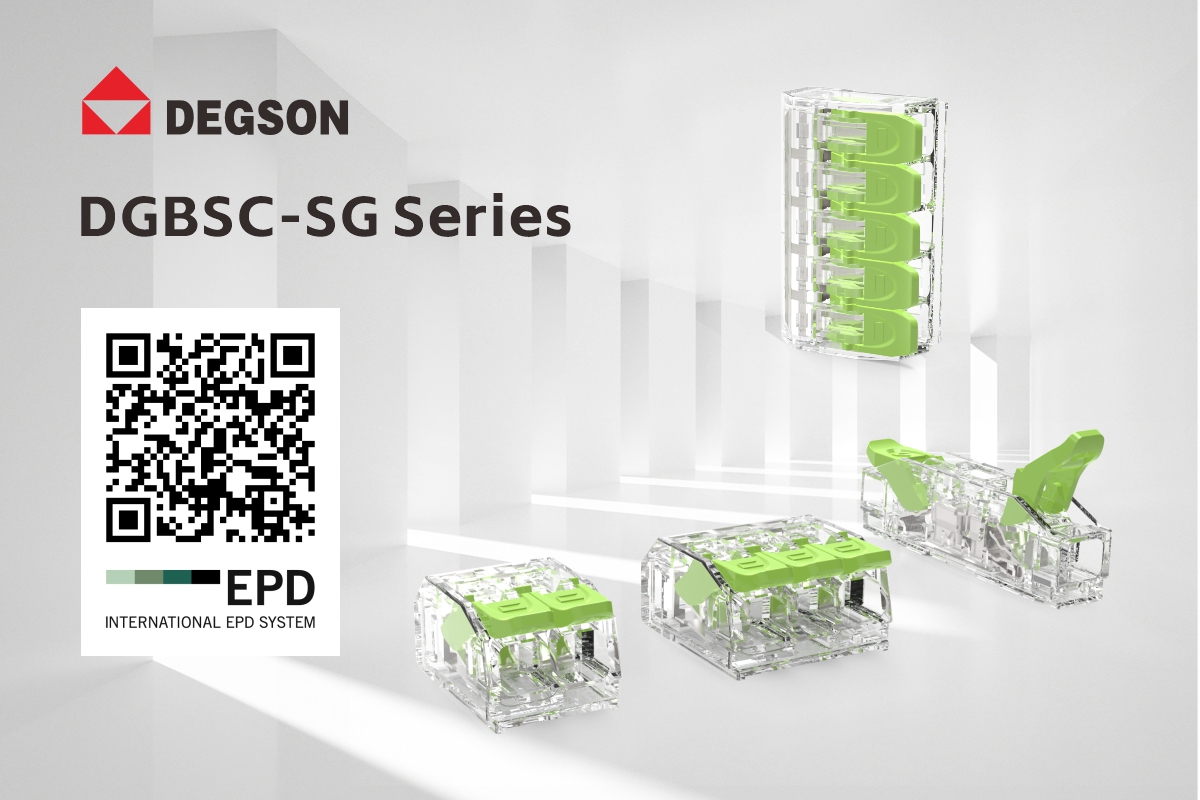
An Environmental Product Declaration (EPD) is a third‑party‑verified environmental statement based on ISO 14025 that quantifies full‑life‑cycle environmental impacts from raw‑material sourcing through end‑of‑life disposal. France's RE2020 regulation mandates a 30 % reduction in whole‑life‑cycle carbon emissions for new buildings constructed from 2025 onwards. Building‑electrical products with valid EPDs earn bonus points for France's E+C‑ label and HQE certification. The DEGSON DGBSC‑series EPD covers full‑life‑cycle assessment (LCA) from raw‑material extraction to end‑of‑life treatment.
| Compliance Element | Requirements | DEGSON DGBSC Capabilities |
| RE2020 | 30 % reduction in building whole‑life‑cycle carbon emissions | EPD supplies carbon‑footprint data supporting building carbon accounting |
| E+C‑ Label | Product environmental‑performance scoring | EPD data can be directly imported into scoring frameworks |
| RoHS 2.0 | Restriction of hazardous substances | Full‑range RoHS 2.0 (2011/65/EU) compliance |
| REACH | Control of Substances of Very High Concern (SVHC) | Regularly updated SVHC compliance statements |
According to the 2024 revised EU Energy Performance of Buildings Directive (EPBD), all new EU buildings must achieve net‑zero emissions by 2030. EPDs for electrical products will evolve from a bonus criterion toward a market‑access prerequisite. DEGSON is among the early Chinese connector manufacturers to secure EPD certification for building terminals. The DGBSC‑series EPD is 内部工具able from the Environdec official database (https://www.environdec.com/library/epd27231) and can be directly submitted for green‑building certification applications.
EPD should be treated as a mandatory selection criterion for projects in France, Denmark, the Netherlands and other jurisdictions with strict low‑carbon regulations. For other markets, EPD‑qualified products are preferred to future‑proof against tightening regulatory updates. DGBSC‑SG effectively addresses environmental‑compliance demands across multiple markets.
VI. Frequently Asked Questions (FAQ)
Q1: Can PUSH‑IN terminals connect flexible stranded conductors?A: Yes. The DEGSON DGBSC series accepts direct insertion of 0.2‑4 mm² flexible wires. Some variants are equipped with actuation levers. For flexible conductors, crimped wire ferrules are recommended, or lever‑operated models may be adopted.
Q2: What is the difference between NF certification and ENEC certification?A: NF is a national French certification with mandatory force on the French market. ENEC represents pan‑European harmonised certification recognised across more than 20 member states. While France accepts both NF and ENEC, certain local French inspection authorities give higher preference to the NF mark.
Q3: What is the validity period of an EPD?A: EPDs are generally valid for five years. Renewal requires re‑running life‑cycle assessment and updating the declaration. DEGSON publishes the latest revision of the DGBSC‑series EPD on its official website.
Q4: Are there performance drawbacks when using ‑40 °C low‑temperature‑rated terminals at ambient temperatures?A: No. Cold‑climate‑rated terminals deliver identical performance at room temperature as standard terminals. Thanks to enhanced heat‑treatment for springs, they typically exhibit superior long‑term contact stability.
VII. Conclusion
Terminal selection for building projects is multi‑dimensional optimisation; optimal performance in one dimension does not guarantee overall system suitability. Use the checklist below for verification:
Validated by third‑party test data across the four dimensions above, DEGSON DGBSC‑series building terminals constitute a trusted wiring solution for building‑construction applications.


