Key Technical Parameters for Selecting Automotive High-Voltage Connectors
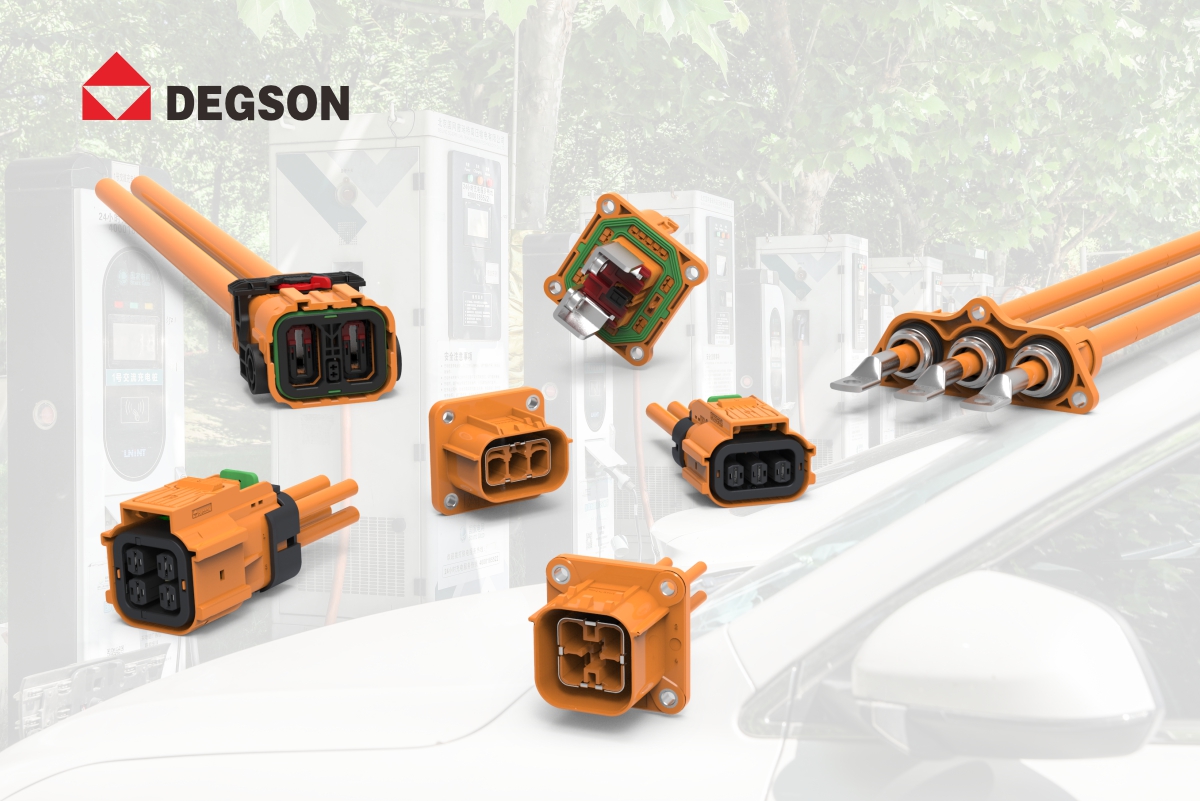
For engineering and procurement teams developing electric vehicle powertrain systems, selecting the right high-voltage connector is far more than a mechanical matching exercise. Each parameter carries direct implications for safety, reliability, thermal performance, and long-term compliance with industry standards. Misjudging a single specification — whether rated current or creepage distance — can lead to overheating, insulation failure, or costly re-qualification cycles. This guide breaks down the core technical parameters that define a high-voltage connector's suitability for automotive applications, and explains how DEGSON addresses each requirement in its product portfolio.
Rated Voltage
Rated voltage is the foundational parameter that sets the entire design boundary. For modern electric vehicle platforms, rated voltage typically ranges from 400 V DC to 1,000 V DC, with 800 V architectures rapidly gaining share in premium and high-performance models. The rated voltage of a connector must exceed the maximum system operating voltage with sufficient margin, and it directly dictates insulation thickness, creepage distance, clearance, and dielectric withstand requirements. Per IEC 60664-1 insulation coordination principles, higher working voltages require proportionally larger air gaps and surface leakage paths to prevent arc flash and tracking failure. All DEGSON high-voltage connector product lines are designed for a minimum 1,000 V DC rating, providing headroom for both 400 V and 800 V electric vehicle platforms.
Rated Current & Temperature Rise
Rated current and temperature rise performance determine whether a connector can safely carry power under real operating conditions. Unlike bench-rated current values, automotive applications require stable performance across -40°C to +125°C ambient temperatures, under vibration, and after thousands of thermal cycles. Excessive contact resistance generates Joule heating, which accelerates material aging and can trigger thermal runaway risks in extreme cases. Key influencing factors include contact terminal cross-sectional area, contact normal force, plating material and thickness, and terminal alloy composition. DEGSON high-voltage connectors utilize high-conductivity copper alloys with precision silver or high-grade tin plating, delivering low and stable contact resistance throughout the product lifecycle. Each product is fully current-cycling tested per LV215 and USCAR test protocols to verify temperature rise stays within safe limits at full rated load.
Creepage Distance & Clearance
Creepage distance and clearance are the most critical insulation safety parameters, and they become increasingly important as system voltages rise. Clearance refers to the shortest air path between two conductive parts, while creepage distance refers to the shortest path along an insulating surface. Both are calculated based on system voltage, pollution degree, material CTI (Comparative Tracking Index), and overvoltage category per IEC 60664-1. For 800 V systems, required creepage distances can nearly double compared with 400 V systems, often exceeding 10 mm for basic insulation under pollution degree 2 conditions. DEGSON employs high-CTI engineering plastics (CTI ≥ 600 V) and optimized ribbed housing geometries to achieve required creepage values without unnecessarily increasing connector footprint.
Ingress Protection Rating
Ingress protection rating defines the connector's ability to resist dust and water intrusion, and requirements vary dramatically by installation location. Cabin-mounted connectors may only require IP20 to IP40, while under-hood power distribution connectors typically need IP67, and underbody battery or charging inlet connectors often demand IP6K9K for high-pressure washdown resistance. Critically, the IP rating must remain valid after environmental aging — temperature cycling, vibration, and chemical exposure — not just on fresh samples. DEGSON validates all sealing performance post-aging per LV215 sequential test procedures, using multi-stage silicone sealing systems that maintain compression set across the full operating temperature range.
High-Voltage Interlock (HVIL)
High-Voltage Interlock (HVIL) is a mandatory safety feature for all electric vehicle high-voltage connector systems. The HVIL circuit is a low-voltage monitoring loop that breaks before the main power contacts separate during unmating, ensuring the high-voltage system is de-energized before live parts are exposed. Design requirements include defined make-before-break sequence, stable contact under vibration, and continuity monitoring capability. DEGSON integrates staged HVIL contacts into all its automotive high-voltage connectors, with timing sequences aligned to ISO 26262 functional safety expectations.
Additional Selection Parameters
Additional parameters that influence selection include mechanical durability (mating cycle count), vibration resistance class (per LV214 / USCAR vibration profiles), terminal retention force, electromagnetic shielding performance, and wire gauge compatibility. For production programs, IATF 16949 quality system compliance, full PPAP documentation availability, and supply chain scalability are equally important decision factors.
In Summary
Selecting an automotive high-voltage connector requires systematic evaluation across electrical, mechanical, environmental, and safety dimensions. DEGSON's full portfolio of electric vehicle high-voltage connectors is engineered to meet LV215, USCAR, and IATF 16949 requirements, with every parameter validated through in-house laboratory testing. For engineering teams building next-generation EV platforms, starting with a properly parameterized connector solution reduces qualification risk and accelerates time-to-market.
References
- IEC 60664-1:2020. Insulation coordination for equipment within low-voltage systems – Part 1: Principles, requirements and tests. International Electrotechnical Commission.
- LV 215-1:2017. High-Voltage Connectors for Motor Vehicles – General Requirements and Test Methods. German Automotive OEM Working Group.
- SAE USCAR-2 Rev.7:2020. Performance Specification for Automotive Electrical Connector Systems. United States Council for Automotive Research.
- ISO 26262:2018. Road Vehicles – Functional Safety. International Organization for Standardization.


