The preferred stable charging connector for compact Ebikes and light electric motorcycles.
I. Customized solutions for specific high-demand scenarios.
1. Compact Electric Bicycles and Folding Scooters
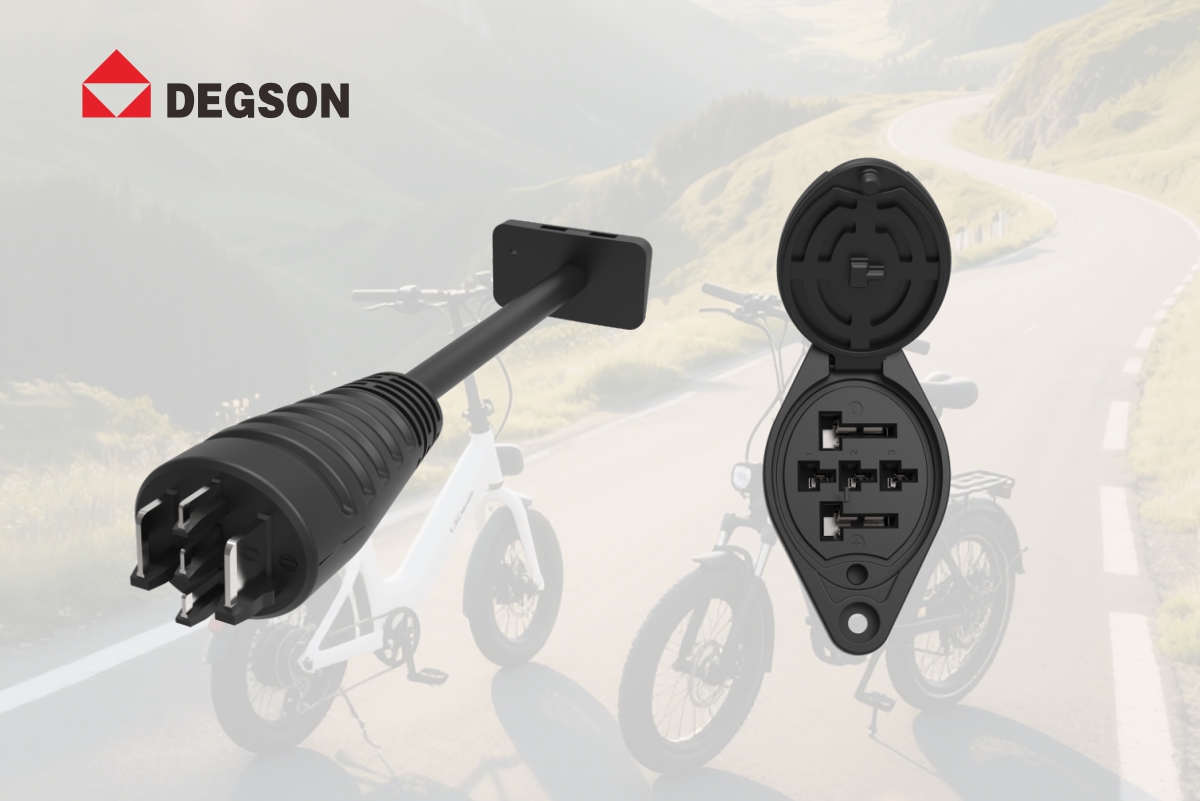
In the design of folding bikes or small commuter electric motorcycles, space at the front fork or frame upright is extremely limited. Ordinary charging ports are often bulky, protruding from the vehicle body and affecting the folding mechanism, and may even cause scraping during rides. The EBSC features a compact and small form factor, coupled with a reasonable bend radius design, allowing it to perfectly fit into narrow spaces and significantly reduce interference with surrounding components, making the vehicle body design more streamlined.
2. High-Frequency Shared Micro-Mobility Vehicles
Shared bicycles and shared scooters face extremely high frequencies of plugging/unplugging and harsh outdoor environments. The connector must withstand dozens of frictions daily while resisting the intrusion of rain and dust. The EBSC offers a mechanical life of over 1,500 cycles and adopts a flip-cap protective design. When not in use, it can effectively seal the interface, providing dust and water protection, greatly extending its service life.
3. Private High-End Scooters with High Reliability Requirements
For individual users pursuing quality, the safety of the charging process is crucial. The EBSC integrates reliable power contacts within its compact volume, with a rated voltage of 48V DC. It has passed rigorous 600V DC withstand voltage tests and UL94-V0 flame retardant grade certification, ensuring absolute safety during the charging process.
II. EBSC solves the difficult trade-off problem of charging interface design for engineers.
You need a port that can carry fast-charging current, yet you are constrained by the extremely limited space in the front fork or seat tube of the frame. You want industrial-grade protection to withstand outdoor wind and sun, but worry that bulky protective covers increase the vehicle's drag and weight. Traditional charging ports often fall into a dilemma: either they are bulky and protrude from the frame, ruining the aesthetics, or their protection is weak and they are highly susceptible to damage. The EBSC series charging connector, designed specifically for space-constrained micro-mobility scenarios, perfectly balances compact structure with efficient protection within an extremely small footprint. It answers the pain point of every structural engineer: how to fit a charging interface that is both compact and robust within such a tiny space?
III. The Difference Between EBSC and Ordinary Charging Connectors Lies in Four Key Engineering Decisions
1. Ultimate Space Optimization: Compact and Small, Freeing Up the Frame
Traditional charging ports are often designed to be overly bulky to ensure strength, severely encroaching on the already precious space around the battery compartment. Through precise internal structure design and terminal arrangement, the EBSC achieves a compact and small form factor, significantly reducing the bend space requirement, so engineers no longer find themselves strapped for space when laying out wiring harnesses.
2. Flip-Cap Protection: Active Defense for True Safeguarding
The protection of many connectors relies on rubber plugs to block holes, which are not only easily lost but also prone to aging and failure. The EBSC innovatively adopts a physical protective structure with a flip-cap at the socket end. It can be easily closed when not in use, forming a first line of defense that effectively prevents dust, mud, and foreign objects from entering the jack, achieving true active protection.
3. Stable Electrical Connection: Moderate Contact Resistance
Under a continuous charging current of 8A, the contact resistance of the connector directly affects heat generation. The EBSC uses high-conductivity materials and precision processing techniques to ensure excellent performance with insulation resistance ≥100MΩ. Coupled with a reasonable extraction force of 30~80N, it ensures smooth plugging and unplugging while maintaining stable contact during charging, rejecting virtual connection and overheating.
4. Wide Temperature Range Adaptability: Fearless of Extreme Climates
Micro-mobility vehicles are found all over the world, from the hot equator to the cold Nordic regions, all imposing stringent requirements on connectors. The EBSC operates in a wide temperature range from -40℃ to +105℃, and has passed the 48-hour neutral salt spray test. Whether in the high-humidity rainy season of Southeast Asia or on the icy and snowy roads of the North, it maintains reliable electrical performance.
IV. Micro-Mobility Connection Solutions for the Future
The Degson EBSC 8A charging connector is not merely a component—it is the ideal choice for charging systems in micro-transportation. By integrating efficient space utilization, active flip-cap protection, stable high-current transmission capability, and wide environmental adaptability within its small dimensions, it helps engineers solve the design challenges of charging interfaces in compact spaces.
When your design team conducts interface selection evaluations for the next vehicle project, consider adding the EBSC to your comparison list. You can:
-
Contact the Degson sales team to obtain Datasheets and 3D models
-
Request the complete Degson micro-mobility connector product catalog
-
Apply for samples for real-world vehicle testing and verification
Contact Information: Website: www.degson.com
FAQ
Q1: What are the electrical specifications of the EBSC? What charging scenarios is it suitable for?
The EBSC has a rated current of 8A, rated voltage of 48V DC, withstand voltage of 600V DC, insulation resistance ≥100MΩ, and UL94-V0 flame retardancy. It is specifically designed for charging interfaces of electric bicycles, folding scooters, shared micro-mobility vehicles, and private high-end scooters. The 8A current capacity perfectly matches the regular charging demands of light ebikes and electric motorcycles.
Q2: How does the EBSC perform in terms of protection and mechanical life?
The EBSC adopts an innovative flip-cap physical protection structure that can be easily closed when not in use, effectively providing dust and water protection — eliminating the drawbacks of traditional rubber plugs that are easily lost or aged. With a mechanical life ≥1,500 cycles and 48-hour neutral salt spray resistance, operating from -40℃ to +105℃, it readily meets the dual challenges of high-frequency plugging in shared fleets and harsh outdoor weather.
Q3: How does the EBSC adapt to compact vehicle frames?
The EBSC features a compact and small form factor, coupled with a reasonable bend radius design, allowing it to perfectly fit into narrow spaces such as front forks or seat tubes while significantly reducing interference with surrounding components. Its extraction force is controlled within a reasonable 30~80N range — ensuring smooth plugging/unplugging while maintaining stable contact during charging. The flip-cap protective design allows the vehicle body to maintain industrial-grade protection without increasing drag and weight due to bulky protective covers, making it the ideal choice for charging interfaces on compact micro-mobility vehicles.


