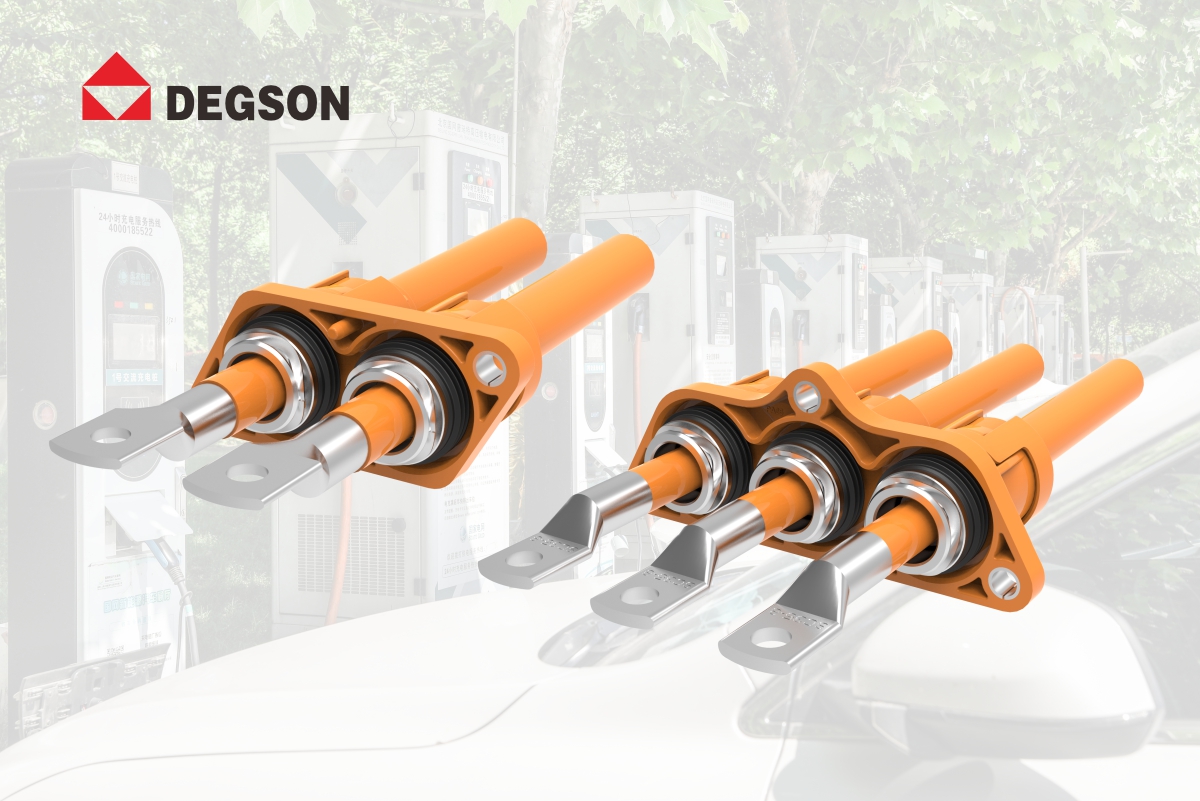
DEGSON 2/3-Pin Automotive Bulkhead Connectors
DEGSON 2/3-Pin Automotive Bulkhead Connectors
In the overall vehicle connection system of intelligent electric vehicles, bulkhead connectors serve as seemingly niche yet indispensable "through-panel hubs." Among them, small-pin-count versions such as 2-pin and 3-pin are high-frequency, mission-critical components deployed across multiple scenarios including the vehicle body, battery pack, electronic control systems, and cabin. Unlike high-current, multi-pin power connectors, these small-pin-count bulkhead products directly face the most fragmented and demanding challenges in automotive applications: cramped panel-wall spaces that are difficult to accommodate, long-term driving vibrations that cause loosening, water and dust ingress during rain or high-pressure washing, performance degradation under extreme temperature cycling, and the dual requirements of mass-production assembly efficiency and full-lifecycle reliability. Conventional standard bulkhead fittings have long been unable to meet automotive-grade standards.
With years of deep expertise in automotive precision connectivity, DEGSON has precisely identified the industry pain points of small-pin-count bulkhead connections and launched dedicated 2-pin and 3-pin automotive bulkhead connectors. Eliminating redundant design, the series focuses on four core needs — sealing and protection, compact fitment, vibration resistance and durability, and convenient installation. With standardized automotive-grade quality, it provides a stable through-panel connection solution for vehicle low-voltage signal transmission and low-power power supply, perfectly adapting to diverse bulkhead scenarios in both new energy vehicles and traditional internal combustion engine vehicles. It has become the preferred solution for small-pin-count automotive bulkhead connections.
Addressing Automotive Bulkhead Pain Points, Solving Three Major Challenges in Small-Pin-Count Connections
Automotive bulkhead connections are mostly located at critical positions such as body panel walls, battery pack enclosures, electronic control unit housings, and chassis protection plates. Once a failure occurs, it can easily lead to line short circuits, signal loss, component water ingress, and other issues. Small-specification 2-pin and 3-pin products, due to their compact size and streamlined structure, are more prone to exposing the shortcomings of traditional solutions. The core pain points are concentrated in three areas:
-
• Sealing performance falls short, with poor adaptation to operating conditions: Standard bulkhead fittings feature rudimentary sealing structures capable only of basic dust protection. They cannot withstand harsh automotive scenarios such as high-pressure washing, heavy rain wading, salt spray corrosion, and engine compartment oil contamination. Over time, gaps allow water and dust ingress, leading to line oxidation and poor contact. This risk is particularly high at exposed installation positions such as the chassis and exterior of the vehicle.
-
• Bulky form factor with poor fitment, encroaching on precious interior space: Most automotive bulkhead locations are spatially constrained. Traditional small-pin-count bulkhead connectors feature redundant structures and oversized dimensions, making them difficult to embed into narrow panel walls and affecting the layout of surrounding wiring harnesses and components. This contradicts the design trends of vehicle lightweighting and space optimization, and loosening or shifting after installation is also common.
-
• Insufficient vibration resistance and reliability, with dual shortcomings in mass production and vehicle use: Continuous bumps and vibrations during vehicle travel can cause terminal loosening and housing cracking in standard fittings. Moreover, the installation process is cumbersome, requiring complex tooling and fixtures, with high rates of manual assembly errors. This both slows down mass-production line efficiency and fails to meet the ultra-long warranty requirements of 10 years/200,000 km, resulting in persistently high maintenance costs.
The DEGSON 2-pin and 3-pin bulkhead connectors are precisely developed to address the above pain points. From structural design, material selection to quality control standards, every dimension is tailored to automotive-specific requirements — achieving full performance in a compact form and uncompromised reliability in a streamlined structure, thoroughly resolving the chronic industry issues of small-pin-count bulkhead connections.
Four Core Advantages, Defining the New Standard for Small-Pin-Count Automotive Bulkhead Connections
1. High-Grade Sealing and Protection, Eliminating Leakage Risks Across All Operating Conditions
This connector adopts an integrated sealing structure design, paired with dedicated waterproof gaskets and bulkhead locking washers, achieving IP67 baseline protection, with high-end versions reaching the IP6K9K high-pressure waterproof and dustproof standard — fully adapted to harsh automotive environments. Whether it is chassis wading in heavy rain, high-pressure water jet cleaning at automatic car washes, salt spray erosion in coastal areas, or oil and dust contamination in the engine compartment, it firmly blocks external impurities and moisture, ensuring that internal terminals remain dry and clean. This fundamentally prevents line failures caused by water or dust ingress, comprehensively safeguarding the stability of through-panel connections.
2. Compact and Lightweight Design, Perfectly Adapted to Cramped Bulkhead Spaces
Addressing the space-constrained nature of automotive bulkhead locations, DEGSON has optimized the product structure, eliminating superfluous exterior features and structural redundancy to create an ultra-compact, small-form-factor body. The standardized 2-pin and 3-pin specifications precisely match conventional automotive bulkhead hole diameters, with a significantly smaller installation footprint than comparable traditional products. It can be easily embedded into the narrow gaps of the vehicle body, battery pack, and electronic control box without requiring additional modification of panel walls or enclosures. High-strength lightweight engineering materials are used, balancing mechanical strength with lightweighting requirements without adding to the overall vehicle weight — perfectly aligned with vehicle space optimization and lightweighting design philosophies.
3. Automotive-Grade Vibration Resistance and Durability, Ensuring Stable Operation Over the Full Lifecycle
The product is strictly manufactured in accordance with the IATF 16949 automotive quality management system and complies with global automotive connector general standards such as USCAR-2. It features built-in anti-loosening terminals and housing locking structures, having passed rigorous vibration and shock testing. It can withstand the bumps and jolts of long-term vehicle operation, eliminating issues such as terminal loosening, housing cracking, and poor contact. It also adapts to a wide temperature range of -40°C to 125°C, with the housing remaining deformation-free and terminal conductivity un-degraded under high-temperature exposure or extreme cold. The insertion/extraction life far exceeds industry standards, easily meeting the ultra-long vehicle warranty requirements with no need for frequent replacement or maintenance throughout the full lifecycle.
4. Convenient Installation Design, Reducing Costs and Boosting Efficiency for Mass Production
Considering the mass-production assembly needs of OEMs and Tier 1 suppliers, this bulkhead connector features a solderless, quick-lock installation structure with foolproof and mis-insertion-proof design. Through-panel fixation and wiring harness mating can be completed without complex tooling, enabling fast manual assembly with extremely low error rates. It is also perfectly compatible with automated production line batch assembly, significantly improving line assembly efficiency. The standardized interface and locking method supports both single-sided bulkhead installation and double-sided locking scenarios, with convenient disassembly and reassembly during after-sales maintenance, effectively reducing the comprehensive costs of vehicle assembly and after-sales service.
Full-Scenario Precision Adaptation, Covering Core Small-Pin-Count Bulkhead Needs Across the Vehicle
The DEGSON 2-pin and 3-pin bulkhead connectors accommodate both low-power power transmission and low-frequency signal transmission, with broad applicability, comprehensively covering all types of small-pin-count through-panel connection scenarios in the vehicle. They serve as reliable supporting components for multi-domain vehicle connectivity:
-
• Body Domain: Through-panel power supply for front/rear headlights, turn signals, and fog lights; bulkhead signal connections for door control modules, window regulators, and mirror adjustment modules; line through-panel routing for body sensors and tire pressure monitoring modules.
-
• Battery/Electronic Control Domain: Low-voltage signal through-panel routing inside the battery pack (PACK), bulkhead connections for BMS auxiliary modules, low-power power through-panel routing for electronic control units and PDU distribution boxes, and bulkhead routing for DC-DC converter auxiliary lines.
-
• Cabin/Chassis Domain: Bulkhead power supply for in-vehicle recorders, chargers, ambient lighting, and other accessories; signal through-panel routing for chassis sensors and braking assist modules; and bulkhead transition for various low-frequency CAN bus lines.
DEGSON Automotive Quality Assurance, Small Products Demonstrating Big Reliability
As a professional brand dedicated to automotive precision connectivity, DEGSON consistently adheres to automotive-grade standards in refining every product. Even for small-specification 2-pin and 3-pin bulkhead connectors, the entire process follows stringent R&D, testing, and production workflows. From raw material screening to finished product delivery, every unit undergoes multiple automotive-specific tests including sealing tests, vibration tests, temperature cycling tests, and salt spray tests, ensuring stable performance and consistent quality.
With precise scenario positioning and robust product performance, DEGSON's 2-pin and 3-pin bulkhead connectors are not only adapted to traditional internal combustion engine vehicles but also perfectly aligned with the design requirements of new energy vehicles. They can flexibly match platform-based development across different vehicle models, providing OEMs and Tier 1 suppliers with a cost-effective, highly reliable small-pin-count bulkhead connection solution.
Going forward, DEGSON will continue to deepen its focus on niche automotive connection scenarios, iterating product performance based on actual customer needs. With professional connection technology and reliable product quality, it will solidify the foundation for all types of vehicle connection scenarios, helping the automotive industry build more stable, efficient, and safe overall vehicle electrical architectures.


